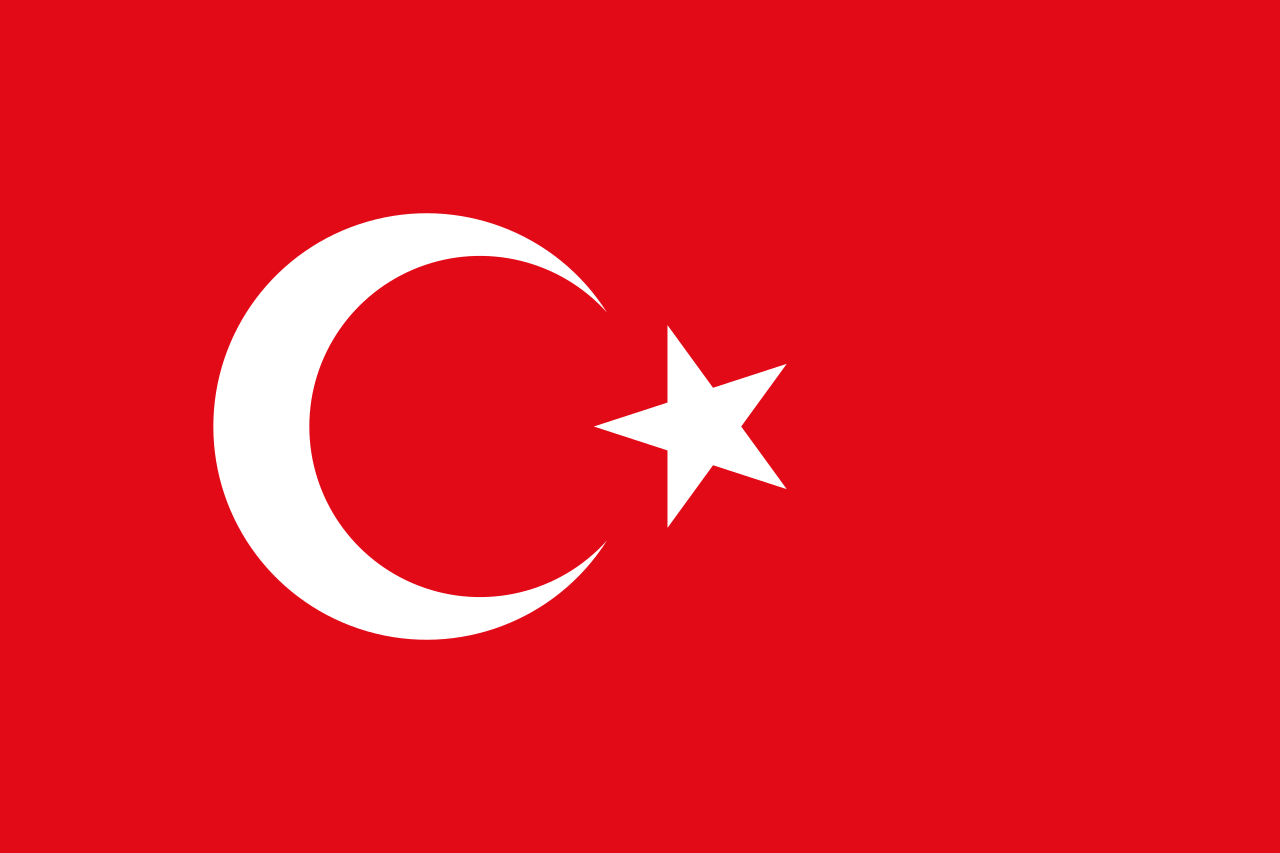
Turkey is a country spanning Western Asia and Southeast Europe with over 86 million people, bordered by the Black Sea, Mediterranean, and Aegean Sea, and neighboring countries including Greece, Syria, Iran, and Georgia. It matters as a strategically important nation bridging Europe and Asia, with a Muslim-majority population and secular government, and major cities including the capital Ankara and Istanbul.
AI-generated from the Wikipedia summary — may contain errors.
Weather now
7-day forecast
via Open-Meteo
Country

- Capital
- Ankara
- Population
- 85,664,944
- Region
- Asia · Western Asia
- Demonym
- Turkish
- Currencies
- TRY (₺)
- Languages
- Turkish
- Calling code
- +90
- Drives on
- Right
- Gini
- 41.9 (2019)
- FIFA code
- TUR
- TLD
- .tr
- Timezones
- UTC+03:00
- Borders
- ARM, AZE, BGR, GEO, GRC, IRN, IRQ, SYR
via REST Countries
Indicators · World Bank
- GDP
- $1.4T(2024)
- Population
- 85,518,661(2024)
- Life expectancy
- 77.4 yrs(2024)
- Unemployment
- 8.5 %(2025)
- Urban population
- 89.3 %(2024)
- Internet users
- 89.8 %(2025)
- Forest area
- 29.5 %(2023)
- Renewable energy
- 12 %(2021)
via World Bank Open Data · CC BY 4.0
Place details
- Locality
- Ankara
- Country
- Türkiye
- Population
- 82,319,724
- Timezone
- Europe/Istanbul
via OpenStreetMap · GeoNames
Wikipedia views (30d)
358,456 totalvia Wikimedia Pageviews API
Key facts
- Country.utc_offset
- +3
- Country.calling_code
- +90
- Country.cctld
- .tr
- Country.map_width
- 250px
- Country.conventional_long_name
- Republic of Türkiye
- Country.common_name
- Turkey
- Country.image_flag
- Flag of Turkey.svg
- Country.national_anthem
- "Independence March"
- Country.image_map
- Turkey (orthographic projection).svg
- Country.capital
- Ankara
- Country.largest_city
- Istanbul
- Country.official_languages
- Turkish
- Country.languages_type
- Spoken languages
- Country.government_type
- Unitary presidential republic
- Country.leader_title1
- President
- Country.leader_name1
- Recep Tayyip Erdoğan
- Country.leader_title2
- Vice President
- Country.leader_name2
- Cevdet Yılmaz
via Wikipedia infobox
Research
448,307 papers- Turkey osteomyelitis complex.ReviewPoultry science · 2000Huff GR, Huff WE, Rath NC et al.DOI: 10.1093/ps/79.7.1050
- Turkey's Selikoff.International journal of occupational and environmental health · 2012Terzi CDOI: 10.1179/1077352512Z.0000000003.A
- Turkey's evolution.Nature · 2005DOI: 10.1038/438001b
- Turkey's disabled.The New York times on the Web · 2005
- Turkey's transformation.Nature · 2007DOI: 10.1038/449116a
- Turkey's contribution to cancer publication: Expected quantity, unsatisfactory quality.Journal of cancer research and therapeutics · 2023Tas F, Erturk KDOI: 10.4103/jcrt.JCRT_1291_20
- Turkey's transformation.Bulletin of the World Health Organization · 2012Adams PDOI: 10.2471/BLT.12.030612
- Specific-pathogen-free Turkey model for reoviral arthritis.Veterinary microbiology · 2019Ngunjiri JM, Ghorbani A, Jang H et al.DOI: 10.1016/j.vetmic.2019.06.016
via PubMed
Wikidata facts
- Official name
- Türkiye Cumhuriyeti
- Demonym
- Turkinja
- Participant in
- Spain–Turkey relations
- Country
- Turkey
- Contains
- Tekirdağ Province
- Continent
- Europe
- Capital
- Ankara
- Official language
- Turkish
- Currency
- New Turkish lira
- Population
- 85372377
- Area
- 783562
- Body of water
- Levantine Sea
- Head of government
- Recep Tayyip Erdoğan
- Head of state
- Hüsamettin Cindoruk
- Form of government
- presidential system
- Legislature
- Grand National Assembly of Turkey
- Anthem
- İstiklâl Marşı
- Shares border with
- Northern Cyprus
- Highest point
- Mount Ararat
- Official website
- www.turkiye.gov.tr
- Image
- Ankara (16290014657).jpg
- Households
- 26599261
- Life expectancy
- 78
- Nominal GDP
- 905987824096
Show 92 more facts
- Unemployment rate
- 9
- Calling code
- +36
- Licence plate code
- TR
- Electrical plug type
- Europlug
- Mains voltage
- 230
- Motto
- Heddwch gartref, heddwch yn y byd
- Flag
- flag of Turkey
- Coat of arms
- national emblem of Turkey
- topic's main Wikimedia portal
- Portal:Turkey
- ethnic group
- Kurds
- Unicode character
- 🇹🇷
- category of associated people
- Category:People of Turkey
- trunk prefix
- 0
- geography of topic
- Geography of Turkey
- office held by head of government
- President of Turkey
- permanent duplicated item
- Turkey
- number of out-of-school children
- 1727790
- diplomatic relation
- Papua New Guinea
- Commons gallery
- Türkiye
- inception
- 1923-10-29
- history of topic
- history of Turkey
- replaces
- Ottoman Empire
- native label
- Türkiye
- compulsory education (maximum age)
- 18
- on focus list of Wikimedia project
- Wikipedia:Vital articles/Level/4
- Commons category
- Turkey
- mobile country code
- 286
- total fertility rate
- 1.63
- maritime identification digits
- 271
- compulsory education (minimum age)
- 6
- retirement age
- 58
- marriageable age
- 16
- topic's main category
- Category:Turkey
- category for people buried here
- Category:Burials in Turkey
- age of majority
- 21
- member of
- G20
- railway traffic side
- right
- located in/on physical feature
- West Asia
- category for films shot at this location
- Category:Films shot in Turkey
- executive body
- government of Turkey
- category for people who died here
- Category:Deaths in Turkey
- office held by head of state
- President of Turkey
- top-level Internet domain
- .tr
- category for people born here
- Category:Births in Turkey
- short name
- TC
- driving side
- right
- lowest point
- Black Sea
- described by source
- Oxford Classical Dictionary
- maintained by WikiProject
- WikiProject Kurdistan
- central bank
- Central Bank of the Republic of Turkey
- language used
- Judaeo-Spanish
- topic has template
- Template:Turkey infobox
- GS1 country code
- 868-869
- culture
- culture of Turkey
- VAT rate
- 20
- different from
- Turkey
- P6413
- Turkey
- BTI Status Index
- 5.45
- BTI Governance Index
- 3.98
- economy of topic
- economy of Turkey
- social media followers
- 114000
- demographics of topic
- demographics of Turkey
- Democracy Index
- 4.35
- hashtag
- Türkiye
- P8168
- Volkswagen Beetle
- Human Development Index
- 0.853
- P11012
- Jupiter
- Gini coefficient
- 41.9
- exact match
- purl.obolibrary.org/obo/ENVO_02000071
- Happy Planet Index score
- 41.3
- Inequality-adjusted Human Development Index
- 0.708
- suicide rate
- 4.15
- described at URL
- wikispooks.com/wiki/Turkey
- name in native language
- Türkiye Cumhuriyeti
- IPA transcription
- ˈtyɾ.ci.je
- P12749
- Grushinsky festival
- has cabinet
- Cabinet of Turkey
- birth rate
- 14.468
- male population
- 42581376
- death rate
- 5.101
- rural population
- 19526684
- female population
- 42398537
- urban population
- 65453229
- annual number of weddings
- 568395
- mean age
- 34.44
- most populous urban area
- Istanbul
- public holiday
- Democracy and National Unity Day
- Gregorian calendar start date
- 1925-12-26
- number of seats in assembly
- 600
- coastline
- 8.333
- age of candidacy
- 25
Sources (15)
via Wikidata · CC0
Travel guide
Understand
right|thumb|Mustafa Kemal Atatürk, the founding father of the Turkish state
See
Many museums and ancient sites in Turkey are closed on Mondays, although there are as many exceptions. The Turkish government offers a museum pass for many sights and museums in Turkey; there are also regional passes. Check out what is included, as they don't cover some sights and numerous others can still be seen for free.
Do
thumb|Tip of the [[Ölüdeniz beach]] thumb|Davraz Ski Resort in [[Isparta]] thumb|Women's volleyball team is the only 'perfect-season' scorer in sport's history. As their international fanbase would agree, they're definitely worth to watch. Beaches and summer sports – Beaches line the entire Mediterranean coast, but those with well-developed resorts are between Alanya to the east and Kuşadası on the Aegean coast to the west - the famous Turkish Riviera. There are scores more small places that only locals head for, such as the Gulf of Saros, is a favourite among scuba-divers. The Marmara and Black Sea beaches are not favorable for swimming because of the hard waves but perfect for surfing. Birdwatching – Both natural spots and preserves are found all over the country. Geographically being in the middle of migration routes of many species has its perks. Camping and trekking – Turkey hosts many sites and routes. A popular example being; a camping stop at Kabak cove during the Lycian Way trip. Cycling and running – The premier cycling race is the President's Tour of Turkey, held over a week in April. The annual Istanbul Marathon, the world's only intercontinental marathon, gets thousands of attendances. Hamams and geothermal spas – A visit to a hamam or Turkish bath is an essential part of any trip to Turkey and is something you'll be sure to repeat before leaving. There is at least one historical hamam in each neighborhood of Istanbul and other large…
Eat
thumb|Assortment of Turkish foods; baklava, sarma, yoğurt, etli nohut-pilav and komposto/hoşaf thumb|Assortment of meze Turkish cuisine combines Balkan, Mediterranean, Central Asian, Caucasian, and Levantine influences, and is extremely rich, reflecting the cultural and biological diversity of the land. Indeed, Turkish cuisine is often said to be not a single, unified national cuisine, but a collection of several distinctive regional cuisines, with preferences on cooking styles and ingredients overlapping in some cases, and diverging in others: e.g., olive oil and other vegetable oils common in the west vs butter elsewhere, some regions are vegetable-heavy while others are meat-heavy, beef is traditionally the most important red meat in the west but lamb and goat fill that niche elsewhere (pork, although not illegal, is very hard to find except the big cities due to its taboo status in Islam). Seafood, mainly fish, is common in the north and west, the south and southeast are heavy on spices while elsewhere is much more moderate and "bland", the main staple is rice in the north and west and is bulgur wheat elsewhere, bread is common everywhere but even it comes in a variety of shapes and forms, and so on. Of course, with the growth of internal immigration, and development of transport and communication technologies, the differences are often blurred and not as clear-cut as in the past, but the major distinctions are still there.
The primary vegetables are eggplant (aubergine)…
Drink
thumb|Turkish coffee with a morsel of Turkish delight thumb|A glass of Turkish tea along with a view of [[Tokat]] Turkish coffee (Türk kahvesi), served in tiny cups, is strong and tasty, just be careful not to drink the sludgy grounds at the bottom of the cup. It is very different from the so-called Turkish coffees sold abroad. Sade (or sade kahve) is served black, while az şekerli, orta (or orta şekerli) and şekerli (or çok şekerli) will get you a little, some or a lot of sugar in your cup.
Filter coffee (filtre kahve) and its many varieties are also very common, with many stores of the international and domestic chains, and local, nonchain copycats dishing them out in the urban centres and major roadside rest areas. Instant coffee (commonly known as neskafe, a genericized trademark) with various flavours is widely available at the grocery stores.
Coffee may be much engraved in the national culture, but tea (çay) is also very popular and is indeed the usual drink of choice. Most Turks are heavy drinkers of tea in their daily lives, and love to share their favourite drink with others — expect a round of tea after finishing your meal or during a lengthened visit to a shop. With a surprisingly brief history for such a widespread habit, tea-drinking has become popular in Turkey only from the 1930s: tea quickly gained ground against coffee as the collapse of the empire meant Yemen, the traditionally coffee-supplying Ottoman province, was now cut off, and the protectionist econo…
Sleep
thumb|[[Çeşme marina]] Accommodation in Turkey varies from 5-star hotels to a simple tent pitched in a vast plateau. So the prices vary hugely as well.
Stay safe
thumb|[[Kars citadel]] Dial 112 to contact all emergency services, including the police or the gendarme (a military-styled unit responsible for rural safety) from any phone, free of charge.
Upon entering some museums, hotels, metro stations, and almost all shopping malls, especially in larger cities, you will notice security checkpoints similar to those found in airports. Don't worry, this is the standard procedure in Turkey and does not imply an immediate danger of attack. These security screenings are also conducted in a much more relaxed way than the airports, so you will not have to remove your belt to avoid the alarm when walking through the metal detector.
Carry your passport or other means of identification at all times. One may not be requested to show them for a long period, then all of a sudden a minibus is checked by the traffic police (or the military, particularly in Eastern Turkey), or one runs into an officer of the law with time on his hand, and one must show papers. Some government buildings may ask you to temporarily surrender your passport in return for equipment such as headphones for simultaneous translation, etc., and you may find your passport stored in an open box along with the locals ID cards which may be a little disconcerting. Hotels may request you to hand your passport in until you paid the bill, which puts you into an awkward situation. Referring to the police always made them hand the passport back, once the registration procedure was finaliz…
Stay healthy
Dial 112 from any telephone, anywhere, free of charge for an ambulance.
Food safety — Food is generally free of biological contamination, but it's best to err on the side of caution. Prefer the places local people patronize and avoid food sold outdoors, at least in summer, when they can spoil fairly quickly without refrigeration. Fresh fruits and vegetables should be washed thoroughly to remove pesticide residue; certified organic produce isn't very common. Some of the ingredients in the east, northeast, and southeast, such as goat or goose meat and heavy spices, might come across as unusual for western palates, and may or may not cause diarrhea, so it is wise to have at least some antidiarrheal medicine at hand, especially if you are going to travel off the beaten track. An antidiarrheal derived from the probiotic yeast Saccharomyces boulardii is commonly available over-the-counter from pharmacies under the brand name Reflor. thumb|There is little reason to get paranoid about water safety in places like the Anzer Plateau, south of [[Rize — indeed locals in the Pontic highlands may be offended if you insistently ask around for bottled water]]
Water safety — Tap water, including that that comes out of the historical public fountains (çeşme) or mosque fountains (şadırvan), generally isn't pleasant to drink; it's often very chalky due to the climate and the underlying geology, and is almost always heavily chlorinated, yet no one guarantees it is safe enough for drinking due to…
Respect
thumb|A pazar. Bazaar or farmers market if you will.
Connect
thumb|Atatürk Dam, 3rd largest in the world
Travel guide from Wikivoyage (CC BY-SA 4.0)
Article · Español
Turquía (en turco, Türkiye /ˈtyɾcije/), oficialmente República de Turquía (en turco, Türkiye Cumhuriyeti /ˈtyɾcije dʒumˈhuːɾijeti/), es un país transcontinental, con la mayor parte de su territorio situado en Asia Occidental y una menor (al oeste del mar de Mármara) en Europa Oriental, que se extiende por toda la península de Anatolia y Tracia Oriental en la zona de los Balcanes. Limita al noreste con Georgia, al este con Armenia, Irán y Azerbaiyán, al norte con las aguas territoriales ucranianas en el mar Negro, al noroeste con Bulgaria y Grecia, al oeste con las islas griegas del mar Egeo, al sur con las aguas chipriotas del mar Mediterráneo y con Siria, y al sureste con Irak. La separación entre Anatolia y Tracia está formada por el mar de Mármara y los estrechos de Turquía (el Bósforo y los Dardanelos), que sirven para delimitar la frontera entre Asia y Europa, por lo que se considera a Turquía como transcontinental. Debido a su posición estratégica, ubicándose entre Europa y Asia así como entre tres mares, Turquía ha sido una encrucijada histórica entre las culturas y civilizaciones orientales y occidentales. Su territorio ha sido el hogar de varias grandes civilizaciones —hititas, frigios, lidios, urartianos, cimerios, asirios, persas, griegos, romanos, armenios, kurdos, selyúcidas, otomanos— y lugar de encuentro entre las culturas de Oriente y Occidente a lo largo de la historia, a veces en convivencia y en ocasiones por medio de enfrentamientos bélicos. La ubicación de la moderna Turquía entre la Unión Europea al oeste, Asia Central hacia el este, Rusia y los países de la antigua Unión Soviética en su frontera norte y el Oriente Próximo en el sur, acentúa su importancia estratégica. Turquía es una república democrática, secular, unitaria y constitucional, cuyo sistema político fue establecido en 1923 bajo el liderazgo de Mustafa Kemal Atatürk, el más destacado miembro del Movimiento Nacional turco, tras la caída del Imperio otomano y la ocupación de Constantinopla, como consecuencia de la Primera Guerra Mundial, ante la perspectiva de la partición del Imperio otomano. Desde entonces, Turquía se ha relacionado cada vez más con Occidente por medio de la afiliación a organizaciones como el Consejo de Europa (1949), la OTAN (1952), la OCDE (1961), la OSCE (1973) y el G-20 (1999). Turquía comenzó las negociaciones para su adhesión plena a la Unión Europea en 2005, después de haber sido miembro asociado de dicha organización desde 1963, y contar con un acuerdo de unión aduanera en 1995. Mientras tanto, el país ha seguido fomentando estrechas relaciones internacionales, especialmente con los otros países túrquicos de Asia Occidental y Central (Azerbaiyán, Kazajistán, Kirguistán, Tayikistán, Turkmenistán y Uzbekistán). En términos de producto interior bruto, su economía está situada en el puesto 11.º del mundo según el Fondo Monetario Internacional (2021). Por su ubicación estratégica está clasificada como potencia regional por varios analistas.
Abstract from DBpedia / Wikipedia · CC BY-SA
Gallery (39)
On the map
4 mapped locations
Available in 334 languages
- Español
- Français
- Deutsch
- 中文
- 日本語
- Русский
- Português
- Italiano
- العربية
- हिन्दी
- Abkhazian
- abstract
- Achinese
- Adyghe
- Afrikaans
- Akan
- Albanian
- Albanian
Show 315 more
- Amharic
- ami
- Angika
- Aragonese
- Aramaic
- Armenian
- Arpitan
- Assamese
- Asturian
- Atikamekw
- Avaric
- Awadhi
- Aymara
- azb
- Azerbaijani
- Bahasa Indonesia
- Balinese
- Bambara
- Bangla
- Banjar
- Bashkir
- Basque
- bat_smg
- Batak Toba
- Bavarian
- bdr
- be_x_old
- Belarusian
- Betawi
- Bhojpuri
- Bikol
- Bishnupriya
- Bislama
- blk
- Bosnian
- Breton
- btm
- Buginese
- Bulgarian
- Buriat
- Burmese
- Catalan
- cbk_zam
- cdo
- Cebuano
- Central Dusun
- Central Kurdish
- Chamorro
- Chechen
- Cherokee
- Cheyenne
- Church Slavic
- Chuvash
- Colognian
- Cornish
- Corsican
- Crimean Tatar
- Croatian
- Czech
- dag
- Danish
- dga
- Dinka
- Divehi
- dty
- Dzongkha
- Egyptian Arabic
- eml
- Erzya
- Esperanto
- Estonian
- Ewe
- Extremaduran
- Faroese
- Fiji Hindi
- Fijian
- Filipino
- Finnish
- fiu_vro
- Fon
- Frafra
- Friulian
- Fula
- Gagauz
- Galician
- Gan Chinese
- Ganda
- gcr
- Georgian
- Gilaki
- Goan Konkani
- Gorontalo
- Gothic
- gpe
- Greek
- Guarani
- Gujarati
- guw
- Haitian Creole
- Hakka Chinese
- Hausa
- Hawaiian
- Hebrew
- Hungarian
- hyw
- Iban
- Icelandic
- Ido
- Igbo
- igl
- Iloko
- Inari Sami
- Ingush
- Interlingua
- Interlingue
- Inuktitut
- Inupiaq
- Irish
- Jamaican Creole English
- Javanese
- Kabardian
- Kabyle
- Kalmyk
- Kannada
- Kanuri
- Kara-Kalpak
- Karachay-Balkar
- Kashmiri
- Kashubian
- Kazakh
- kbp
- kge
- Khmer
- Kikuyu
- Kinyarwanda
- Komi
- Komi-Permyak
- Kongo
- Kotava
- Kurdish
- Kyrgyz
- Ladino
- Lao
- Latgalian
- Latin
- Latvian
- lbe
- Lezghian
- Ligurian
- Limburgish
- Lingala
- Lingua Franca Nova
- Lithuanian
- lld
- Lojban
- Lombard
- Low German
- Lower Sorbian
- Luxembourgish
- Macedonian
- Madurese
- Maithili
- Malagasy
- Malay
- Malayalam
- Maltese
- Manipuri
- Manx
- Māori
- map_bms
- Marathi
- Mari
- Mazanderani
- Minangkabau
- Mingrelian
- Mirandese
- Moksha
- Mongolian
- Moroccan Arabic
- Mossi
- N’Ko
- Navajo
- Ndonga
- nds_nl
- Neapolitan
- Nederlands
- Nepali
- Newari
- Nias
- Nigerian Pidgin
- Northern Frisian
- Northern Sami
- Northern Sotho
- Norwegian
- Norwegian Nynorsk
- Novial
- nrm
- Nyanja
- Occitan
- Odia
- Old English
- olo
- Oromo
- Ossetic
- Palatine German
- Pampanga
- Pangasinan
- Papiamento
- Pashto
- Pennsylvania German
- Picard
- Piedmontese
- Polski
- Pontic
- ppl
- Punjabi
- Quechua
- roa_rup
- roa_tara
- Romanian
- Romansh
- Romany
- rsk
- Rundi
- Rusyn
- Samoan
- Sango
- Sanskrit
- Santali
- Sardinian
- Saterland Frisian
- Scots
- Scottish Gaelic
- Serbian
- Serbian (Latin)
- Shan
- Shona
- Sicilian
- Silesian
- simple
- Sindhi
- Sinhala
- skr
- Slovak
- Slovenian
- Somali
- South Ndebele
- Southern Sotho
- Sranan Tongo
- Standard Moroccan Tamazight
- Sundanese
- Svenska
- Swahili
- Swati
- syl
- szy
- Tachelhit
- Tahitian
- Tajik
- Talysh
- Tamil
- Taroko
- Tatar
- tay
- Telugu
- Tetum
- Tibetan
- Tiếng Việt
- Tigre
- Tigrinya
- Tok Pisin
- Toki Pona
- Tongan
- Tsonga
- Tswana
- Tulu
- Tumbuka
- Türkçe
- Turkmen
- Tuvinian
- Tyap
- Udmurt
- Ukrainian
- Upper Sorbian
- Urdu
- Uyghur
- Uzbek
- Venda
- Venetian
- Veps
- Volapük
- Walloon
- Waray
- Wayuu
- Welsh
- West Flemish
- Western Frisian
- Western Mari
- Western Panjabi
- Wolof
- Wu Chinese
- Xhosa
- Yakut
- Yiddish
- Yoruba
- Zaza
- Zeelandic
- zh_classical
- zh_min_nan
- zh_yue
- Zhuang
- Zulu
- فارسی
- ไทย
- 한국어
via Wikidata sitelinks · CC0