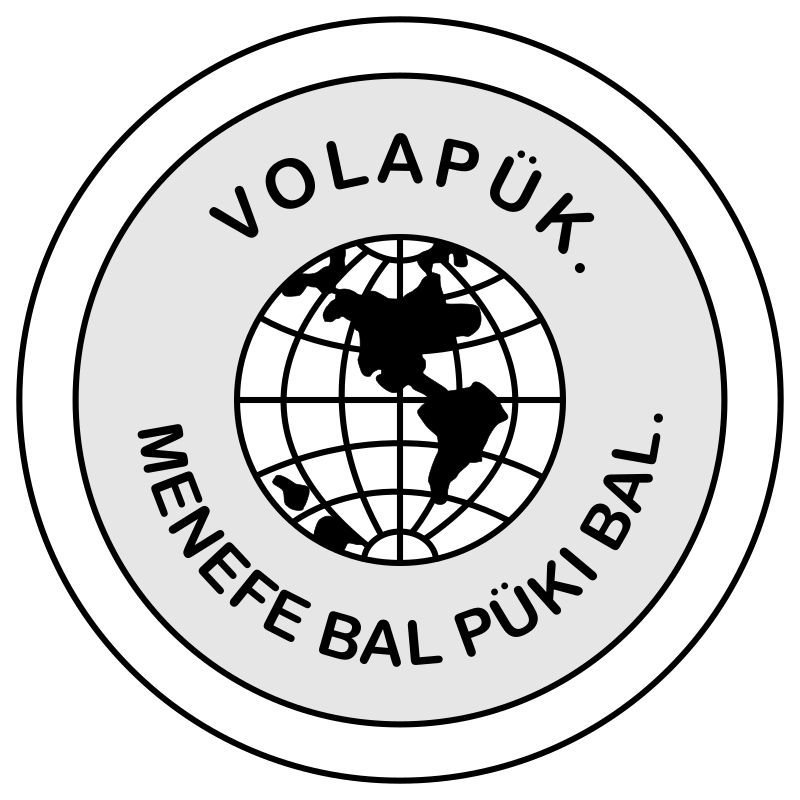
File:Volapuk_symbol.svg · Wikimedia Commons · See Wikimedia Commons
Volapük
Sign in to saveAlso known as Volapuk, Volapük nulik
Volapük (; , 'Language of the World', or ) is a constructed language created in 1879 and 1880 by Johann Martin Schleyer, a Roman Catholic priest in Baden, Germany. Notable as the first major constructed international auxiliary language, it primarily drew from Germanic languages. Its grammar is inspired largely by German, although it was heavily regularized by Schleyer, while its lexicon is rooted mostly in English, with additional influence from German, the Romance languages, and Russian. Despite some roots remaining recognizable, many words were altered beyond recognition, as Schleyer sought
Volapük is a constructed language created in 1879-1880 by a German Catholic priest named Johann Martin Schleyer, designed to serve as an international auxiliary language for communication between people of different nations. It was notable as the first major constructed language of its kind, drawing primarily from Germanic and English vocabulary with a heavily regularized German-inspired grammar, though many of its words were altered to the point of being unrecognizable from their original sources.
AI-generated from the Wikipedia summary — may contain errors.
Key facts
- Language.name
- Volapük
- Language.nativename
- , ,
- Language.image
- Volapuk symbol.svg
- Language.imagescale
- 0.7
- Language.imagecaption
- Logo of the Volapük movement (2nd phase)
- Language.image_class
- skin-invert-image
- Language.creator
- Johann Martin Schleyer
- Language.created
- 1879–1880 (Classical Volapük), 1931 (Reformed Volapük)
- Language.setting
- International: mostly in Europe
- Language.speakers
- 20
- Language.date
- 2000
- Language.fam2
- International auxiliary language
- Language.posteriori
- Mostly influenced by Germanic languages, particularly English and German, with some influence from Romance languages and Russian
- Language.agency
- Kadäm Volapüka
- Language.script
- Latin
- Language.iso1
- vo
- Language.iso2
- vol
- Language.iso3
- vol
via Wikipedia infobox
Described at
View – The Conlang Database
database.conlang.org →Link to a page describing this subject · 547 chars · not written by Vinony
Wikidata facts
- Instance of
- planned language
- Creator
- Johann Martin Schleyer
- Official website
- volapük.com
- Image
- Volapükahüm.png
Show 17 more facts
- P10369
- Ich bin ein Berliner
- Commons gallery
- Volapük
- Commons category
- Volapük
- linguistic typology
- nominative–accusative language
- inception
- 1880-00-00
- topic's main category
- Category:Volapük
- writing system
- Latin script
- number of speakers, writers, or signers
- 20
- language regulatory body
- International Volapük Academy
- Wikimedia language code
- vo
- native label
- Volapük
- publication date
- 1931-00-00
- Stack Exchange tag
- conlang.stackexchange.com/tags/volapuk
- described at URL
- langmaker.github.io/db/mdl_volapuk.htm
- female form of label
- la langue volapük
- has grammatical number
- plural
via Wikidata · CC0
~21 min read
Encyclopedic overview
23 sectionsContents
- History
- Decline and absorption by Esperanto
- {{Anchor|Volapük Nulik|Volapük Rigik}} 20th century temporary revival
- Modern day use and resurgence
- Orthography and phonology
- Special consonantal letters
- Linguistic features
- Grammar
- Nouns
- Adjectives and adverbs
- Pronouns
- Verbs
- Examples
- The Lord's Prayer
- Usage as common noun
- See also
- Notes
- References
- External links
- Summaries
- Tutorials
- Handbooks, grammars and dictionaries
- Fictional treatments
Volapük (; , 'Language of the World', or ) is a constructed language created in 1879 and 1880 by Johann Martin Schleyer, a Roman Catholic priest in Baden, Germany. Notable as the first major constructed international auxiliary language, it primarily drew from Germanic languages. Its grammar is inspired largely by German, although it was heavily regularized by Schleyer, while its lexicon is rooted mostly in English, with additional influence from German, the Romance languages, and Russian. Despite some roots remaining recognizable, many words were altered beyond recognition, as Schleyer sought to make most of the vocabulary monosyllabic.
Volapük conventions took place in 1884 (Friedrichshafen), 1887 (Munich) and 1889 (Paris). The first two conventions used German, and the last conference used only Volapük. By 1889, there were an estimated 283 clubs, 25 periodicals in or about Volapük, and 316 textbooks in 25 languages; at that time the language claimed nearly a million adherents. Volapük experienced a small revival in the 1930s due to Arie de Jong's reforms of the language, which became called Volapük nulik. This form simplified the language and became the commonly accepted form of it. Volapük was largely displaced between the late 19th and early 20th century by Esperanto, as many Volapükists switched to Esperanto due to the internal conflicts within the Volapükist movement.
Excerpted from Wikipedia’s “Volapük” article, available under the CC BY-SA 4.0 licence.
Gallery (24)
Available in 109 languages
- Español
- Français
- Deutsch
- 中文
- 日本語
- Русский
- Português
- Italiano
- العربية
- हिन्दी
- Afrikaans
- Albanian
- Amharic
- Aragonese
- Armenian
- Asturian
- Azerbaijani
- Bahasa Indonesia
Show 90 more
- Basque
- Bavarian
- Belarusian
- Bulgarian
- Catalan
- Chechen
- Church Slavic
- Crimean Tatar
- Croatian
- Czech
- Danish
- Esperanto
- Estonian
- Filipino
- Finnish
- Galician
- Georgian
- Greek
- Haitian Creole
- Hakka Chinese
- Hebrew
- Hungarian
- Icelandic
- Ido
- Interlingua
- Interlingue
- Irish
- Javanese
- Kazakh
- Komi
- Kotava
- Kurdish
- Latin
- Latvian
- Ligurian
- Limburgish
- Lingua Franca Nova
- Lithuanian
- Lojban
- Lombard
- Low German
- Macedonian
- Malagasy
- Malay
- Manipuri
- Marathi
- Mazanderani
- nds_nl
- Nederlands
- Norwegian
- Norwegian Nynorsk
- Novial
- Occitan
- Papiamento
- Pashto
- Piedmontese
- Polski
- Romanian
- Romansh
- Romany
- Santali
- Scottish Gaelic
- Serbian
- Serbian (Latin)
- simple
- Slovak
- Slovenian
- Svenska
- Tamil
- Tiếng Việt
- Toki Pona
- Türkçe
- Udmurt
- Ukrainian
- Urdu
- Uyghur
- Venetian
- Volapük
- Walloon
- Welsh
- Western Frisian
- Western Panjabi
- wikifunctions
- Wu Chinese
- Yiddish
- zh_min_nan
- zh_yue
- فارسی
- ไทย
- 한국어
via Wikidata sitelinks · CC0