
Wilhelm von Ockham
Also known as Guilelmus de Ockham, William of Occam, William of Oakham
Franziskaner, Philosoph und Scholastiker
AI overview
William of Ockham was an English Franciscan friar and theologian from the late 1200s and 1300s who developed influential ideas about logic, language, and knowledge that challenged the thinking of his time. His work matters because his approach to explaining how we understand the world—particularly his emphasis on not multiplying explanations unnecessarily—shaped philosophical and scientific thinking for centuries to come.
AI-generated from the Wikipedia summary — may contain errors.
Person · Open Library
- Born
- ca. 1285
- Died
- ca. 1349
- Works
- 177
Top works
- [Commentary on the Sentences
- Notitia deitatis sub propria ratione deitatis ...
- Explicit sc[ri]ptu[m] Fr[atr]is Wilh[elm]i de Hockam sup[er] p[ri]mu[m] Sen[tenci]ar[um]
- Logica dei termini
- Wilhelm Ockham (1349-1949)
via Open Library + Wikidata
Listeners · Last.fm
- Listeners
- 2
- Total plays
- 2
<a href="https://www.last.fm/music/William+of+Ockham">Read more on Last.fm</a>
Works in European collections
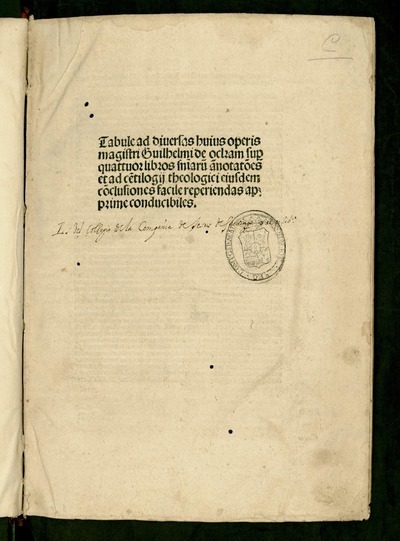
17 objects attributed to Wilhelm von Ockham, held across European museums, libraries & archives · via Europeana
![Dyalog[us] inter clericum et laycum super dignitate regia. De natiuitate [et] morib[us] antichristi.](https://api.europeana.eu/thumbnail/v2/url.json?uri=https%3A%2F%2Fdibiki.ub.uni-kiel.de%2Fviewer%2Fcontent%2FPPN820040584%2F800%2F0%2F00000001.jpg&type=IMAGE)
![Egidius de roma super libros metheorum. De bona fortuna. Thomas super duos primos libros celi et mundi. Et petrus de aluernia super duos sequentes. Egidius de roma super de generatione et corruptione. Et quedam expositiones super libros ethicorum. Questiones ockam super phisicam. Et tractatus eiusdem de futuris contingentibus [fenestratitel]](https://api.europeana.eu/thumbnail/v2/url.json?uri=https%3A%2F%2Fimagines.manuscriptorium.com%2Floris%2FOBBB__-OBBB__MS_496______10685PA-nl%2Fidvoorplatr%2Ffull%2F!400%2C400%2F0%2Fdefault.jpg&type=IMAGE)
Article · Deutsch
Wilhelm von Ockham, englisch William of Ockham oder Occam (* um 1288 in Ockham in der Grafschaft Surrey, England; † 9. April 1347 in München), war einer der bedeutendsten mittelalterlichen Philosophen, Theologen und politischen Theoretiker der Spätscholastik. Traditionell gilt er als ein Hauptvertreter des Nominalismus. Sein umfangreiches philosophisches Werk enthält Arbeiten zur Logik, Naturphilosophie, Erkenntnistheorie, Wissenschaftstheorie, Metaphysik, Ethik und politischen Philosophie.
Abstract from DBpedia / Wikipedia · CC BY-SA
![Due partes in summa logice ockam, Consequentie insolubilia et obligationes Roberti. Item obligationes magistri Ricardi sophiste et alia diuersa sophismata [fenestratitel]](https://api.europeana.eu/thumbnail/v2/url.json?uri=https%3A%2F%2Fimagines.manuscriptorium.com%2Floris%2FOBBB__-OBBB__MS_497______1DAMKKC-nl%2Fidvoorplatr%2Ffull%2F!400%2C400%2F0%2Fdefault.jpg&type=IMAGE)

![Magister guillelmus ockam super librum predicabilium, predicamentorum et elenchorum [fenestratitel]](https://api.europeana.eu/thumbnail/v2/url.json?uri=https%3A%2F%2Fimagines.manuscriptorium.com%2Floris%2FOBBB__-OBBB__MS_499______2XP2QCB-nl%2Fidvoorplatr%2Ffull%2F!400%2C400%2F0%2Fdefault.jpg&type=IMAGE)
![Tractatus aliquot Gualteri de Borlay, Rogeri Anglici alias Seveneset, G. Ockem, et Thome Braduardini [titel Carolus de Visch]](https://api.europeana.eu/thumbnail/v2/url.json?uri=https%3A%2F%2Fimagines.manuscriptorium.com%2Floris%2FOBBB__-OBBB__MS_500______00CUIX1-nl%2Fidvoorplatr%2Ffull%2F!400%2C400%2F0%2Fdefault.jpg&type=IMAGE)
![Liber de pace et tranquilitate reipublice cum aliis quibusdam [titel 18de eeuw]](https://api.europeana.eu/thumbnail/v2/url.json?uri=https%3A%2F%2Fimagines.manuscriptorium.com%2Floris%2FOBBB__-OBBB__MS_557______3Y13137-nl%2Fidvoorplatr%2Ffull%2F!400%2C400%2F0%2Fdefault.jpg&type=IMAGE)


