File:Vapor_pressure.svg · Wikimedia Commons · See Wikimedia Commons
vapor pressure
Sign in to saveAlso known as equilibrium vapor pressure, vapour pressure
pressure exterted by a vapor in thermodynamic equilibrium
Vapor pressure is the force exerted by a gas that forms when a liquid or solid evaporates and reaches a balance with its non-evaporated form. It matters because this pressure helps determine how quickly substances evaporate, how they behave in mixtures, and whether they'll boil at a given temperature.
AI-generated from the Wikipedia summary — may contain errors.
Research
10,828 papers- Vapor Pressure, Vaping, and Corrections to Misconceptions Related to Medical Cannabis' Active Pharmaceutical Ingredients' Physical Properties and Compositions.ReviewCannabis and cannabinoid research · 2023Eyal AM, Berneman Zeitouni D, Tal D et al.DOI: 10.1089/can.2021.0173
- Plant responses to rising vapor pressure deficit.ReviewThe New phytologist · 2020Grossiord C, Buckley TN, Cernusak LA et al.DOI: 10.1111/nph.16485
- Systemic effects of rising atmospheric vapor pressure deficit on plant physiology and productivity.ReviewGlobal change biology · 2021López J, Way DA, Sadok WDOI: 10.1111/gcb.15548
- Gels without Vapor Pressure: Soft, Nonaqueous, and Solvent-Free Supramolecular Biomaterials for Prospective Parenteral Drug Delivery Applications.ReviewAdvanced healthcare materials · 2019Tabet A, Wang CDOI: 10.1002/adhm.201800908
- Limited-transpiration response to high vapor pressure deficit in crop species.ReviewPlant science : an international journal of experimental plant biology · 2017Sinclair TR, Devi J, Shekoofa A et al.DOI: 10.1016/j.plantsci.2017.04.007
- Warming-induced vapor pressure deficit suppression of vegetation growth diminished in northern peatlands.Nature communications · 2023Chen N, Zhang Y, Yuan F et al.DOI: 10.1038/s41467-023-42932-w
- The influence of vapor pressure of chemicals on dermal penetration.ReviewReviews on environmental health · 2014Gilpin SDOI: 10.1515/reveh-2014-0056
- Vapor detection and vapor pressure measurements of fentanyl and fentanyl hydrochloride salt at ambient temperatures.The Analyst · 2022Ewing RG, Nims MK, Morrison KA et al.DOI: 10.1039/d2an01149b
via PubMed
Wikidata facts
- Image
- Vapor pressure.svg
Show 2 more facts
- studied by
- thermodynamics
- on focus list of Wikimedia project
- Wikipedia:Vital articles/Level/4
Sources (2)
via Wikidata · CC0
~16 min read
Encyclopedic overview
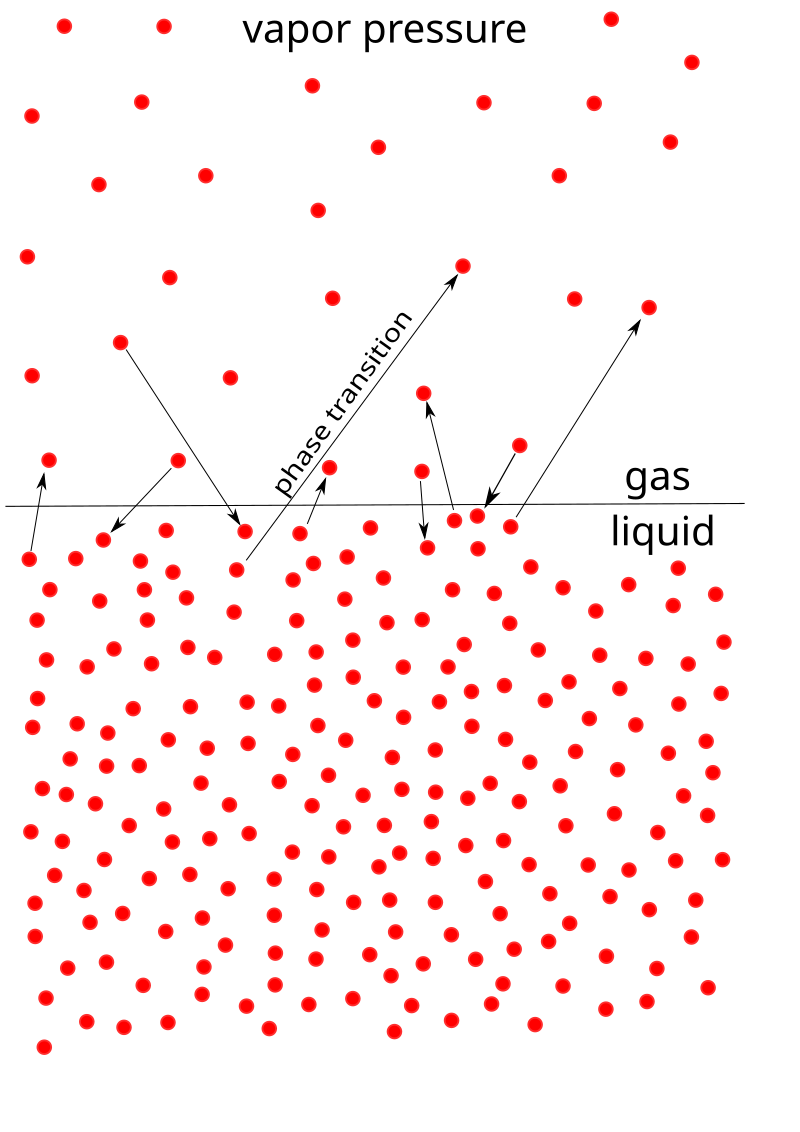
The microscopic process of evaporation and condensation at the liquid surface. If vapor pressure exceeds the thermodynamic equilibrium value, condensation occurs in presence of nucleation sites. This principle is indigenous in cloud chambers, where ionized particles form condensation tracks when passing through. The pistol test tube experiment. The tube contains alcohol and is closed with a piece of cork. By heating the alcohol, the vapors fill in the space, increasing the pressure in the tube to the point of the cork popping out.
Vapor pressure or equilibrium vapor pressure is the pressure exerted by a vapor in thermodynamic equilibrium with its condensed phases (solid or liquid) at a given temperature in a closed system. The equilibrium vapor pressure is an indication of a liquid's thermodynamic tendency to evaporate. It relates to the balance of particles escaping from the liquid (or solid) in equilibrium with those in a coexisting vapor phase. A substance with a high vapor pressure at normal temperatures is often referred to as volatile. The pressure exhibited by vapor present above a liquid surface is known as vapor pressure. As the temperature of a liquid increases, the attractive interactions between liquid molecules become less significant in comparison to the entropy of those molecules in the gas phase, increasing the vapor pressure. Thus, liquids with strong intermolecular interactions are likely to have smaller vapor pressures, with the reverse true for weaker interactions.
Excerpted from Wikipedia’s “vapor pressure” article, available under the CC BY-SA 4.0 licence.
Gallery (5)
Available in 61 languages
- Español
- Français
- Deutsch
- 中文
- 日本語
- Русский
- Português
- Italiano
- العربية
- हिन्दी
- Afrikaans
- Aragonese
- Armenian
- Asturian
- Bahasa Indonesia
- Bangla
- Basque
- Belarusian
Show 42 more
- Bhojpuri
- Bulgarian
- Catalan
- Chuvash
- Esperanto
- Estonian
- Finnish
- Galician
- Greek
- Haitian Creole
- Hebrew
- Hungarian
- Icelandic
- Irish
- Javanese
- Latin
- Lombard
- Macedonian
- Malay
- Mongolian
- Nederlands
- Norwegian
- Norwegian Nynorsk
- Polski
- Romanian
- Serbian
- Serbian (Latin)
- Sicilian
- simple
- Slovenian
- Svenska
- Tamil
- Telugu
- Tiếng Việt
- Türkçe
- Ukrainian
- Urdu
- Wu Chinese
- zh_yue
- فارسی
- ไทย
- 한국어
via Wikidata sitelinks · CC0