Category
page 1Microtechnology

microelectronics
thumb|An integrated circuit (IC) as an example application in the field of microelectronics. The chip housing is opened to allow a view of the actual circuit. The golden connecting cables, which form the electrical wiring between the IC and the housing contacts, can be seen on the sides.
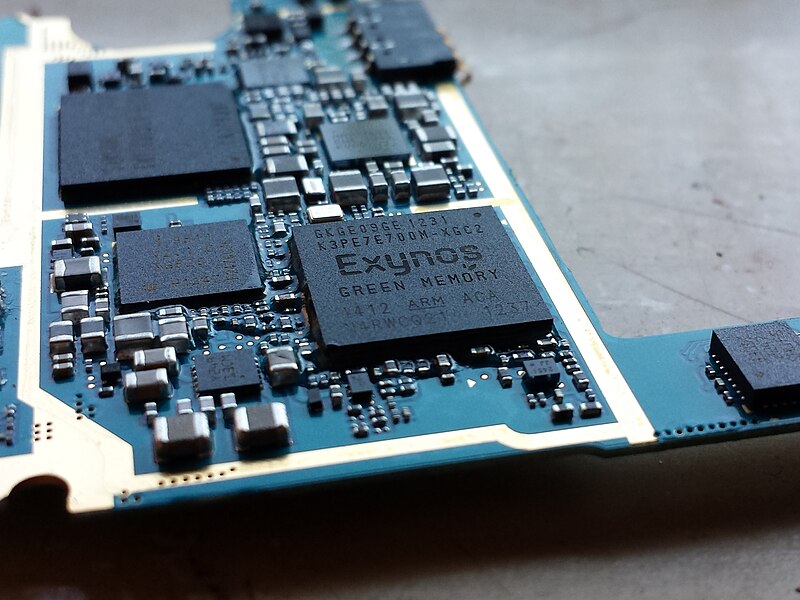
system on a chip
type of integrated circuit; integration of the functions of a system on a chip

micro-electromechanical systems
thumb|MEMS microcantilever resonating inside a scanning electron microscope
thumb|Proposal submitted to DARPA in 1986 first introducing the term "microelectromechanical systems"

photolithography
thumb|Silicon wafer that has undergone photolithography
Photolithography (also known as optical lithography) is a process that involves using light to transfer a pattern onto a photoresist layer deposited on a sample, typically a silicon wafer. It is used in the manufacturing of integrated circuits.
DNA microarray
use of large set of oligonucleotide probes

microtechnology
Microtechnology is technology whose features have dimensions of the order of one micrometre (one millionth of a metre, or 10−6 metre, or 1μm). It focuses on physical and chemical processes as well as the production or manipulation of structures with one-micrometre magnitude.
xenobot
Xenobots, named after the clawed frog (Xenopus laevis), are synthetic lifeforms that are designed by computers to perform some desired function and built by combining together different biological tissues. There is debate among scientists whether xenobots are robots, organisms, or something else entirely.
silicon on insulator
semiconductor manufacturing process
surface acoustic wave
acoustic wave traveling along the surface of a material exhibiting elasticity, with an amplitude that typically decays exponentially with depth into the substrate
energy harvesting
process by which wireless autonomous devices capture and store small amounts of energy from the environment
smartdust
Smartdust is a system of many tiny microelectromechanical systems (MEMS) such as sensors, robots, or other devices, that can detect, for example, light, temperature, vibration, magnetism, or chemicals. They are usually operated on a computer network wirelessly and are distributed over some area to perform tasks, usually sensing through radio-frequency identification. Without an antenna of much greater size the range of tiny smart dust communication devices is measured in a few millimeters and they may be vulnerable to electromagnetic disablement and destruction by microwave exposure.

Bio-MEMS
thumb|An example of a bio-MEMS device is this automated Fluorescence in situ hybridization|FISH microchip, which integrates a reagent multiplexer, a cell chamber with a thin-film heater layer, and a peristaltic pump.
Bio-MEMS is an abbreviation for biomedical (or biological) microelectromechanical systems. Bio-MEMS have considerable overlap, and is sometimes considered synonymous, with lab-on-a-chip (LOC) and micro total analysis systems (). Bio-MEMS is typically more focused on mechanical parts and microfabrication technologies made suitable for biological applications. On the other hand, lab

microbotics
thumb|Jasmine minirobots each smaller than in width
Microbotics (or microrobotics) is the field of miniature robotics, in particular mobile robots with characteristic dimensions less than 1 mm. The term can also be used for robots capable of handling micrometer size components.
Thermal oxidation
process creating a thin layer of silicon dioxide

microfabrication
right|thumb|Synthetic detail of a micromanufactured integrated circuit through four layers of planarized copper interconnect, down to the polysilicon (pink), wells (greyish) and substrate (green)
Microfabrication is the process of fabricating miniature structures of micrometre scales and smaller. Historically, the earliest microfabrication processes were used for integrated circuit fabrication, also known as "semiconductor manufacturing" or "semiconductor device fabrication". In the last two decades, microelectromechanical systems (MEMS), microsystems (European usage), micromachines (Japanese
.svg)
LOCOS
thumb|250px|Typical LOCOS structure. 1) Silicon 2) Silicon dioxide
etching
technique in microfabrication

system in package
group of a number of integrated circuits enclosed in a single module (a package)

microreactor
right|frame|Microreactor technologies developed at Lawrence Livermore National Laboratory|LLNL use micromachining techniques to miniaturize the reactor design. Applications include fuel processors for generating [[hydrogen, chemical synthesis, and bioreaction studies.]]
Dry etching
controlled material removal, without the use of liquid substances
X-ray microtomography
X-ray imaging method
Digital micromirror device
mirror-based electronic display technology
deep reactive-ion etching
highly anisotropic etch process
LIGA
right|thumb|The X-ray LIGA process was originally developed at the Forschungszentrum Karlsruhe, Germany, to produce nozzles for Enriched uranium#Aerodynamic processes|uranium enrichment.
thumb|SEM picture of a polymer LIGA structure made by molding. Smallest polymer width is 6 μm; polymer height is 120 μm, the aspect ratio is, therefore, 20.
thumb|SEM picture of a polymer LIGA structure made by x-ray lithography. Step length is 3 μm, step height is 0.7 μm. The pattern extends downwards towards the substrate for 150 μm leading to an aspect ratio of the contour of 200.
L
Supercritical fluid extraction
process of separating components using supercritical fluids
microprobe
A microprobe is an instrument that applies a stable and well-focused beam of charged particles (electrons or ions) to a sample.
micromachinery
thumb|A spider mite next to a MEMS gear train.
thumb|A micromachine by Sandia National Laboratories|Sandia is moved by a lit [[LED at Miraikan in Tokyo]]
thumb|A circuit diagram for a Sandia National Laboratories|Sandia micromachine
Interdigital transducer
or interdigitated transducer, a sensor and transmitter for a surface acoustic wave
Dip-pen nanolithography
scanning probe lithography technique
industrial computed tomography scanning
computer-aided tomographic process
microlens
thumb|A microlens array used in a spectrograph
micropump
thumb|A Ti–Cr–Pt tube (~40 μm long) releases oxygen bubbles when immersed in hydrogen peroxide (catalytic decomposition). [[Polystyrene spheres (1 μm diameter) were added to study the flow kinetics.]]
thumb|Electrochemical micropump activating the flow of human blood through a 50×100 μm pipe.
Ion track
trails created by swift heavy ions penetrating through solids
nanogenerator
A nanogenerator is a compact device that converts mechanical or thermal energy into electricity, serving to harvest energy for small, wireless autonomous devices. It uses ambient energy sources like solar, wind, thermal differentials, and kinetic energy. Nanogenerators can use ambient background energy in the environment, such as temperature gradients from machinery operation, electromagnetic energy, or even vibrations from motions.
microphotonics
Microphotonics is a branch of technology that deals with directing light on a microscopic scale and is used in optical networking. Particularly, it refers to the branch of technology that deals with wafer-level integrated devices and systems that emit, transmit, detect, and process light along with other forms of radiant energy with photon as the quantum unit.
supercritical drying
scientific process