Category
page 1Russian cuisine
.jpg)
Rumex acetosa
Sorrel (Rumex acetosa) is a perennial herbaceous plant in the family Polygonaceae. It is also called common sorrel, garden sorrel, spinach dock and narrow-leaved dock ("dock" often used for the genus).

caviar
thumb|The rarest and most expensive form of caviar comes from the critically endangered beluga sturgeon that swims in the [[Caspian Sea.]]

kumis
Kumis ( , ), alternatively spelled coumis or kumyz, also known as airag ( ), is a traditional fermented dairy product made from mare milk. The drink is important to the peoples of the Central and East Asian steppes, of Turkic and Mongolic origin: Kazakhs, Bashkirs, Kalmyks, Kyrgyz, Mongols, and Yakuts. Kumis was historically consumed by the Khitans, Jurchens, Magyars, and Han Chinese of North China as well.

blood sausage
sausage filled with blood that are cooked or dried and mixed with a filler until they are thick enough to congeal when cooled

Olivier salad
salad dish

Welsh onion
species of plant

pelmeni
Pelmeni (, ; pelmen, , ) are dumplings of Russian cuisine that consist of a filling wrapped in thin, unleavened dough. They are considered a national dish.

Crucian carp
species of fish
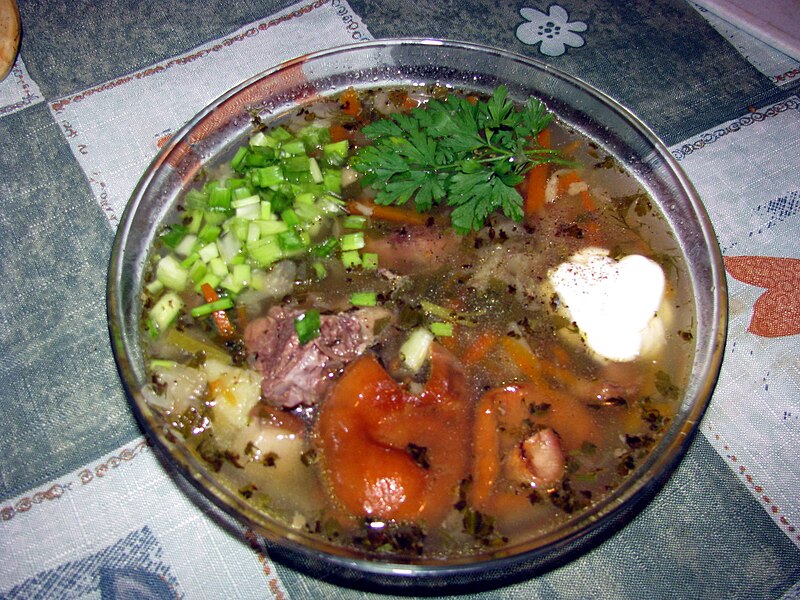
Russian cuisine
culinary traditions of Russian people

börek
Börek (also burek or byrek) is a family of pastries or pies made in the Middle East and Southeast Europe. The pastry is made of a thin flaky dough such as filo with a variety of fillings, such as meat, cheese, spinach, or potatoes. A börek may be prepared in a large pan and cut into portions after baking, or as individual pastries. They are usually baked but some varieties can be fried. Börek is sometimes sprinkled with sesame or nigella seeds, and it can be served hot or cold.

Rubus saxatilis
species of plant

smetana
dairy product produced by souring heavy cream, popular in Eastern and Central Europe

potato pancake
fried pancakes of grated or ground potato

aspic
thumb|upright|Aspic with chicken and eggs
Aspic () or meat jelly is a savoury gelatin made with a meat stock or broth, set in a mold to encase other ingredients. These often include pieces of meat, seafood, vegetable, or eggs. Aspic is also sometimes referred to as aspic gelée or aspic jelly. In its simplest form, aspic is essentially a gelatinous version of conventional soup.

cabbage roll
dish of cabbage leaves with a filling

pierogi
Pierogi ( ; , ) are filled dumplings made by wrapping unleavened dough around a filling and cooking in boiling water. They are occasionally flavored with a savory or sweet garnish. Typical fillings include potato and twaróg cheese, sauerkraut, ground meat, mushrooms, fruits, or berries. Savory pierogi are often served with a topping of sour cream, fried onions, or both.

baba ghanoush
Levantine appetizer consisting of finely chopped roasted eggplant, olive oil, lemon juice, various seasonings, and tahini

strained yogurt
dairy product

Kutia
Kutia or kutya is a ceremonial grain dish with sweet gravy traditionally served predominantly in Belarusian and Ukrainian cuisine, but also in parts of Lithuania, Poland, and Russia. It is consumed by both Eastern Orthodox Christians and Catholics, though whether it is served on Christmas–Feast of Jordan holiday season or as part of a funeral feast can vary between regions. The word with a descriptor is also used to describe the eves of Christmas, New Year, and Feast of Jordan days.

Pacific saury
species of fish
baursak
Boortsog, boorsoq, baursak, baursaq, bauyrsaq, borsok or boorsok is a fried dough food found in the cuisines of Central Asia, Idel-Ural, Mongolia and the Middle East. They are shaped into triangles or sometimes spheres. The dough consists of flour, yeast, milk, eggs, butter, salt, sugar, and margarine. Tajik boortsog are often decorated with a criss-cross pattern by pressing the bottom of a small strainer on the dough before it is fried. It has been adopted by Cossack cuisine as "bursak".
open sandwich
single slice of bread with food items on top
Chiburekki
Chebureki ( Cheburek) are deep-fried turnovers with a filling of ground or minced meat and onions. A popular street dish, they are made with a single round piece of dough folded over the filling in a crescent shape. They have become widespread in the former Soviet-aligned countries of Eastern Europe in the 20th century.
samsa
pastry from Central Asia
baked potato
potato dish

halušky
right|thumb|Haluškár strainer
laghman
Central Asian noodle dish
Karelian pasty
traditional pasties from Karelia

Lactarius resimus
species of fungus
Crimean Tatar cuisine
culinary traditions of Crimean Tatars

kasha
In English, kasha () is a porridge usually made from buckwheat, a pseudocereal. In the Slavic languages, kasha means porridge. In some varieties of Central and Eastern European cuisine, kasha can apply to any kind of cooked grain. It can be baked but most often is boiled, either in water or milk, but the word can also refer to the grain before preparation, which corresponds to the definition of 'groats'.
Vinegret
Vinegret (), or Russian vinaigrette, is a salad in Russian cuisine which is also popular in other post-Soviet states. The dish includes diced cooked vegetables (red beets, potatoes, carrots), chopped onions, as well as sauerkraut and/or brined pickles. Other ingredients, such as green peas or beans, are sometimes also added. The naming comes from vinaigrette, which is used as a dressing. However, in spite of the name, vinegar is often omitted in modern cooking, and sunflower or other vegetable oil is just used. Some cooks add the brine from the pickled cucumbers or sauerkraut.

oladyi
Oladyi or oladi ( pl., diminutive: оладушки, oladushki, sg. оладья, oladya ; , oladky) are small thick pancakes or fritters common in Russian and Ukrainian cuisines. The batter for oladyi is made from wheat or (nowadays more rarely) buckwheat flour, eggs, milk, salt, and sugar with yeast or baking soda. The batter may also contain kefir, soured milk or yoghurt. Oladyi may also include various additions, such as apple or raisins.

venison
thumb|right|Venison steaks
Venison refers primarily to the meat of deer (or antelope in South Africa). Venison can be used to refer to any part of the animal, so long as it is edible, including the internal organs. Venison, much like beef or pork, is categorized into specific cuts, including roast, sirloin, and ribs.
pig slaughter
work of slaughtering domestic pigs to obtain pig meat (pork)

stroganina
thumb|300px|Prepared stroganina on a table
thumb|Whittling off stroganina with a Yakutian knife
belyash
Peremech ( / pərəməç / pärämäç; , tr. beremes; ) is an individual-sized fried dough pastry common in Volga Tatar and Bashkir cuisines. It is made from unleavened or leavened dough and usually filled with ground meat and chopped onion. Originally, finely chopped pre-cooked meat was used as a filling, but later raw ground meat became more common. Alternatively, peremech can be filled with potato or quark.

rollmops
Rollmops () are pickled herring fillets, rolled into a cylindrical shape, often around a savoury filling.

coulibiac
thumb|Uncooked salmon coulibiac
A coulibiac ( ) is a type of pirog usually filled with salmon or sturgeon, rice or buckwheat, hard-boiled eggs, mushrooms, onions, and dill. The pie is baked in a pastry shell, usually of brioche or puff pastry.
zakuski
Zakuski (, ; ) is the term for an assortment of cold hors d'oeuvres, entrées and snacks in Russian food culture. They are considered to be an integral part of any Russian festive meal, as well as often everyday meals.
egg drop soup
Chinese soup of wispy beaten eggs in boiled chicken broth
Ajapsandali
Ajapsandali ( ) or ajapsandal ( ) is a traditional Georgian and Armenian dish, also popular in the Northern Caucasus.
lingonberry jam
traditional fruit preserve in Scandinavian cuisine

bublik
Bublik (also booblik or bublyk; , plural: ; ) is a traditional Eastern European bread roll. It is a ring of yeast-leavened wheat dough that has been boiled in water for a short time before baking.
kalach
Eastern European bread

oatmeal
Oatmeal is a preparation of oats that have been dehusked, steamed, and flattened, or a coarse flour of hulled oat grains (groats) that have either been milled (ground), rolled, or steel-cut. Ground oats are also called white oats. Steel-cut oats are known as coarse oatmeal, Irish oatmeal, or pinhead oats. Rolled oats were traditionally thick old-fashioned oats, but they can be made thinner or smaller and may be categorized as quick oatmeal or instant oatmeal depending on the cooking time required, which is determined by the size of the oats and the amount of precooking.
dressed herring
Russian layered salad

korovai
thumb|Wedding korovai in Kyiv, 2020
thumb|A korovai and a kolach (bread)| kolach served alongside [[kvass and kefir in a Polish household]]
pickled herring
traditional way of preserving herring

koliva
Koliva, also spelled, depending on the language, kollyva, kollyba, kolyvo, or colivă, is a dish based on boiled wheat that is used liturgically in the Eastern Orthodox Church for commemorations of the dead.
makarony po-flotski
Russian dish of pasta and ground meat
pollock roe
eggs of the Pollock fish
lazanki
Lazanki (, , , singular łazanka or łazanek, , Ukrainian: лазанки) is a Polish, Russian, Lithuanian and Belarusian type of pasta.
mimosa salad
Eastern European layered cold composed salad of cheese, eggs, canned fish, onion, and mayonnaise
Tatarstan cuisine
cuisine of the Tatar people
whale meat
flesh of whales used for consumption by humans or other animals
Bashkir cuisine
cuisine of the Bashkir people
Borodinsky bread
dark brown sourdough rye bread of Russian origin
Naryn
Central Asian noodle dish
Sakha cuisine
cuisine of the Yakut people