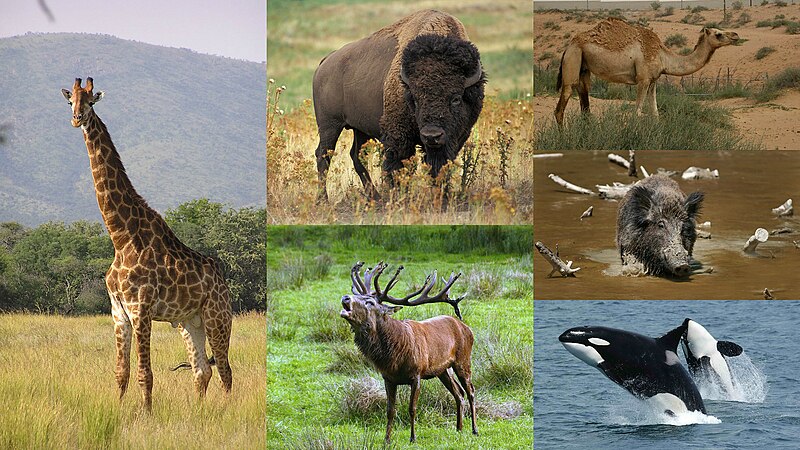
File:The_Cetartiodactyla.jpg · Wikimedia Commons · See Wikimedia Commons
Artiodactyla
Sign in to saveAlso known as Artiodactylla, Artiodactylamorpha, even-toed ungulate, even-toed, even-toed ungulates, artiodactyls
Artiodactyla ( ; ) is an order of placental mammals. Typically, they are ungulates which bear weight equally on two (an even number) of their five toes (the third and fourth, often in the form of a hoof). The other three toes are either present, absent, vestigial, or pointing posteriorly. By contrast, most perissodactyls bear weight on an odd number of the five toes. Another difference between the two orders is that many artiodactyls (except for Suina) digest plant cellulose in one or more stomach chambers rather than in their intestine (as perissodactyls do). Molecular biology, along with fos
OverviewAI-generated
Artiodactyla is an order of mammals within the phylum Chordata and kingdom Animalia. Also referred to as even-toed ungulates, this taxon is a subclass of Mammalia. It is the opposite of odd-toed ungulates. The group has a temporal range starting in the Ypresian, approximately 55 million years ago. A taxon synonym for Artiodactyla is Cetartiodactyla.
The order is recognized as an accepted taxon under the International Code of Zoological Nomenclature. It has been described in sources such as the Brockhaus and Efron Encyclopedic Dictionary and the Encyclopædia Britannica 11th edition. Records of Artiodactyla are held by institutions including USNM, CM, and NHMUK in the United States and the United Kingdom.
Scientific literature references the group extensively, with 789,798 PubMed entries and 2,325 other encyclopedia articles citing it. Occurrence data includes 8,611,352 records, while specific databases hold 16,251 records and 742 media items.
Synthesized by Vinony from 36 facts across 7 sources: Wikidata, GBIF, PubMed, Gbif Occ, WoRMS, iDigBio, Vinony graph. Generated from structured data (not the Wikipedia text) and checked against those facts — may still contain errors.
Species
Artiodactyla
ORDER
- KingdomAnimalia
- PhylumChordata
- ClassMammalia
- OrderArtiodactyla
偶蹄目(學名:Artiodactyla)是哺乳动物中的一个大目,约220种,其中包括许多对人类生活很重要的动物。偶蹄目动物是现代进步的繁盛的有蹄类,90%的现存有蹄动物都是偶蹄动物。其中又以牛科最为繁盛。除了陆地上的种类,四足已经高度特化的海洋动物鲸豚类也是属于这一演化支。
via GBIF
Museum specimens
- Specimen records
- 16,251
- With media
- 742
- Collections
- USNM, CM, NHMUK
- Recorded in
- United States, United Kingdom
Research
789,798 papers- Systematics of the Artiodactyla of China in the 21(st) century.ReviewDong wu xue yan jiu = Zoological research · 2016Groves CDOI: 10.13918/j.issn.2095-8137.2016.3.119
- Identification and characterisation of Gamma-herpesviruses in zoo artiodactyla.Virology journal · 2024Bianchessi L, Flach E, Monacchia G et al.DOI: 10.1186/s12985-024-02311-3
- TUBERCULOSIS.ReviewThe Practitioner · 1963HEAF F
- Morphological study of the anterior dentition in Raoellidae (Mammalia, Artiodactyla), new insight on their dietary habits.ReviewJournal of anatomy · 2026Bouaziz H, Orliac MJ, Waqas M et al.DOI: 10.1111/joa.14209
- Phylogeny of the Bovidae (Artiodactyla, Mammalia), based on mitochondrial ribosomal DNA sequences.Molecular biology and evolution · 1992Gatesy J, Yelon D, DeSalle R et al.DOI: 10.1093/oxfordjournals.molbev.a040734
- First clear evidence of Anoplotherium (Mammalia, Artiodactyla) in the Iberian Peninsula: an update on the Iberian anoplotheriines.Anatomical record (Hoboken, N.J. : 2007) · 2025Badiola A, De Vicuña NJ, Perales-Gogenola L et al.DOI: 10.1002/ar.25238
- The complete mitochondrial DNA sequence of the greater Indian rhinoceros, Rhinoceros unicornis, and the Phylogenetic relationship among Carnivora, Perissodactyla, and Artiodactyla (+ Cetacea).Molecular biology and evolution · 1996Xu X, Janke A, Arnason UDOI: 10.1093/oxfordjournals.molbev.a025681
- Phylogenetic evidence from the IRBP gene for the paraphyly of toothed whales, with mixed support for Cetacea as a suborder of Artiodactyla.Molecular biology and evolution · 1996Smith MR, Shivji MS, Waddell VG et al.DOI: 10.1093/oxfordjournals.molbev.a025659
via PubMed
Wikidata facts
Show 13 more facts
- taxon rank
- order
- Commons category
- Artiodactyla
- taxon name
- Artiodactyla
- topic's main category
- Category:Artiodactyls
- Code of nomenclature
- International Code of Zoological Nomenclature
- taxon synonym
- Cetartiodactyla
- start time
- 55000000-0
- opposite of
- odd-toed ungulate
- name
- even-toed ungulate
- taxon common name
- artadachtail
- on focus list of Wikimedia project
- Wikipedia:Vital articles/Level/4
- described by source
- Encyclopædia Britannica 11th edition
- temporal range start
- Ypresian
via Wikidata · CC0
~37 min read
Encyclopedic overview
27 sectionsContents
- Evolutionary history
- Taxonomy and phylogeny
- Classification
- Research history
- Historical classification of Artiodactyla
- Historical classification of Cetacea
- Inner systematics
- Anatomy
- Limbs
- Head
- Horns and antlers
- Teeth
- Senses
- Digestive system
- Genitourinary system
- Other
- Lifestyle
- Distribution and habitat
- Social behavior
- Reproduction and life expectancy
- Predators and parasites
- Interactions with humans
- Domestication
- Threats
- See also
- References
- External links
Artiodactyla ( ; ) is an order of placental mammals. Typically, they are ungulates which bear weight equally on two (an even number) of their five toes (the third and fourth, often in the form of a hoof). The other three toes are either present, absent, vestigial, or pointing posteriorly. By contrast, most perissodactyls bear weight on an odd number of the five toes. Another difference between the two orders is that many artiodactyls (except for Suina) digest plant cellulose in one or more stomach chambers rather than in their intestine (as perissodactyls do). Molecular biology, along with fossil discoveries, has found that cetaceans (whales, dolphins, and porpoises) fall within this taxonomic branch, being most closely related to hippopotamuses. Some modern taxonomists thus apply the name Cetartiodactyla () to this group, while others opt to include cetaceans within the existing name of Artiodactyla. Some researchers use "even-toed ungulates" to exclude cetaceans and only include terrestrial artiodactyls, making the term paraphyletic in nature.
The roughly 270 land-based even-toed ungulate species include pigs, peccaries, hippopotamuses, antelopes, deer, giraffes, camels, llamas, alpacas, sheep, goats and cattle. Many are herbivores, but suids are omnivorous, and cetaceans are entirely carnivorous. Artiodactyls are also known by many extinct groups such as anoplotheres, cainotheriids, merycoidodonts, entelodonts, anthracotheres, basilosaurids, and palaeomerycids. Many artiodactyls are of great dietary, economic, and cultural importance to humans.
Excerpted from Wikipedia’s “Artiodactyla” article, available under the CC BY-SA 4.0 licence.
Gallery (54)
Available in 113 languages
- Español
- Français
- Deutsch
- 中文
- 日本語
- Русский
- Português
- Italiano
- العربية
- हिन्दी
- Afrikaans
- Albanian
- Albanian
- Amharic
- Aragonese
- Armenian
- Asturian
- azb
Show 94 more
- Azerbaijani
- Bahasa Indonesia
- Balinese
- Bangla
- Bashkir
- Basque
- be_x_old
- Belarusian
- Bosnian
- Breton
- Bulgarian
- Burmese
- Catalan
- Cebuano
- Chuvash
- Croatian
- Czech
- Danish
- Egyptian Arabic
- Esperanto
- Estonian
- Filipino
- Finnish
- Galician
- Georgian
- Greek
- Guarani
- Hebrew
- Hungarian
- Icelandic
- Ido
- Inari Sami
- Interlingua
- Irish
- Javanese
- Kabyle
- Kannada
- Kashmiri
- Kazakh
- Komi-Permyak
- Kotava
- Kyrgyz
- Latin
- Latvian
- Ligurian
- Limburgish
- Lingua Franca Nova
- Lithuanian
- Luxembourgish
- Macedonian
- Malay
- Marathi
- Mingrelian
- Nederlands
- Northern Frisian
- Norwegian
- Norwegian Nynorsk
- Novial
- Occitan
- Old English
- Oromo
- Ossetic
- Polski
- Quechua
- Romanian
- Scots
- Scottish Gaelic
- Serbian
- Serbian (Latin)
- Sicilian
- simple
- Slovak
- Slovenian
- Svenska
- Tamil
- Tiếng Việt
- Türkçe
- Ukrainian
- Uzbek
- Waray
- West Flemish
- Western Frisian
- Western Mari
- Western Panjabi
- Wu Chinese
- Yakut
- Zaza
- Zeelandic
- zh_min_nan
- zh_yue
- Zhuang
- فارسی
- ไทย
- 한국어
via Wikidata sitelinks · CC0