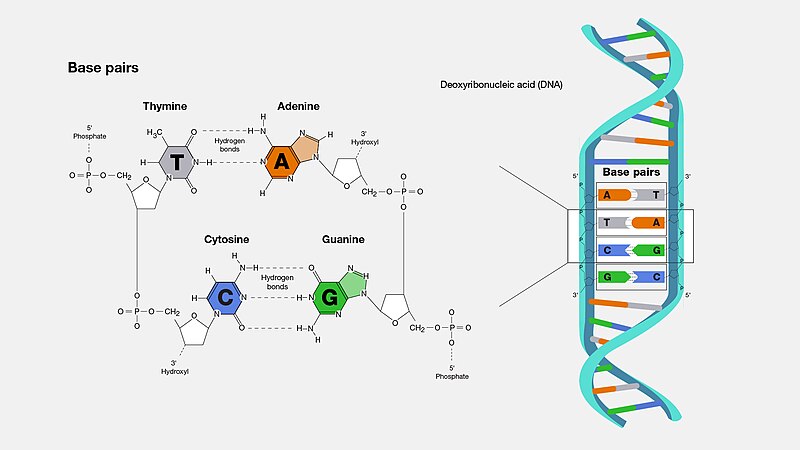
File:DNA_base-pair_diagram.jpg · Wikimedia Commons · See Wikimedia Commons
Also known as bp, pb
unit consisting of two nucleobases bound to each other by hydrogen bonds: either adenine–thymine or guanine–cytosine in natural DNA (additional types occur in RNA)
A base pair is two nucleobases (the building blocks of DNA) linked together by chemical bonds, with adenine always pairing with thymine and guanine always pairing with cytosine. Base pairs matter because they form the rungs of DNA's double helix structure and determine how genetic information is stored and copied.
AI-generated from the Wikipedia summary — may contain errors.
Wikidata facts
Show 3 more facts
- Commons category
- Base pairing
- unit symbol
- pb
- Wikidata SPARQL query equivalent
- wd:Q145911 p:P2370/psn:P2370 [wikibase:quantityAmount ?source; wikibase:quantityUnit ?base]. ?item p:P2370/psn:P2370 [wikibase:quantityAmount ?target; wikibase:quantityUnit ?base]. BIND(?source / ?target as ?value)
Sources (3)
via Wikidata · CC0
Article · 日本語
塩基対(えんきつい、英: base pair、bp)とは、デオキシリボ核酸の2本のポリヌクレオチド分子が、アデニン (A) とチミン (T)(もしくはウラシル (U))、グアニン (G) とシトシン (C) という決まった組を作り、水素結合で繋がったもの。この組み合わせはジェームズ・ワトソンとフランシス・クリックが発見したもので、「ワトソン・クリック型塩基対」「天然型塩基対」と言う。DNA や RNA の場合、ワトソン・クリック型塩基対が形成しさらに隣り合う塩基対の間に疎水性相互作用がはたらくことが、二重らせん構造が安定化する駆動力となっている。 これに対して、DNAが三重鎖を作るときなどには「フーグスティーン型塩基対」という別のパターンの塩基対も現れる。テロメア配列が持つ四重鎖構造、もフーグスティーン型の構造をとっている。さらに人工的に合成したATGC以外の塩基を使って、特別な塩基対を作り出すことも可能である。 インターカレーションとは、平面状の部位を持つ有機分子(インターカレーター)が、2個の塩基対の間にその平面部位を挿入する現象を指す。臭化エチジウムはインターカレーターの代表例である。
Abstract from DBpedia / Wikipedia · CC BY-SA