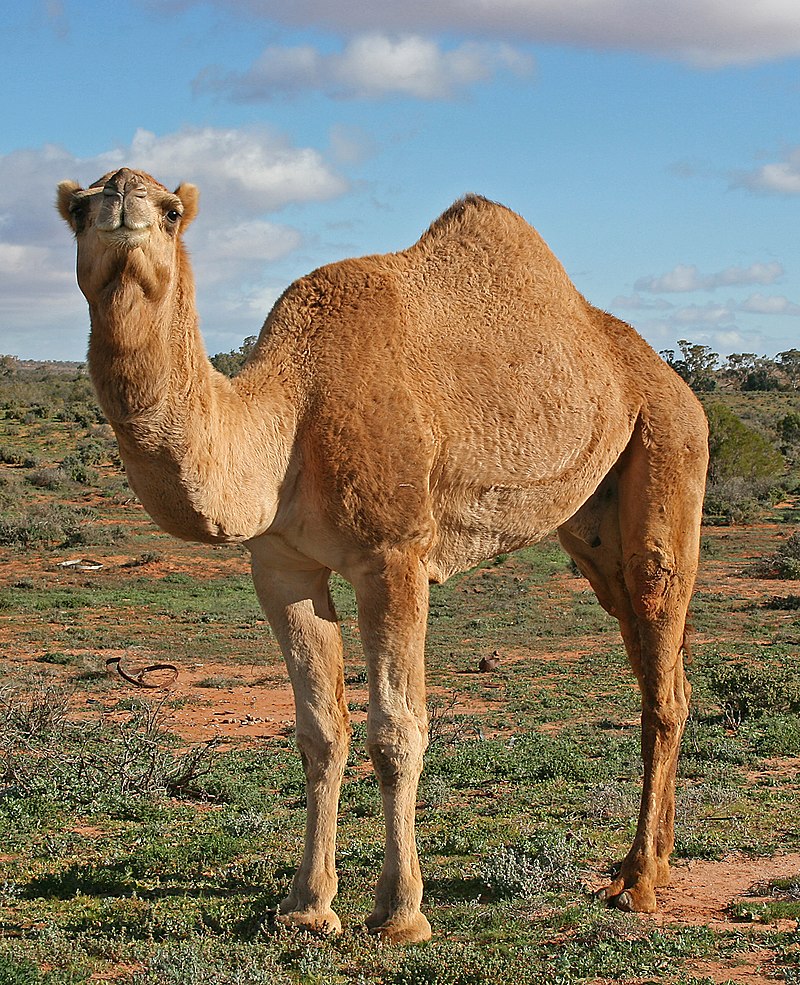
File:07._Camel_Profile,_near_Silverton,_NSW,_07.07.2007.jpg · Wikimedia Commons · See Wikimedia Commons
Camelus
Sign in to saveAlso known as the camel genus, camel
A camel (from and () from Ancient Semitic: gāmāl) is an even-toed ungulate in the genus Camelus that bears distinctive fatty deposits known as "humps" on its back. Camels have long been domesticated and, as livestock, they provide food (camel milk and meat) and textiles (fiber and felt from camel hair). Camels are working animals especially suited to their desert habitat and are a vital means of transport for passengers and cargo. There are three surviving species of camel. The one-humped dromedary makes up 94% of the world's camel population, and the two-humped Bactrian camel makes up 6%. The
OverviewAI-generated
Camelus is a genus within the family Camelidae, classified under the order Artiodactyla and class Mammalia. The taxon was described by Linnaeus in 1758, with Camelus bactrianus serving as the taxonomic type. It is an instance of a taxon and is subclassed as an ungulate. The group is naturally invasive to the Australian continent and acts as a natural reservoir for Middle East respiratory syndrome coronavirus.
Records indicate that the taxon originated about 4 million years ago. It has been referenced by 2,043 other encyclopedia articles. Scientific literature includes 6,285 PubMed entries, while occurrence data shows 11,973 records. Specimens are held by institutions including USNM, FHSM, NHMUK, SDNHM, and UAZ in countries such as the United States, Israel, and Tunisia.
Synthesized by Vinony from 40 facts across 7 sources: Wikidata, GBIF, PubMed, iNaturalist, Gbif Occ, iDigBio, Vinony graph. Generated from structured data (not the Wikipedia text) and checked against those facts — may still contain errors.
Species
Common Ostrich
Camelus
GENUS
- KingdomAnimalia
- PhylumChordata
- ClassMammalia
- OrderArtiodactyla
- FamilyCamelidae
本条目需要擴充。(2015年1月30日) 请協助改善这篇條目,更進一步的信息可能會在討論頁或扩充请求中找到。请在擴充條目後將此模板移除。 駱駝属(学名:Camelus)通称駱駝,是偶蹄目骆驼科的动物,主要有两种。生活在沙漠边缘的人类早在公元前3000年已经开始驯养駱駝,作为役畜,以供驮运和骑乘,有许多国家有倚赖骆驼为生的骆驼牧民,甚至有骆驼骑兵,所以稱為“沙漠之舟”。 目录 1 種類 2 生態 3 分布数量 4 混血骆驼 5 环境适应 6 參考資料 7 相關條目 8 外部链接 種類 駱駝餵食 单峰骆驼毛短,主要生活在東北非洲和西歐洲、印度等热带地區,生活在沙漠地带的牧民以駱駝奶甚至骆驼血作为食物,目前全世界約有1400万头,全部是家畜。19世纪末澳大利亚曾从非洲引进部分单峰骆驼,后来由于不再应用役畜,只向中东出口,大约有3200头散落到澳洲沙漠重新野化。 双峰骆驼毛长,耐寒,春季脱毛,主要生活在中亚、中国和西北蒙古。大约只有120万头。另外還有一種已列為極危物種的野雙峰駱駝,只生長在中国西北地区及蒙古国,數量不多,20世纪在塔克拉玛干沙漠发现野骆驼(Camelus ferus),与一般的双峰骆驼有不同的祖先起源,大约有1000头,中国政府已将这一带划为野骆驼自然保护区。 骆驼屬中有94%是单峰骆驼,其餘的6%是双峰骆驼[3]。 生態 骆驼的平均寿命可长达40—50年[4][5]。成年的骆驼肩膀離地有1.85米(6英尺1英寸),驼峰離地有2.15米(7英尺1英寸)[6]。骆驼衝刺時的速度可以到65 km/h(40 mph),長程的速度為40 km/h(25 mph)[7]雙峰骆驼重300至1,000公斤(660至2,200磅),單峰骆驼重300至600公斤(660至1,320磅)。因此單峰骆驼的平均速度為40 km/hour,而雙峰骆驼的平均速度為每小時27.2千米[3]。骆驼食用大部分的綠色植物,堅韌的嘴脣與口腔組織能夠幫助食用仙人掌。 公的單峰駱駝在喉部有一個稱為dulla(英语:dulla (organ))的器官,是一個可膨脹的囊,在發情時會將從口中擠壓出來,表示主導性並且吸引異性。外觀是长長的,肿胀的,粉红色的物體,從嘴巴側邊伸出[8]。駱駝交配時,公的和母的都會坐在地上,公的從後方交配[9]。公駱駝在一次交配時會射精三至四次[10],駱駝是唯一以坐姿進行交配的有蹄类動物[11]。 双峰驼有两层皮毛:一层是温暖的内层绒毛,和一层粗糙的长毛外皮。两层皮毛会混合成团状脱落,可以收集并分离加工。双峰驼每年可产约7公斤毛纤维,其结构类似于羊绒。双峰驼的绒毛通常为2-8厘米长,可用于纺纱或针织品。 因为骆驼作为役用畜的作用随着机械化的进程而减弱,所以数量越来越少,已经快要成为需要受保护的动物。 骆驼于旅游业,四川省叠溪海子 分布数量 2003年全球骆驼数量分布图
via GBIF
Museum specimens
- Specimen records
- 228
- With media
- 110
- Family
- Camelidae
- Collections
- USNM, FHSM, NHMUK, SDNHM, UAZ, UCMP
- Recorded in
- United States, Israel, Tunisia
Research
6,285 papers- Camelus knoblochi genome reveals the complex evolutionary history of Old World camels.Current biology : CB · 2024Yuan J, Hu J, Liu W et al.DOI: 10.1016/j.cub.2024.04.050
- Selective brain cooling in desert animals: the camel (Camelus dromedarius).ReviewComparative biochemistry and physiology. Comparative physiology · 1992Elkhawad AODOI: 10.1016/0300-9629(92)90522-r
- Use of assisted reproduction for the improvement of milk production in dairy camels (Camelus dromedarius).ReviewAnimal reproduction science · 2013Nagy P, Skidmore JA, Juhasz JDOI: 10.1016/j.anireprosci.2012.10.011
- New genetic lineage of whipworm present in Bactrian camel (Camelus bactrianus).Veterinary parasitology · 2023Rivero J, Cutillas C, Callejón RDOI: 10.1016/j.vetpar.2023.109886
- The camel in health and disease. 2. Aspects of the husbandry and management of the genus Camelus.ReviewThe British veterinary journal · 1984Dorman AEDOI: 10.1016/0007-1935(84)90013-7
- Some comparative aspects of drug metabolism in nubian goats (Capra hircus), desert sheep (Ovis aries) and dromedary camels (Camelus dromedarius).ReviewComparative biochemistry and physiology. C, Comparative pharmacology and toxicology · 1992Ali BH, el Sheikh HADOI: 10.1016/0742-8413(92)90259-a
- The racing camel (Camelus dromedarius). Physiology, metabolic functions and adaptations. Background and general introduction.ReviewActa physiologica Scandinavica. Supplementum · 1994
- Characterization and genetic diversity of MHC class II DRB genes in the Arabian camel (Camelus dromedarius).Immunogenetics · 2023Yahyaoui MHDOI: 10.1007/s00251-023-01303-x
via PubMed
Wikidata facts
Show 13 more facts
- topic's main category
- Category:Camels
- Commons gallery
- Camelus
- described by source
- Encyclopædia Britannica 11th edition
- taxonomic type
- Camelus bactrianus
- on focus list of Wikimedia project
- Wikipedia:Vital articles/Level/4
- invasive to
- Australian continent
- natural reservoir of
- Middle East respiratory syndrome coronavirus
- start time
- 3600000-00
- taxon author citation
- Linnaeus, 1758
- exact match
- ids.clld.org/parameters/3-780
- Commons category
- Camelus
- taxon name
- Camelus
- taxon rank
- genus
Sources (8)
via Wikidata · CC0
~33 min read
Encyclopedic overview
23 sectionsContents
- Taxonomy
- Extant species
- Biology
- Ecological and behavioral adaptations
- Genetics
- Evolution
- Domestication
- History
- Textiles
- Military uses
- 19th and 20th centuries
- 21st century
- Food uses
- Dairy
- Meat
- Religion
- Islam
- Judaism
- Cultural depictions
- Distribution and numbers
- See also
- References
- External links
A camel (from and () from Ancient Semitic: gāmāl) is an even-toed ungulate in the genus Camelus that bears distinctive fatty deposits known as "humps" on its back. Camels have long been domesticated and, as livestock, they provide food (camel milk and meat) and textiles (fiber and felt from camel hair). Camels are working animals especially suited to their desert habitat and are a vital means of transport for passengers and cargo. There are three surviving species of camel. The one-humped dromedary makes up 94% of the world's camel population, and the two-humped Bactrian camel makes up 6%. The wild Bactrian camel is a distinct species that is not ancestral to the domestic Bactrian camel, and is now critically endangered, with fewer than 1,000 individuals.
The word camel is also used informally in a wider sense, where the more correct term is "camelid", to include all seven species of the family Camelidae: the true camels (the above three species), along with the "New World" camelids: the llama, the alpaca, the guanaco, and the vicuña, which belong to the separate tribe Lamini. Camelids originated in North America during the Eocene, with the ancestor of modern camels, Paracamelus, migrating across the Bering land bridge into Asia during the late Miocene, around 6 million years ago.
Excerpted from Wikipedia’s “Camelus” article, available under the CC BY-SA 4.0 licence.
Gallery (49)
Available in 185 languages
- Español
- Français
- Deutsch
- 中文
- 日本語
- Русский
- Português
- Italiano
- العربية
- हिन्दी
- Adyghe
- Afrikaans
- Albanian
- Albanian
- Amharic
- Angika
- Aragonese
- Aramaic
Show 166 more
- Armenian
- Assamese
- Asturian
- Avaric
- Awadhi
- azb
- Azerbaijani
- Bahasa Indonesia
- Balinese
- Bangla
- Bashkir
- Basque
- bat_smg
- be_x_old
- Belarusian
- Bikol
- Bislama
- Bosnian
- Breton
- Bulgarian
- Buriat
- Burmese
- Catalan
- cdo
- Cebuano
- Central Kurdish
- Chechen
- Cherokee
- Chuvash
- Cornish
- Corsican
- Crimean Tatar
- Croatian
- Czech
- dag
- Danish
- Egyptian Arabic
- Erzya
- Esperanto
- Estonian
- Faroese
- Fiji Hindi
- Filipino
- Finnish
- fiu_vro
- Fon
- Gagauz
- Galician
- Georgian
- Goan Konkani
- Greek
- Guarani
- Haitian Creole
- Hakka Chinese
- Hausa
- Hebrew
- Hungarian
- hyw
- Icelandic
- Ido
- Iloko
- Ingush
- Interlingua
- Inupiaq
- Irish
- Jamaican Creole English
- Javanese
- Kabyle
- Kalmyk
- Kannada
- Kara-Kalpak
- Kashubian
- Kazakh
- kbp
- Kinyarwanda
- Kotava
- Kurdish
- Kyrgyz
- Ladino
- Latin
- Latvian
- lbe
- Lezghian
- Lingua Franca Nova
- Lithuanian
- Low German
- Macedonian
- Madurese
- Malay
- Malayalam
- Marathi
- Mari
- Mazanderani
- Minangkabau
- Mingrelian
- Mongolian
- Moroccan Arabic
- Navajo
- Nederlands
- Nepali
- Newari
- Northern Sotho
- Norwegian
- Norwegian Nynorsk
- Occitan
- Old English
- Oromo
- Ossetic
- Pashto
- Picard
- Polski
- Punjabi
- Quechua
- Romanian
- Romany
- Sanskrit
- Santali
- Scots
- Scottish Gaelic
- Serbian
- Serbian (Latin)
- Shona
- Sicilian
- Silesian
- simple
- Sindhi
- Sinhala
- skr
- Slovak
- Slovenian
- Somali
- Sundanese
- Svenska
- Swahili
- Tajik
- Tamil
- Tatar
- Telugu
- Tibetan
- Tiếng Việt
- Tok Pisin
- Tulu
- Türkçe
- Tyap
- Udmurt
- Ukrainian
- Urdu
- Uyghur
- Uzbek
- Veps
- Walloon
- Waray
- Welsh
- West Flemish
- Western Frisian
- Western Panjabi
- Wu Chinese
- Yakut
- Yiddish
- Yoruba
- Zaza
- zh_min_nan
- zh_yue
- فارسی
- ไทย
- 한국어
via Wikidata sitelinks · CC0