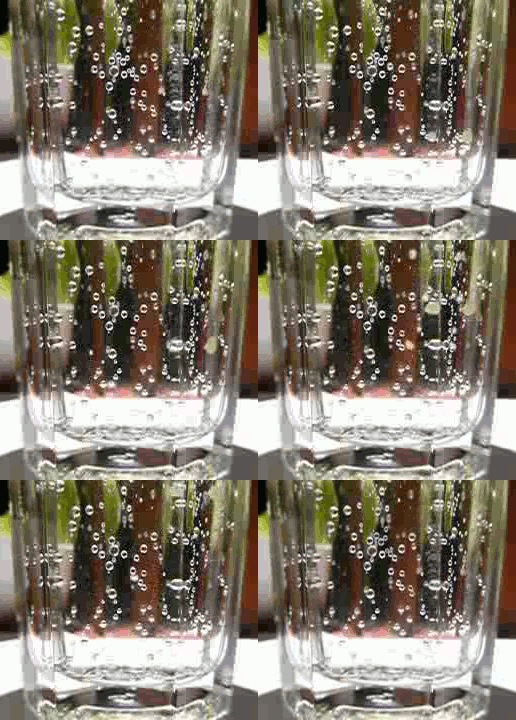
File:Drinking_glass_00118.gif · Wikimedia Commons · See Wikimedia Commons
carbonated water
Sign in to saveAlso known as club soda, soda water, sparkling water, seltzer water, fizzy water, cool water, aerated waters, aerated water
water containing dissolved carbon dioxide gas and intended for drinking
OverviewAI-generated
Carbonated water was discovered or invented in 1767. It is categorized as a carbonated mineral water. According to product data, it contains 0 kcal of energy, 0 grams of fat, 0 grams of carbohydrates, 0 grams of sugars, 0 grams of fiber, and 0 grams of protein. The salt content is 0.11.
The product has a nutriscore of a and a nova classification of 1. There are 13 products listed in this category. A PubMed query for carbonated water yields a count of 1401. The subject is referenced by 616 other encyclopedia articles.
Synthesized by Vinony from 17 facts across 4 sources: Wikidata, PubMed, Openfoodfacts, Vinony graph. Generated from structured data (not the Wikipedia text) and checked against those facts — may still contain errors.
Nutrition · Open Food Facts
Typical values per 100 g · averaged across 13 products
- Energy
- 0 kcal
- Fat
- 0 g
- — of which saturates
- 0 g
- Carbohydrates
- 0 g
- — of which sugars
- 0 g
- Fibre
- 0 g
- Protein
- 0 g
- Salt
- 0.11 g
via Open Food Facts · ODbL
Research
1,401 papers- Can carbonated water support weight loss?BMJ nutrition, prevention & health · 2025Takahashi ADOI: 10.1136/bmjnph-2024-001108
- Carbonated water droplets on a dusty hydrophobic surface.Soft matter · 2020Abubakar AA , Yilbas BS , Al-Qahtani H et al.DOI: 10.1039/d0sm00841a
- Carbonated Waters.JAMA · 2023DOI: 10.1001/jama.2023.11155
- Effects of Carbonated Water Concentration on Swallowing Function in Healthy Adults.Dysphagia · 2022Min HS, Shin H, Yoon CH et al.DOI: 10.1007/s00455-022-10420-w
- Carbonated Beverage, Fruit Drink, and Water Consumption and Risk of Acute Stroke: the INTERSTROKE Case-Control Study.Journal of stroke · 2024Smyth A, Hankey GJ, Damasceno A et al.DOI: 10.5853/jos.2024.01543
- Ingesting carbonated water post-exercise in the heat transiently ameliorates hypotension and enhances mood state.Experimental physiology · 2024Kajiki M, Katagiri A, Matsutake R et al.DOI: 10.1113/EP091925
- Use of Carbonated Water as Kneading in Mortars Made with Recycled Aggregates.Materials (Basel, Switzerland) · 2022Suescum-Morales D, Jiménez JR, Fernández-Rodríguez JMDOI: 10.3390/ma15144876
- Carbonated Water Droplet Can Ease Dust Mitigation from Hydrophobic Surfaces.Langmuir : the ACS journal of surfaces and colloids · 2020Abubakar AA, Yilbas BS, Al-Qahtani H et al.DOI: 10.1021/acs.langmuir.0c01702
via PubMed
Wikidata facts
- Subclass of
- soft drink
- Image
- Drinking glass 00118.gif
Show 6 more facts
- Commons category
- Carbonated water
- topic's main category
- Category:Carbonated water
- time of discovery or invention
- 1767-00-00
- partially coincident with
- bottled water
- described by source
- Encyclopædia Britannica 11th edition
- fabrication method
- carbonation
via Wikidata · CC0
~18 min read
Encyclopedic overview
Carbonated water showing its carbonation, which may be either natural or artificially introduced
Carbonated water is water containing dissolved carbon dioxide gas, either artificially injected under pressure, or occurring due to natural geological processes. Carbonation causes small bubbles to form, giving the water an effervescent quality. Common forms include sparkling natural mineral water, club soda, and commercially produced sparkling water.
Excerpted from Wikipedia’s “carbonated water” article, available under the CC BY-SA 4.0 licence.
Gallery (9)
Available in 68 languages
- Español
- Français
- Deutsch
- 中文
- 日本語
- Русский
- Português
- Italiano
- العربية
- हिन्दी
- Afrikaans
- Albanian
- Armenian
- Asturian
- Azerbaijani
- Bahasa Indonesia
- Basque
- be_x_old
Show 49 more
- Betawi
- Bosnian
- Bulgarian
- Catalan
- Croatian
- Czech
- Danish
- Esperanto
- Estonian
- Finnish
- fiu_vro
- Galician
- Georgian
- Greek
- Hausa
- Hebrew
- Hungarian
- Icelandic
- Ido
- Javanese
- Kannada
- Latvian
- Lithuanian
- Macedonian
- Malay
- Malayalam
- Nederlands
- Northern Frisian
- Norwegian
- Polski
- Romanian
- Serbian
- simple
- Svenska
- Tamil
- Tiếng Việt
- Toki Pona
- Türkçe
- Tuvinian
- Ukrainian
- Uzbek
- Walloon
- Welsh
- Wu Chinese
- Yiddish
- zh_yue
- فارسی
- ไทย
- 한국어
via Wikidata sitelinks · CC0