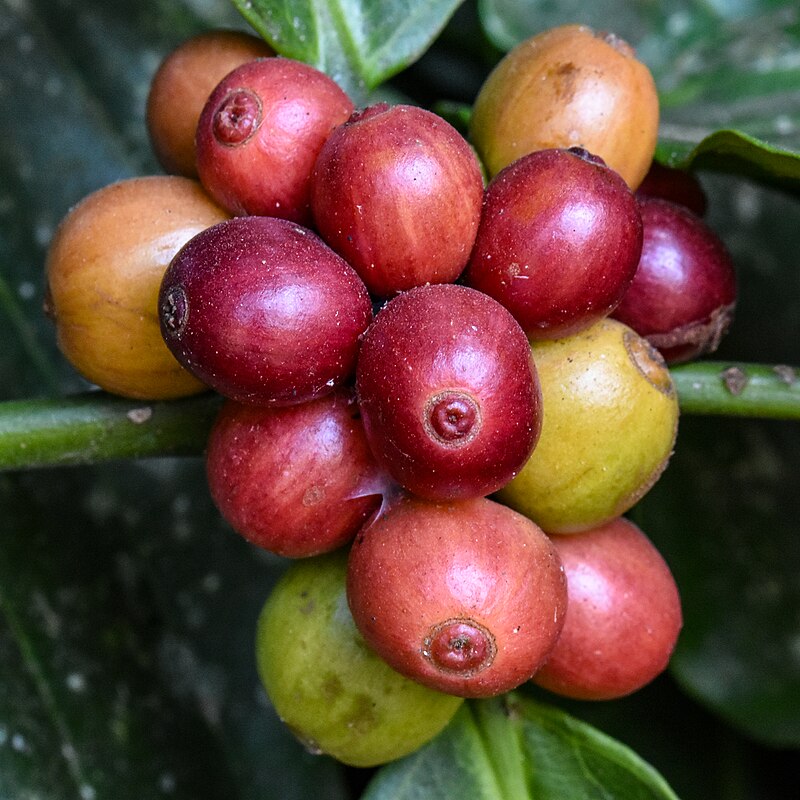
File:Ripe_Seeds_Coffee_Robusta_Coorg_Karnataka_India_Feb24_D72_25688.jpg · Wikimedia Commons · See Wikimedia Commons
Coffea canephora
Sign in to saveAlso known as robusta, robusta coffee, Coffea robusta
species of plant
OverviewAI-generated
Coffea canephora, commonly known as robusta coffee, is a species within the genus Coffea. It belongs to the family Rubiaceae in the order Gentianales. The plant is classified in the class Magnoliopsida, phylum Tracheophyta, and kingdom Plantae. This taxon serves as a source for coffee beans and robusta coffee.
The species has uses as a medicinal plant, food, and psychoactive drug. Its taxon range includes Guangdong. According to the IUCN Red List, Coffea canephora holds a conservation status of Least Concern, a designation recorded in 2017. Occurrence data from various institutions, including INECOL and MNHN, document the species in countries such as Mexico, El Salvador, Honduras, Nouvelle-CaléDonie, and Brasil.
Synthesized by Vinony from 34 facts across 7 sources: Wikidata, GBIF, IUCN Red List, Gbif Occ, Plants of the World, iDigBio, Vinony graph. Generated from structured data (not the Wikipedia text) and checked against those facts — may still contain errors.
Species
Least ConcernSPECIES
- KingdomPlantae
- PhylumTracheophyta
- ClassMagnoliopsida
- OrderGentianales
- FamilyRubiaceae
Kaffeeanbaugebiete der Welt: dunkelgrün (r) sind Länder überwiegender, hellgrün (m) teilweiser Produktion von Robusta, gelblich (a) jene überwiegender Produktion von Arabica Der Robusta-Kaffee oder Tiefland-Kaffee (wissenschaftl. Coffea canephora) ist eine Pflanzenart aus der Gattung Kaffee (Coffea). Sie wurde 1898 im Kongo entdeckt. Laut Schätzungen gibt es Robusta-Kaffee bereits seit ca. 100.000 Jahren. Mittlerweile wird Robusta in vielen Ländern der Welt angebaut, sogar auch außerhalb Afrikas. Ungeröstete Kaffeebohnen
via GBIF · IUCN · Kew POWO
Museum specimens
- Specimen records
- 796
- With media
- 711
- Family
- Rubiaceae
- Collections
- INECOL, CAS, IGL-UNAM, IBUNAM, MNHN, UCR
- Recorded in
- Mexico, El Salvador, Honduras, Nouvelle-CaléDonie, Brasil, Gabon, Congo (Kinshasa), Nigeria
Wikidata facts
- Instance of
- taxon
- Parent taxon
- Coffea
- Image
- Coffea canephora berries.JPG
- Has use
- psychoactive drug
Show 10 more facts
- taxon rank
- species
- taxon name
- Coffea canephora
- Commons category
- Coffea canephora
- Commons gallery
- Coffea canephora
- taxon common name
- 中粒咖啡
- IUCN conservation status
- Least Concern
- sequenced genome URL
- plants.ensembl.org/Coffea_canephora
- short name
- C. canephora
- taxon range
- Guangdong
via Wikidata · CC0
~5 min read
Encyclopedic overview
Field of robusta bushes, Kodagu Flowers close-up Coffea canephora (especially C. canephora subvar. robusta, syn. Coffea robusta, or commonly robusta coffee) is a species of coffee plant that has its origins in central and western sub-Saharan Africa. It is a species of flowering plant in the family Rubiaceae. Though widely known as Coffea robusta, the plant is scientifically identified as Coffea canephora, which has two main varieties, robusta and nganda (nom. illeg.).
Coffea canephora represents between 40% and 45% of global coffee production, with Coffea arabica constituting most of the remainder. There are several differences between the composition of coffee beans from C. arabica and C. canephora. Beans from C. canephora tend to have lower acidity, more bitterness, and a more woody and less fruity flavor compared to C. arabica beans. Most of it is used for instant coffee.
Excerpted from Wikipedia’s “Coffea canephora” article, available under the CC BY-SA 4.0 licence.