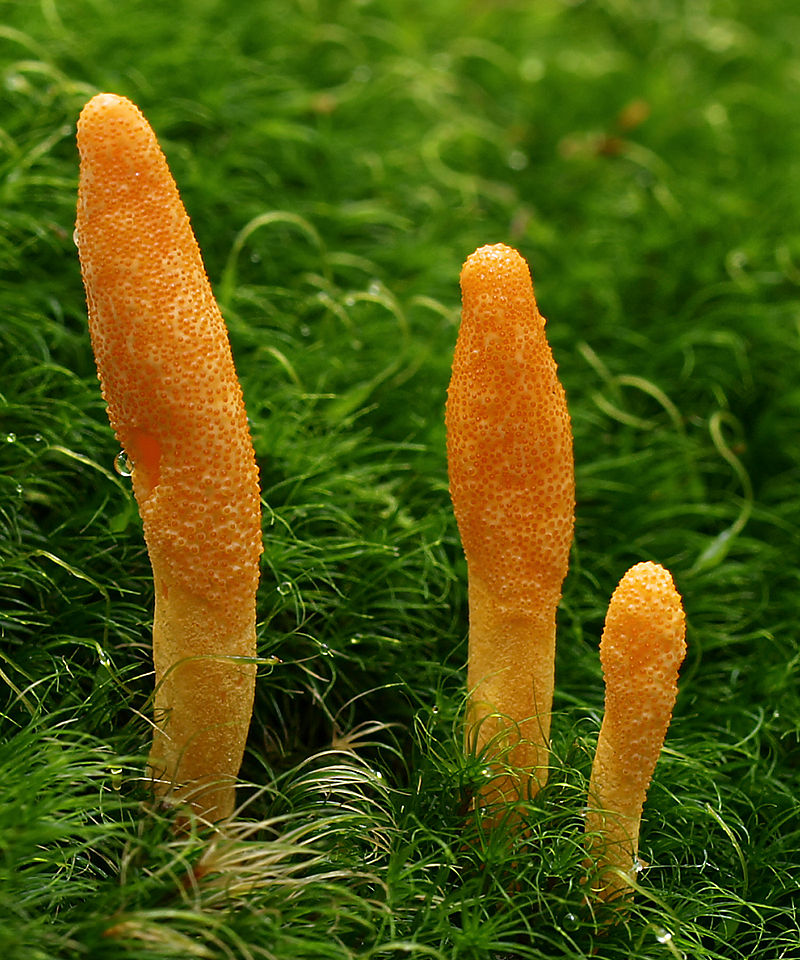
File:2010-08-06_Cordyceps_militaris_1.jpg · Wikimedia Commons · See Wikimedia Commons
Cordyceps
Sign in to saveCordyceps is a genus of ascomycete fungi (sac fungi) that includes over 260 species worldwide, many of which are parasitic. Diverse variants of cordyceps have had more than 1,500 years of use in Chinese medicine. Most Cordyceps species are endoparasitoids, parasitic mainly on insects and other arthropods (they are thus entomopathogenic fungi); a few are parasitic on other fungi.
OverviewAI-generated
Cordyceps is a genus of fungi within the kingdom Fungi. It belongs to the phylum Ascomycota, class Sordariomycetes, order Hypocreales, and family Cordycipitaceae. The taxon was described by Fr. in 1818 and holds an accepted status. One species within this group is commonly known as the Scarlet Caterpillar Club.
Records for Cordyceps have been documented in Mexico, the United States, Brasil, and Australia. These records are held by institutions including ECOSUR, NCU, LSUM, INSTITUTO NACIONAL DE PESQUISAS DA AMAZÔNIA (INPA), and UFRGS. The genus has been the subject of 2862 PubMed entries and has 4408 occurrence records in GBIF. Additionally, iNaturalist lists 2979 observations for the species, while iDigBio contains 826 records and 259 media items.
Synthesized by Vinony from 31 facts across 8 sources: Wikidata, GBIF, iNaturalist, PubMed, Gbif Occ, WoRMS, iDigBio, Vinony graph. Generated from structured data (not the Wikipedia text) and checked against those facts — may still contain errors.
Species
Scarlet Caterpillar Club
GENUS
- KingdomFungi
- PhylumAscomycota
- ClassSordariomycetes
- OrderHypocreales
- FamilyCordycipitaceae
Cordyceps /ˈkɔːrdɪsɛps/ is a genus of ascomycete fungi (sac fungi) that includes about 600 worldwide species. Diverse variants of cordyceps have had more than 1,500 years of use in Chinese medicine. Most Cordyceps species are endoparasitoids, parasitic mainly on insects and other arthropods (they are thus entomopathogenic fungi); a few are parasitic on other fungi. The generic name Cordyceps is derived from the Ancient Greek word κορδύλη kordýlē, meaning "club", and the Latin suffix -ceps, meaning "-headed". Currently, the genus has a worldwide distribution and most of the approximately 600 species that have been described are from Asia (notably Nepal, China, Japan, Bhutan, Korea, Vietnam, and Thailand).
via GBIF
Museum specimens
- Specimen records
- 826
- With media
- 259
- Family
- Cordycipitaceae
- Collections
- ECOSUR, NCU, LSUM, INSTITUTO NACIONAL DE PESQUISAS DA AMAZÔNIA (INPA), UFRGS, DUKE
- Recorded in
- Mexico, United States, Brasil, Australia
Research
2,862 papers- Cordyceps Polysaccharides: A Review of Their Immunomodulatory Effects.Molecules (Basel, Switzerland) · 2024
- Cordyceps as potential therapeutic agents for atherosclerosis.Journal of integrative medicine · 2024
- Cordyceps militaris: A novel mushroom platform for metabolic engineering.Biotechnology advances · 2024
- Extracellular polysaccharide biosynthesis in Cordyceps.Critical reviews in microbiology · 2020
- Chinese Cordyceps: Bioactive Components, Antitumor Effects and Underlying Mechanism-A Review.Molecules (Basel, Switzerland) · 2022
via PubMed
Wikidata facts
- Instance of
- taxon
- Parent taxon
- Cordycipitaceae
- Image
- 2010-08-06 Cordyceps militaris 1.jpg
Show 6 more facts
- taxon rank
- genus
- taxon name
- Cordyceps
- topic's main category
- Category:Cordyceps
- taxonomic type
- Cordyceps militaris
- Commons category
- Cordyceps
- taxon author citation
- Fr.
via Wikidata · CC0
~6 min read
Encyclopedic overview
11 sectionsContents
- Taxonomy
- Splits
- Selected species
- Anamorphic genera
- Biology
- Research
- Uses
- Cultural representations
- Gallery
- See also
- References
Cordyceps is a genus of ascomycete fungi (sac fungi) that includes over 260 species worldwide, many of which are parasitic. Diverse variants of cordyceps have had more than 1,500 years of use in Chinese medicine. Most Cordyceps species are endoparasitoids, parasitic mainly on insects and other arthropods (they are thus entomopathogenic fungi); a few are parasitic on other fungi.
The generic name Cordyceps is derived from the ancient Greek κορδύλη kordýlē, meaning "club", and the Latin -ceps, derived from Latin caput, meaning "head". The genus has a worldwide distribution, with most of the known species being from Asia.
Excerpted from Wikipedia’s “Cordyceps” article, available under the CC BY-SA 4.0 licence.
Gallery (13)
Available in 36 languages
- Español
- Français
- Deutsch
- 中文
- 日本語
- Русский
- Português
- Italiano
- العربية
- Armenian
- Bahasa Indonesia
- Belarusian
- Bulgarian
- Catalan
- Cebuano
- Central Kurdish
- Egyptian Arabic
- Estonian
Show 17 more
via Wikidata sitelinks · CC0