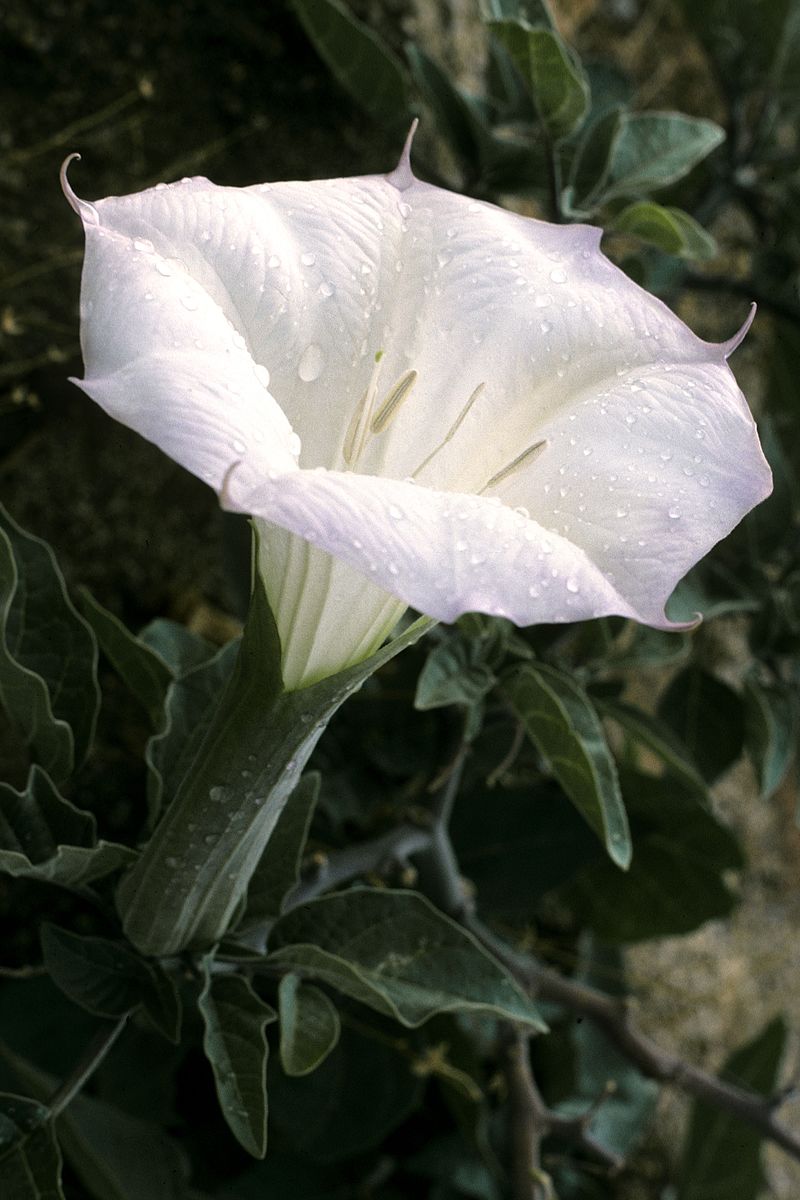
File:Sacred_datura_(Datura_wrightii)_(14212557338).jpg · Wikimedia Commons · See Wikimedia Commons
Datura
Sign in to saveDatura is a genus of nine species of highly poisonous, vespertine-flowering plants belonging to the nightshade family (Solanaceae). They are commonly known as thornapples or jimsonweeds, but are also known as '''devil's trumpets or mad apple''' (not to be confused with angel's trumpets, which are placed in the closely related genus Brugmansia). Other English common names include moonflower, '''devil's weed, and hell's bells'. All species of Datura'' are extremely poisonous and psychoactive, especially their seeds and flowers, which can cause respiratory depression, arrhythmias, fever, delirium
OverviewAI-generated
Datura is a genus of plants within the family Solanaceae. It belongs to the order Solanales, class Magnoliopsida, and phylum Tracheophyta in the kingdom Plantae. The genus was described by Linnaeus in 1753 and has an accepted taxonomic status. Its common names include jimsonweed, 曼陀罗属, and kristavec. The type species for the genus is Datura stramonium.
The genus comprises 15 species primarily distributed in tropical and subtropical regions. All Old World Daturas are collectively known as the Thorn. The fruit type for this genus is a capsule.
Records of Datura have been documented in Mexico and the United States, with specimens held by institutions such as CIBNOR, INECOL, IBUNAM, FC-UNAM, and GH. These records include 769 entries and 390 media files.
Synthesized by Vinony from 41 facts across 9 sources: Wikidata, GBIF, Encyclopedia of Life, PubMed, Gbif Occ, Plants of the World, iDigBio, WoRMS, Vinony graph. Generated from structured data (not the Wikipedia text) and checked against those facts — may still contain errors.
Species
Datura
GENUS
- KingdomPlantae
- PhylumTracheophyta
- ClassMagnoliopsida
- OrderSolanales
- FamilySolanaceae
曼陀罗属(学名:Datura)是茄科下的一个属。该属共有15种,主要分布于热带和亚热带地区。
via GBIF · Kew POWO
Museum specimens
- Specimen records
- 769
- With media
- 390
- Family
- Solanaceae
- Collections
- CIBNOR, INECOL, IBUNAM, FC-UNAM, GH, UNICACH
- Recorded in
- Mexico, United States
Research
2,057 papers- Datura metel: A Review on Chemical Constituents, Traditional Uses and Pharmacological Activities.ReviewCurrent pharmaceutical design · 2021Alam W, Khan H, Khan SA et al.DOI: 10.2174/1381612826666200519113752
- Datura fruit poisoning.The Medical journal of Malaysia · 2018Chung WM, Chian YY, Azmir A
- Efficacy of extracts from Datura Metel L. for Psoriasis: a meta-analysis of case series and single-arm studies.BMC complementary medicine and therapies · 2023Sang X, Bi H, Si X et al.DOI: 10.1186/s12906-023-04159-6
- Datura intoxication in an adolescent male: A challenge in the Internet era.ReviewJournal of paediatrics and child health · 2018Beynon SJ, Chaturvedi SDOI: 10.1111/jpc.13726
- Alkaloids of the Genus Datura: Review of a Rich Resource for Natural Product Discovery.ReviewMolecules (Basel, Switzerland) · 2021Cinelli MA, Jones ADDOI: 10.3390/molecules26092629
- Anti-nutritional factors of Datura in feedstuffs.ReviewNatural toxins · 1995Piva G, Piva ADOI: 10.1002/nt.2620030413
- [Datura stramonium poisoning].Anales espanoles de pediatria · 2000Castañón López L, Martínez Badás JP, Lapeña López De Armentia S et al.
- The genus Datura L. (Solanaceae) in Mexico and Spain - Ethnobotanical perspective at the interface of medical and illicit uses.ReviewJournal of ethnopharmacology · 2018Benítez G, March-Salas M, Villa-Kamel A et al.DOI: 10.1016/j.jep.2018.03.007
via PubMed
Wikidata facts
- Instance of
- taxon
- Parent taxon
- Solanaceae
- Image
- Datura stramonium flower01.jpg
Show 9 more facts
- Commons category
- Datura
- taxon name
- Datura
- taxon rank
- genus
- topic's main category
- Category:Datura
- Commons gallery
- Datura
- taxon common name
- kristavec
- has fruit type
- capsule
- taxonomic type
- Datura stramonium
via Wikidata · CC0
~20 min read
Encyclopedic overview
14 sectionsContents
- Etymology
- Description
- Species and cultivars
- Past classified species
- Cultivation
- Toxicity
- Effects of ingestion
- Treatment
- Psychoactive use
- Gallery
- See also
- References
- External links
- Further reading
Datura is a genus of nine species of highly poisonous, vespertine-flowering plants belonging to the nightshade family (Solanaceae). They are commonly known as thornapples or jimsonweeds, but are also known as '''devil's trumpets or mad apple''' (not to be confused with angel's trumpets, which are placed in the closely related genus Brugmansia). Other English common names include moonflower, '''devil's weed, and hell's bells'. All species of Datura are extremely poisonous and psychoactive, especially their seeds and flowers, which can cause respiratory depression, arrhythmias, fever, delirium, hallucinations, anticholinergic toxidrome, psychosis, and death, if taken internally.
The name Datura originates from the Hindi and Sanskrit words for "thorn-apple," with historical and cultural significance in Ayurveda and Hinduism, while the American term "jimsonweed" derives from its prevalence in Jamestown, Virginia, where it was called "Jamestown-Weed." Datura species are herbaceous annual or short-lived perennial plants up to 2 meters tall with trumpet-shaped flowers and spiny fruit capsules, historically used in traditional medicine, especially in India, where they hold cultural and ritual significance. Datura species classification is complex due to high variability and overlapping traits among species, with many "new species" later reclassified as local varieties or subspecies; most species are native to Mexico, though some have disputed native ranges outside the Americas. Datura is closely related to Brugmansia and the recently established Trompettia.
Excerpted from Wikipedia’s “Datura” article, available under the CC BY-SA 4.0 licence.
Gallery (41)
Available in 71 languages
- Español
- Français
- Deutsch
- 中文
- 日本語
- Русский
- Português
- Italiano
- العربية
- हिन्दी
- Albanian
- Armenian
- Azerbaijani
- Bahasa Indonesia
- Basque
- Belarusian
- Bikol
- Bosnian
Show 52 more
- Bulgarian
- Burmese
- Catalan
- Cebuano
- Central Kurdish
- Chuvash
- Croatian
- Czech
- Danish
- Egyptian Arabic
- Erzya
- Esperanto
- Finnish
- Georgian
- Greek
- Hebrew
- Hungarian
- Ido
- Kashmiri
- Kashubian
- Kazakh
- Kyrgyz
- Latin
- Latvian
- Lithuanian
- Lombard
- Malagasy
- Malay
- Malayalam
- Mingrelian
- Nederlands
- Northern Frisian
- Norwegian
- Ossetic
- Pashto
- Polski
- Punjabi
- Romanian
- Santali
- simple
- Sindhi
- Svenska
- Tamil
- Telugu
- Türkçe
- Udmurt
- Ukrainian
- Urdu
- Waray
- Western Panjabi
- فارسی
- 한국어
via Wikidata sitelinks · CC0