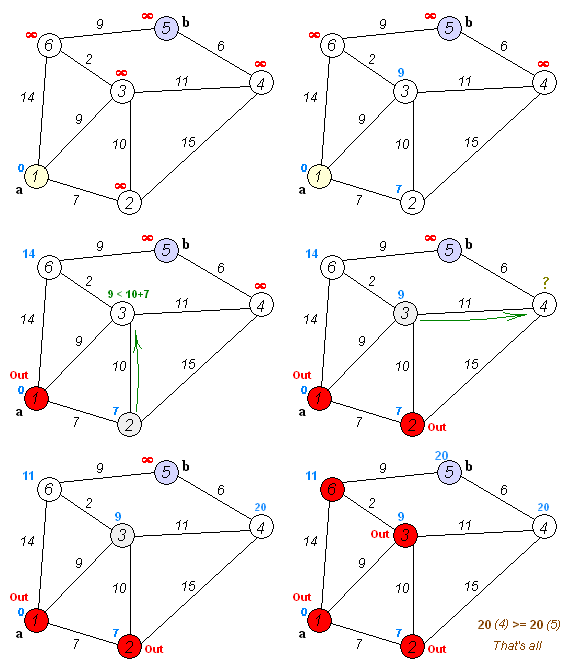
File:Dijkstra_Animation.gif · Wikimedia Commons · See Wikimedia Commons
Dijkstra's algorithm is a method for finding the shortest path between points in a network or graph by systematically exploring nearby connections and gradually expanding outward. It matters because it's widely used in real-world applications like GPS navigation, network routing, and mapping services where finding efficient routes quickly is important.
AI-generated from the Wikipedia summary — may contain errors.
Key facts
- Class
- Search algorithm , Greedy algorithm , Dynamic programming
- Data structure
- Graph , Usually used with priority queue or heap for optimization
- Worst case performance
- Θ ( | E | + | V | log | V | ) {\displaystyle \Theta (|E|+|V|\log |V|)}
via Wikipedia infobox
Wikidata facts
- Image
- Dijkstra Animation.gif
Show 4 more facts
- Commons category
- Dijkstra's algorithm
- Stack Exchange tag
- stackoverflow.com/tags/dijkstra
- Commons gallery
- Dijkstra's algorithm
- time of discovery or invention
- 1959-00-00
via Wikidata · CC0
~34 min read
Article
Dijkstra's algorithm (/ˈdaɪk.strəz/, DYKE-strəz) is an algorithm for finding the shortest paths between nodes in a weighted graph, which may represent, for example, a road network. It was conceived by computer scientist Edsger W. Dijkstra in 1956 and published three years later.
Dijkstra's algorithm finds the shortest path from a given source node to every other node. It can be used to find the shortest path to a specific destination node, by terminating the algorithm after determining the shortest path to that node. For example, if the nodes of the graph represent cities, and the costs of edges represent the distances between pairs of cities connected by a direct road, then Dijkstra's algorithm can be used to find the shortest route between one city and all other cities. A common application of shortest path algorithms is network routing protocols, most notably IS-IS (Intermediate System to Intermediate System) and OSPF (Open Shortest Path First). It is also employed as a subroutine in algorithms such as Johnson's algorithm.