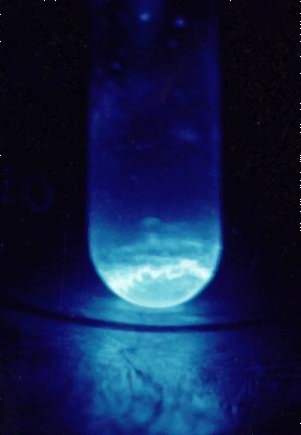
File:Einsteinium.jpg · Wikimedia Commons · See Wikimedia Commons
OverviewAI-generated
Einsteinium is a chemical element with the symbol Es and atomic number 99. Its chemical formula is Es, and it is represented by the Unicode character 鑀. The canonical SMILES notation for the element is [Es].
The element was discovered in 1952. It has an electronegativity of 1.3 and a molecular weight of 252.0830. According to IUPAC nomenclature, the name is einsteinium. The substance has a charge of 0, with zero hydrogen bond donors and acceptors, and a topological polar surface area of 0.
Synthesized by Vinony from 21 facts across 4 sources: Wikidata, PubChem, PubMed, Vinony graph. Generated from structured data (not the Wikipedia text) and checked against those facts — may still contain errors.
Chemical data
- Formula
- Es
- Molecular weight
- 252.083 g/mol
- IUPAC name
- einsteinium
- SMILES
- [Es]
- InChIKey
- CKBRQZNRCSJHFT-UHFFFAOYSA-N
- Polar surface area
- 0 Ų
- H-bond donors
- 0
- H-bond acceptors
- 0
- Formal charge
- 0
via PubChem
Research
29 papers- The blue hue of einsteinium.Nature chemistry · 2021Natrajan LS, Faulkner SDOI: 10.1038/s41557-021-00693-3
- Einsteinium declassified.Nature chemistry · 2016Redfern JDOI: 10.1038/nchem.2676
- Mysterious einsteinium spills its secrets.Nature · 2021Bundell S, Petrić Howe NDOI: 10.1038/d41586-021-00306-6
- Structural and spectroscopic characterization of an einsteinium complex.Nature · 2021Carter KP, Shield KM, Smith KF et al.DOI: 10.1038/s41586-020-03179-3
- Daily briefing: Einsteinium illuminates the edge of the periodic table.Nature · 2021Graham FDOI: 10.1038/d41586-021-00344-0
- Publisher Correction: The blue hue of einsteinium.Nature chemistry · 2021Natrajan LS, Faulkner SDOI: 10.1038/s41557-021-00743-w
- Extending deterministic transport capabilities for very-high and ultra-high energy electron beams.Scientific reports · 2024Naceur A, Bienvenue C, Romano P et al.DOI: 10.1038/s41598-023-51143-8
- Feasibility of a multigroup Boltzmann-Fokker-Planck solution for electron beam dose calculations.Scientific reports · 2023Naceur A, Hébert A, Romano P et al.DOI: 10.1038/s41598-023-27376-y
via PubMed
Wikidata facts
- Instance of
- synthetic element
- Part of
- actinide
- Named after
- Albert Einstein
- Image
- Einsteinium.jpg
Show 15 more facts
- maintained by WikiProject
- WikiProject Elements
- element symbol
- Es
- Commons category
- Einsteinium
- discoverer or inventor
- Glenn T. Seaborg
- time of discovery or invention
- 1952-01-01
- topic's main category
- Category:Einsteinium
- atomic number
- 99
- Commons gallery
- Einsteinium
- described by source
- Armenian Soviet Encyclopedia
- Unicode character
- 鑀
- canonical SMILES
- [Es]
- chemical formula
- Es
- electronegativity
- 1.3
- on focus list of Wikimedia project
- Wikipedia:Vital articles/Level/4
- topic has template
- Template:Infobox einsteinium
via Wikidata · CC0
Gallery (27)
Available in 133 languages
- Español
- Français
- Deutsch
- 中文
- 日本語
- Русский
- Português
- Italiano
- العربية
- हिन्दी
- Afrikaans
- Albanian
- Amharic
- Angika
- Armenian
- Asturian
- Azerbaijani
- Bahasa Indonesia
Show 114 more
- Balinese
- Bangla
- Basque
- be_x_old
- Belarusian
- Bhojpuri
- Bikol
- Bosnian
- Breton
- Bulgarian
- Burmese
- Catalan
- cdo
- Cebuano
- Central Kurdish
- Chuvash
- Cornish
- Corsican
- Croatian
- Czech
- Danish
- Egyptian Arabic
- Esperanto
- Estonian
- Faroese
- Fiji Hindi
- Filipino
- Finnish
- Friulian
- Galician
- Georgian
- Greek
- Gujarati
- Haitian Creole
- Hakka Chinese
- Hebrew
- Hungarian
- Icelandic
- Ido
- Interlingua
- Irish
- Javanese
- Kalmyk
- Kannada
- Kazakh
- kbp
- Komi
- Kyrgyz
- Latin
- Latvian
- Ligurian
- Limburgish
- Lithuanian
- Lojban
- Luxembourgish
- Macedonian
- Malay
- Malayalam
- Manx
- Marathi
- Mongolian
- Moroccan Arabic
- Nederlands
- Newari
- Northern Frisian
- Norwegian
- Norwegian Nynorsk
- Novial
- Odia
- olo
- Pashto
- Piedmontese
- Polski
- Quechua
- roa_rup
- Romanian
- Sanskrit
- Sardinian
- Saterland Frisian
- Scottish Gaelic
- Serbian
- Serbian (Latin)
- Sicilian
- simple
- Slovak
- Slovenian
- Svenska
- Swahili
- Tajik
- Tamil
- Tatar
- Telugu
- Tiếng Việt
- Türkçe
- Ukrainian
- Urdu
- Uyghur
- Uzbek
- Venetian
- Veps
- Waray
- Welsh
- Western Mari
- Western Panjabi
- Wu Chinese
- Yakut
- Yoruba
- zh_classical
- zh_min_nan
- zh_yue
- Zulu
- فارسی
- ไทย
- 한국어
via Wikidata sitelinks · CC0