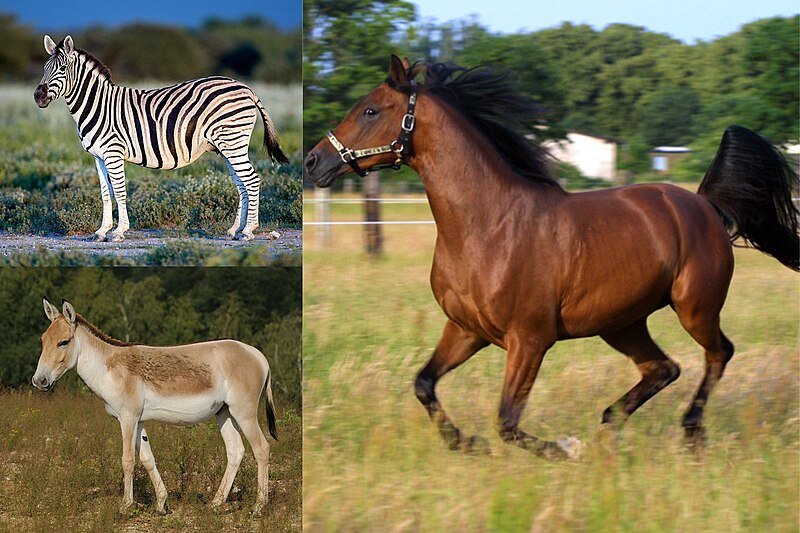
File:Equus_species.jpg · Wikimedia Commons · See Wikimedia Commons
OverviewAI-generated
Equus is a taxon of the genus rank within the family Equidae and the order Perissodactyla. It belongs to the class Mammalia, phylum Chordata, and kingdom Animalia. The genus was described by Linnaeus in 1758 and is currently accepted as a valid taxon. Its parent taxa include Equini and Equidae.
The genus originated about 5 million years ago. Records of the taxon are held by institutions including NHMUK, USNM, UTEP, and SDNHM, with occurrences documented in the United Kingdom and the United States. The taxon has been described in sources such as the Brockhaus and Efron Encyclopedic Dictionary and the Jewish Encyclopedia of Brockhaus and Efron.
Synthesized by Vinony from 40 facts across 7 sources: Wikidata, GBIF, iNaturalist, Gbif Occ, iDigBio, WoRMS, Vinony graph. Generated from structured data (not the Wikipedia text) and checked against those facts — may still contain errors.
Species
Domestic Horse
Equus
GENUS
- KingdomAnimalia
- PhylumChordata
- ClassMammalia
- OrderPerissodactyla
- FamilyEquidae
马属(学名:Equus)是奇蹄目马科中仅存的唯一属,也是现存奇蹄目动物中种类最多,分布最广,人们最熟悉的。马属分布于欧亚大陆和非洲,成员包括马、驴和斑马,曾存在着约22种,现仅存8种(家马和家驴分别被归类为野马和非洲野驴的亚种)大多数野生种都处于濒危状态。 分类 马亚属 E. (Equus) 野马 E. ferus 欧洲野马 E. f. ferus † 普氏野马 E. f. przewalskii 马 E. f. caballus 驴亚属 E. (Asinus) 非洲野驴 E. africanus 努比亚野驴 E. a. africanus 北非野驴 E. a. atlanticus † 索马里野驴 E. a. somalicus 家驴 E. a. asinus 亚洲野驴 E. hemionus 蒙古野驴 E. h. hemionus 叙利亚野驴 E. h. hemippus † 戈壁野驴 E. h. luteus 土库曼野驴 E. h. kulan 波斯野驴 E. h. onager 印度野驴 E. h. khur 西藏野驴 E. kiang 西藏野驴 西部亚种 E. k. kiang 东部亚种 E. k. holdereri 南部亚种 E. k. polyodon 北部亚种 E. k. chu 欧洲野驴 E. hydruntinus † 康氏野驴 E. cumminsii † 长脚野驴 E. calobatus † 矮野驴 E. tau † 育空野驴 E. lambei † 细纹斑马亚属 E. (Dolichohippus) 细纹斑马 E. grevyi 斑马亚属 E. (Hippotigris) 普通斑马 E. quagga 斑驴 E. q. quagga † 布氏斑马 E. q. burchellii 格兰特氏斑马 E. q. boehmi 社氏斑马 E. q. borensis 辑氏斑马 E. q. chapmani 克氏斑马 E. q. crawshayi 山斑马 E. zebra 哈氏山斑马 (E. z. hartmannae) 海角山斑马 (E. z. zebra) 美洲马亚属 E. (Amerhippus) † 史氏马 E. scotti † Equus niobrarensis † 墨西哥马 E. conversidens † 木氏马亚属 E. (Parastylidequus) † 木氏马 E. parastylidens † 地位未定 克文马 E. simplicidens † (可能是细纹斑马的近亲) Equus occidentalis Equus complicatus Equus fraternus Equus excelsus Equus giganteus 巨马种族群 巨马 E. giganteus Equus pacif
via GBIF
Museum specimens
- Specimen records
- 32,522
- With media
- 7,236
- Family
- Equidae
- Collections
- NHMUK, USNM, UTEP, SDNHM
- Recorded in
- United Kingdom, United States
Wikidata facts
Show 8 more facts
- taxon rank
- genus
- taxon name
- Equus
- Commons category
- Equus
- topic's main category
- Category:Equus (genus)
- Commons gallery
- Equus
- described by source
- Brockhaus and Efron Encyclopedic Dictionary
- start time
- 5330000-00
- taxon author citation
- Linnaeus, 1758
via Wikidata · CC0
~23 min read
Encyclopedic overview
Equus (/ˈɛkwəs, ˈiːkwəs/) is a genus of mammals in the perissodactyl family Equidae, which includes horses, asses, and zebras. Within the Equidae, Equus is the only recognized extant genus, comprising seven living species. Like Equidae more broadly, Equus has numerous extinct species known only from fossils. The genus originated in North America and dispersed into the Old World and South America during the Early and Middle Pleistocene. Equines are odd-toed ungulates with slender legs, long heads, relatively long necks, manes (erect in most subspecies), and long tails. All species are herbivorous, and mostly grazers, with simpler digestive systems than ruminants but able to subsist on lower-quality vegetation.
While the domestic horse and donkey (along with their feral descendants) exist worldwide, wild equine populations are limited to Africa and Asia. Wild equine social systems are in two forms; a harem system with tight-knit groups consisting of one adult male or stallion/jackass, several females or mares/jennets, and their young or foals; and a territorial system where males establish territories with resources that attract females, which associate very fluidly. In both systems, females take care of their offspring, but males may play a role as well. Equines communicate with each other both visually and vocally. Human activities have threatened wild equine populations.
Excerpted from Wikipedia’s “Equus” article, available under the CC BY-SA 4.0 licence.
Gallery (15)
Available in 80 languages
- Español
- Français
- Deutsch
- 中文
- 日本語
- Русский
- Português
- Italiano
- العربية
- Albanian
- Aragonese
- Asturian
- azb
- Azerbaijani
- Bahasa Indonesia
- Balinese
- Basque
- Breton
Show 61 more
- Bulgarian
- Catalan
- Cebuano
- Chechen
- Chuvash
- Croatian
- Czech
- Danish
- Egyptian Arabic
- Esperanto
- Estonian
- Filipino
- Galician
- Georgian
- Guarani
- Hebrew
- Ingush
- Interlingua
- Javanese
- Kashmiri
- Kazakh
- Kotava
- Kurdish
- Latin
- Latvian
- Lezghian
- Ligurian
- Limburgish
- Luxembourgish
- Malay
- Minangkabau
- Mingrelian
- Navajo
- Nederlands
- Northern Frisian
- Norwegian
- Ossetic
- Polski
- Romanian
- Scots
- Serbian
- simple
- Slovak
- Svenska
- Talysh
- Tamil
- Tatar
- Tiếng Việt
- Turkmen
- Tuvinian
- Ukrainian
- Urdu
- Waray
- Welsh
- West Flemish
- Wu Chinese
- Yakut
- zh_yue
- فارسی
- ไทย
- 한국어
via Wikidata sitelinks · CC0