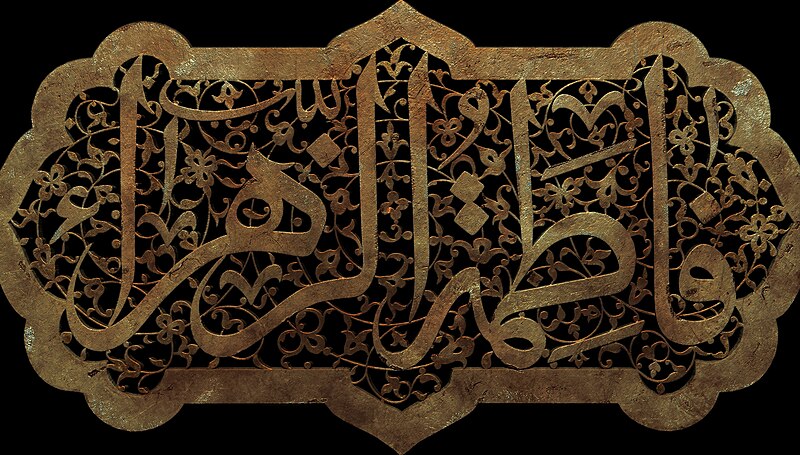
File:FatimaalZahra_(cropped).jpg · Wikimedia Commons · See Wikimedia Commons
Fatima
Sign in to saveAlso known as Zahra, Fatimah, Fatimah bint Muhammad, Fatima bint Muhammad, Fatima Zahra
Fatima bint Muhammad (; 605/15–632 CE), commonly known as Fatima al-Zahra (), was the daughter of the Islamic prophet Muhammad and his wife Khadija. Fatima's husband was Ali, the fourth of the Rashidun caliphs and the first Shia imam. Fatima's sons were Hasan and Husayn, the second and third Shia imams, respectively. Fatima has been compared to Mary, mother of Jesus, especially in Shia Islam. Muhammad is said to have regarded her as the best of women and the dearest person to him. She is often viewed as an ultimate archetype for Muslim women and an example of compassion, generosity, and enduri
OverviewAI-generated
Fatima was a female human born in Mecca and died in Medina. She was a citizen of the Rashidun Caliphate and practiced Islam. Her father was Muhammad and her mother was Khadija bint Khuwaylid. She was married to Alī ibn Abī Ṭālib. She had four children: Umm Kulthum bint Ali, Zaynab bint Ali, Mohsin ibn Ali, and Hasan ibn Ali. She was also the sister of Umm Kulthum bint Muhammad, Ruqayya bint Muhammad, Zainab bint Muhammad, and Ibrahim ibn Muhammad.
Fatima was a poet who spoke and wrote Arabic. Her name in her native language is written as فاطِمَةُ بِنْتُ مُحَمَّدٍ and فَاطِمَةُ الزَّهْرَاء. She is part of the companions of the Prophet and the Ahl al-Bayt. She is buried at Al-Baqi'. She is described by sources including the Brockhaus and Efron Encyclopedic Dictionary and The Nuttall Encyclopædia.
Synthesized by Vinony from 23 facts across 2 sources: Wikidata, Open Library. Generated from structured data (not the Wikipedia text) and checked against those facts — may still contain errors.
Person · Open Library
- Works
- 29
Top works
- Hummingbird Coloring Book
- Geometric Pattern Adult Coloring Book
- 100 Countryside Scenes
- Butterflies Coloring Book for Adults
- Farm Life Coloring Book
via Open Library + Wikidata
Key facts
- Person.name
- Fatima
- Person.honorific_suffix
- al-Zahra
- Person.image
- FatimaalZahra (cropped).jpg
- Person.caption
- Artwork with Fatima's name, reconstruction from a Safavid piece
- Person.birth_date
- 605 or 612/15
- Person.birth_place
- Mecca, Hejaz, Arabia
- Person.death_date
- 632
- Person.death_place
- Medina, Rashidun Caliphate
- Person.resting_place
- Medina, Hejaz
- Person.spouse
- Ali
- Person.children
- Hasan Husayn Zaynab Umm Kulthum Muhsin
- Person.relatives
- Umm Kulthum (sister) Zainab (sister) Ruqayya (sister)
- Person.family
- House of Muhammad
via Wikipedia infobox
Wikidata facts
- Instance of
- human
- Part of
- Ahl al-Bayt
- Given name
- Fatima
- Gender
- female
- Citizenship
- Rashidun Caliphate
- Place of birth
- Mecca
- Place of death
- Medina
- Spouse
- Alī ibn Abī Ṭālib
- Child
- Husayn ibn Ali
- Father
- Muhammad
- Mother
- Khadija bint Khuwaylid
- Sibling
- Ibrahim ibn Muhammad
- Occupation
- poet
- Languages spoken
- Arabic
- Native language
- Arabic
- Religion
- Islam
- Family
- Banu Hashim
- Image
- Paris, BnF, Supplément Persan 1030 fol. 467v cropped Fatima.jpg
- Number of children
- 4
Show 9 more facts
- topic's main category
- Category:Fatima
- date of death
- 0633-00-00
- name in native language
- فَاطِمَةُ الزَّهْرَاء
- Commons category
- Fatima
- place of burial
- Al-Baqi'
- on focus list of Wikimedia project
- Wikipedia:Vital articles/Level/4
- P12749
- William Eagle Clarke
- date of birth
- 0606-00-00
via Wikidata · CC0
~42 min read
Encyclopedic overview
38 sectionsContents
- Name and titles
- Fatima
- {{Transliteration|ar|Kunya}}s
- Early life
- Marriage
- Significance
- Appearance
- Events after Muhammad's death
- Inheritance
- Sermon of Fadak
- Views
- Alleged attack on her house
- Use of violence
- Death
- Burial
- Descendants
- In the Quran and hadith texts
- Verse of mubahala
- Verse of purification
- Verse of mawadda
- Verses 76:5–22
- Connection with Mary
- Verse of Light
- Hadith literature
- In modern culture
- Mother's Day in Iran
- See also
- Citations
- References
- Books
- Encyclopedias
- Journal articles
- Theses
- Further reading
- Books
- Shia sources
- Sunni primary sources
- External links
Fatima bint Muhammad (; 605/15–632 CE), commonly known as Fatima al-Zahra (), was the daughter of the Islamic prophet Muhammad and his wife Khadija. Fatima's husband was Ali, the fourth of the Rashidun caliphs and the first Shia imam. Fatima's sons were Hasan and Husayn, the second and third Shia imams, respectively. Fatima has been compared to Mary, mother of Jesus, especially in Shia Islam. Muhammad is said to have regarded her as the best of women and the dearest person to him. She is often viewed as an ultimate archetype for Muslim women and an example of compassion, generosity, and enduring suffering. It is through Fatima that Muhammad's family line has survived to this date. Her name and her epithets remain popular choices for Muslim girls.
When Muhammad died in 632, Fatima and her husband Ali refused to acknowledge the authority of the first caliph, Abu Bakr. The couple and their supporters held that Ali was the rightful successor of Muhammad, possibly referring to his announcement at the Ghadir Khumm. Controversy surrounds Fatima's death within six months of Muhammad's. Sunni Islam holds that Fatima died from grief. In Shia Islam, however, Fatima's miscarriage and death are said to have been the direct result of her injuries during a raid on her house to subdue Ali, ordered by Abu Bakr. It is believed that Fatima's dying wish was that the caliph should not attend her funeral. She was buried secretly at night and her exact burial place remains uncertain.
Excerpted from Wikipedia’s “Fatima” article, available under the CC BY-SA 4.0 licence.
Gallery (19)
Available in 93 languages
- Español
- Français
- Deutsch
- 中文
- 日本語
- Русский
- Português
- Italiano
- العربية
- हिन्दी
- Achinese
- Afrikaans
- Albanian
- Armenian
- Assamese
- Asturian
- Avaric
- azb
Show 74 more
- Azerbaijani
- Bahasa Indonesia
- Bangla
- Bashkir
- Basque
- Belarusian
- Bosnian
- Bulgarian
- Catalan
- Central Kurdish
- Chechen
- Czech
- Danish
- Egyptian Arabic
- Esperanto
- Filipino
- Finnish
- Fula
- Galician
- Georgian
- Greek
- Hausa
- Hebrew
- Hungarian
- Icelandic
- Irish
- Javanese
- Kashmiri
- Kazakh
- Khmer
- Kurdish
- Latin
- Latvian
- Lithuanian
- Madurese
- Malagasy
- Malay
- Malayalam
- Nederlands
- Norwegian
- Polski
- Romanian
- Scots
- Serbian
- Serbian (Latin)
- Sicilian
- simple
- Sindhi
- Somali
- Standard Moroccan Tamazight
- Sundanese
- Svenska
- Swahili
- syl
- Tajik
- Tamil
- Tatar
- Telugu
- Tiếng Việt
- Türkçe
- Ukrainian
- Urdu
- Uyghur
- Uzbek
- Waray
- Western Panjabi
- Wu Chinese
- Yiddish
- Yoruba
- Zaza
- zh_yue
- فارسی
- ไทย
- 한국어
via Wikidata sitelinks · CC0