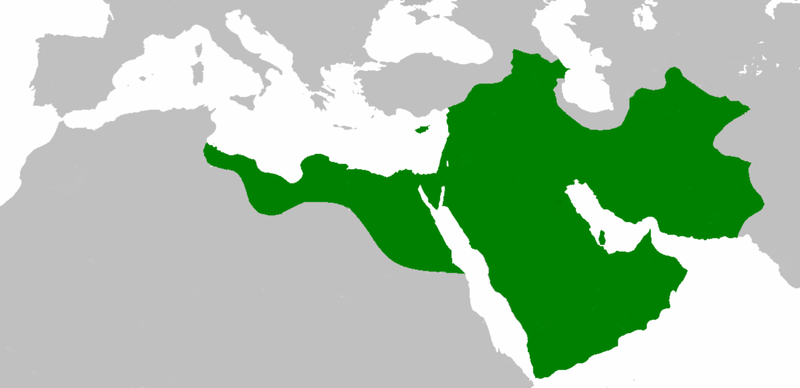
File:Mohammad_adil-Rashidun-empire-at-its-peak-close.PNG · Wikimedia Commons · See Wikimedia Commons
Rashidun Caliphate
Sign in to saveAlso known as al-Khilāfat ar-Rāshidah
first caliphate established after the death of the Islamic prophet Muhammad (632–661)
The Rashidun Caliphate was the first Islamic state, ruled by Muhammad's successors from 632 to 661 CE, and it rapidly expanded Islamic territory across the Middle East and North Africa. It matters historically because it established the early political and religious foundations of Islam and set patterns for Islamic governance that influenced Muslim societies for centuries afterward.
AI-generated from the Wikipedia summary — may contain errors.
Wikidata facts
- Instance of
- historical country
- Part of
- caliphate
- Participant in
- Siege of Alexandria
- Continent
- Africa
- Capital
- Medina
- Official language
- Arabic
- Currency
- dinar
- Head of state
- Hasan ibn Ali
- Form of government
- theocracy
- Founded by
- Hazrat Abu Bakr
- Followed by
- Umayyad Caliphate
- Follows
- first Islamic state
- Image
- RashidunCaliphateEng.png
Show 12 more facts
- main regulatory text
- Sunnah
- dissolved, abolished or demolished date
- 0661-07-28
- Commons category
- Rashidun Caliphate
- topic's main category
- Category:Rashidun Caliphate
- inception
- 0632-06-00
- foundational text
- Constitution of Medina
- office held by head of state
- Amir al-Mu'minin
- native label
- الخلافة الراشدة
- language used
- Arabic
- official religion
- Islam
- position held by head of the organization
- Rashidun
- replaces
- first Islamic state
Sources (2)
via Wikidata · CC0
~40 min read
Encyclopedic overview
The Rashidun Caliphate (Arabic: الخلافة الرّاشدة, romanized: al-Khilāfat ar-Rāshidah) was the early Islamic polity led by the first four successive caliphs (lit. "successors"): Abu Bakr, Umar, Uthman, and Ali, collectively known as the Rashidun, or "Rightly Guided" caliphs. These early caliphs led the Muslim community (Ummah) from the death of the Islamic prophet Muhammad in 632 CE to the establishment of the succeeding Umayyad Caliphate in 661 CE.
The title Rashidun stems from the doctrine in Sunni Islam that the caliphs were "rightly guided". Endowed with superior piety and wisdom, their era is regarded in Sunni Islam as a "golden age", second only to the lifetime of Muhammad in sanctity and in providing moral and religious guidance. Sunni Muslims consider the "rightly guided" reign of the first four caliphs as a model to be followed and emulated from a religious point of view. The term Rashidun is not used by Shia Muslims, who make up 10–15% of the global Muslim population, as they only consider Ali to have been a legitimate caliph and reject the first three caliphs as usurpers; while Ibadi Muslims only regard the first two caliphs, Abu Bakr and Umar, as rightly-guided caliphs.
Excerpted from Wikipedia’s “Rashidun Caliphate” article, available under the CC BY-SA 4.0 licence.
Gallery (12)
Available in 76 languages
- Español
- Français
- 中文
- Русский
- Português
- Italiano
- العربية
- हिन्दी
- Afrikaans
- Albanian
- Asturian
- azb
- Azerbaijani
- Bahasa Indonesia
- Bangla
- Banjar
- Bashkir
- Basque
Show 57 more
- Bosnian
- Bulgarian
- Catalan
- Central Kurdish
- Chechen
- Croatian
- Czech
- Danish
- Egyptian Arabic
- Esperanto
- Filipino
- Finnish
- Galician
- gpe
- Greek
- Hausa
- Hebrew
- Icelandic
- Javanese
- Kashmiri
- Kurdish
- Latvian
- Lithuanian
- Macedonian
- Malagasy
- Malay
- Malayalam
- Minangkabau
- Moroccan Arabic
- Nederlands
- Norwegian
- Norwegian Nynorsk
- Romanian
- Scots
- Serbian
- Serbian (Latin)
- simple
- Sindhi
- skr
- Slovak
- Slovenian
- Somali
- Svenska
- Tajik
- Tamil
- Tiếng Việt
- Türkçe
- Ukrainian
- Urdu
- Uzbek
- Western Panjabi
- Wu Chinese
- zh_min_nan
- zh_yue
- فارسی
- ไทย
- 한국어
via Wikidata sitelinks · CC0