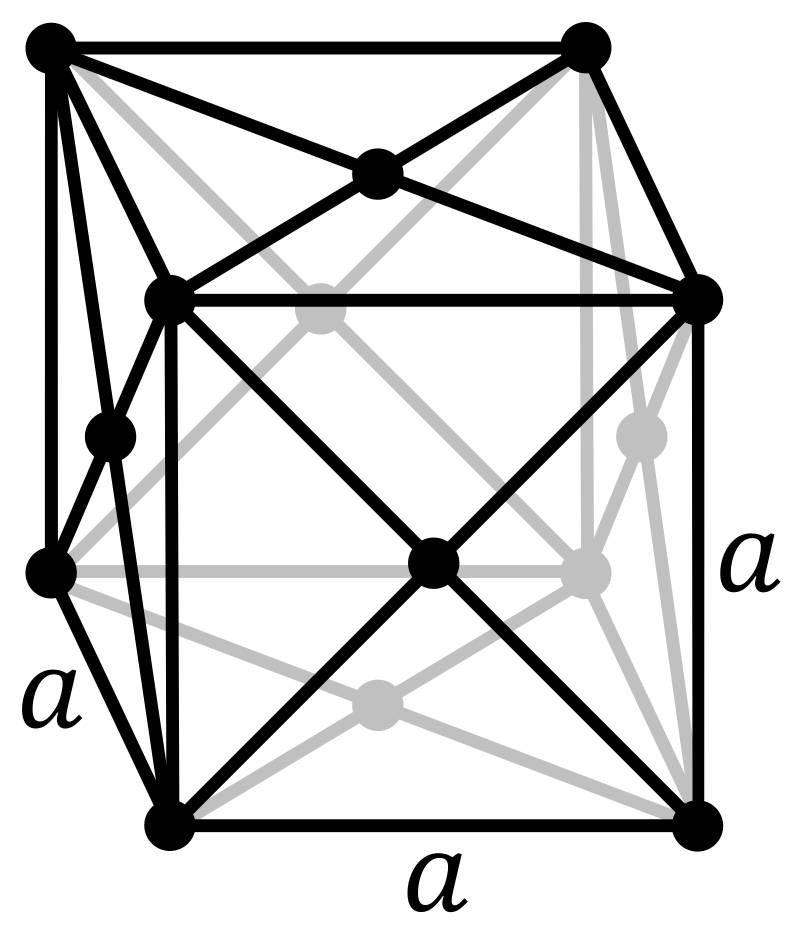
File:Cubic-face-centered.svg · Wikimedia Commons · See Wikimedia Commons
fermium
Sign in to saveAlso known as Fm, element 100, 100Fm
Fermium is a synthetic chemical element; it has symbol Fm and atomic number 100. It is an actinide and the heaviest element that can be formed by neutron bombardment of lighter elements, and hence the last element that can be prepared in macroscopic quantities, although pure fermium metal has not been prepared yet. A total of 20 isotopes are known, with 257Fm being the longest-lived with a half-life of 100.5 days.
OverviewAI-generated
Fermium is a chemical element with the symbol Fm and atomic number 100. Its IUPAC name is fermium, and it is represented by the Unicode character "鐨". The canonical SMILES notation for the element is "[Fm]". It has an electronegativity of 1.3.
The element was discovered on December 1, 1952. Its mass is 257.095, while its molecular weight is listed as 257.09511. The chemical formula is Fm. In chemical terms, it has a topological polar surface area of 0, with zero hydrogen bond donors and acceptors, and a charge of 0.
Fermium is referenced by 482 other encyclopedia articles. There are 16 PubMed records associated with the query "fermium". A Commons gallery and category exist for the subject.
Synthesized by Vinony from 22 facts across 4 sources: Wikidata, PubChem, PubMed, Vinony graph. Generated from structured data (not the Wikipedia text) and checked against those facts — may still contain errors.
Chemical data
- Formula
- Fm
- Molecular weight
- 257.09511 g/mol
- IUPAC name
- fermium
- SMILES
- [Fm]
- InChIKey
- MIORUQGGZCBUGO-UHFFFAOYSA-N
- Polar surface area
- 0 Ų
- H-bond donors
- 0
- H-bond acceptors
- 0
- Formal charge
- 0
via PubChem
Research
16 papers- Smooth trends in fermium charge radii and the impact of shell effects.Nature · 2024Warbinek J, Rickert E, Raeder S et al.DOI: 10.1038/s41586-024-08062-z
- Frantically forging fermium.Nature chemistry · 2017Thornton BF, Burdette SCDOI: 10.1038/nchem.2806
- Radioimmunotherapy with alpha-emitting nuclides.ReviewEuropean journal of nuclear medicine · 1998McDevitt MR, Sgouros G, Finn RD et al.DOI: 10.1007/s002590050306
- Investigation of the solvent extraction of californium, fermium and mendelevium.Talanta · 1966Gavrilov KA, Gvuzdz E, Starý J et al.DOI: 10.1016/0039-9140(66)80065-6
- First observation of atomic levels for the element fermium (Z=100).Physical review letters · 2003Sewtz M, Backe H, Dretzke A et al.DOI: 10.1103/PhysRevLett.90.163002
- ICRP Publication 141: Occupational Intakes of Radionuclides: Part 4.Annals of the ICRP · 2019Paquet F, Bailey MR, Leggett RW et al.DOI: 10.1177/0146645319834139
- Author Correction: Hidden hassium.Nature chemistry · 2018Tarselli MADOI: 10.1038/s41557-018-0108-6
- Review on the progress in nuclear fission-experimental methods and theoretical descriptions.Reports on progress in physics. Physical Society (Great Britain) · 2018Schmidt KH, Jurado BDOI: 10.1088/1361-6633/aacfa7
via PubMed
Wikidata facts
- Instance of
- synthetic element
- Subclass of
- actinide
- Part of
- actinide
- Named after
- Enrico Fermi
- Mass
- 257.095
- Image
- Fermium-Ytterbium Alloy.jpg
Show 13 more facts
- atomic number
- 100
- Commons gallery
- Fermium
- described by source
- Armenian Soviet Encyclopedia
- Commons category
- Fermium
- time of discovery or invention
- 1952-12-01
- topic's main category
- Category:Fermium
- element symbol
- Fm
- discoverer or inventor
- Glenn T. Seaborg
- Unicode character
- 鐨
- electronegativity
- 1.3
- canonical SMILES
- [Fm]
- chemical formula
- Fm
- on focus list of Wikimedia project
- Wikipedia:Vital articles/Level/4
via Wikidata · CC0
~13 min read
Encyclopedic overview
13 sectionsContents
- Discovery
- Isotopes
- Occurrence
- Production
- Synthesis in nuclear explosions
- Natural occurrence
- Chemistry
- Toxicity
- Notes and references
- Notes
- References
- Further reading
- External links
Fermium is a synthetic chemical element; it has symbol Fm and atomic number 100. It is an actinide and the heaviest element that can be formed by neutron bombardment of lighter elements, and hence the last element that can be prepared in macroscopic quantities, although pure fermium metal has not been prepared yet. A total of 20 isotopes are known, with 257Fm being the longest-lived with a half-life of 100.5 days.
Fermium was discovered in the debris of the first hydrogen bomb explosion in 1952, and named after Enrico Fermi, one of the pioneers of nuclear physics. Its chemistry is typical for the late actinides, with a preponderance of the +3 oxidation state but also an accessible +2 oxidation state. Owing to the small amounts of produced fermium and all of its isotopes having relatively short half-lives, there are currently no uses for it outside basic scientific research.
Excerpted from Wikipedia’s “fermium” article, available under the CC BY-SA 4.0 licence.
Gallery (23)
Available in 133 languages
- Español
- Français
- Deutsch
- 中文
- 日本語
- Русский
- Português
- Italiano
- العربية
- हिन्दी
- Afrikaans
- Albanian
- Amharic
- Angika
- Armenian
- Asturian
- Azerbaijani
- Bahasa Indonesia
Show 114 more
- Balinese
- Bangla
- Bashkir
- Basque
- be_x_old
- Belarusian
- Bhojpuri
- Bosnian
- Breton
- Bulgarian
- Burmese
- Catalan
- cdo
- Cebuano
- Central Kurdish
- Chuvash
- Cornish
- Corsican
- Croatian
- Czech
- Danish
- Egyptian Arabic
- Esperanto
- Estonian
- Faroese
- Fiji Hindi
- Filipino
- Finnish
- Friulian
- Galician
- Georgian
- Greek
- Gujarati
- Haitian Creole
- Hakka Chinese
- Hebrew
- Hungarian
- Icelandic
- Ido
- Interlingua
- Irish
- Javanese
- Kalmyk
- Kannada
- Kazakh
- kbp
- Komi
- Kyrgyz
- Latin
- Latvian
- Ligurian
- Limburgish
- Lithuanian
- Lojban
- Luxembourgish
- Macedonian
- Malay
- Malayalam
- Manx
- Marathi
- Mongolian
- Moroccan Arabic
- Nederlands
- Newari
- Northern Frisian
- Norwegian
- Norwegian Nynorsk
- Novial
- Odia
- olo
- Pashto
- Piedmontese
- Polski
- Quechua
- roa_rup
- Romanian
- Sanskrit
- Sardinian
- Saterland Frisian
- Scottish Gaelic
- Serbian
- Serbian (Latin)
- Sicilian
- simple
- Slovak
- Slovenian
- Svenska
- Swahili
- Tajik
- Tamil
- Tatar
- Telugu
- Tiếng Việt
- Türkçe
- Ukrainian
- Urdu
- Uyghur
- Uzbek
- Veps
- Volapük
- Waray
- Welsh
- Western Mari
- Western Panjabi
- Wu Chinese
- Yakut
- Yoruba
- zh_classical
- zh_min_nan
- zh_yue
- Zulu
- فارسی
- ไทย
- 한국어
via Wikidata sitelinks · CC0