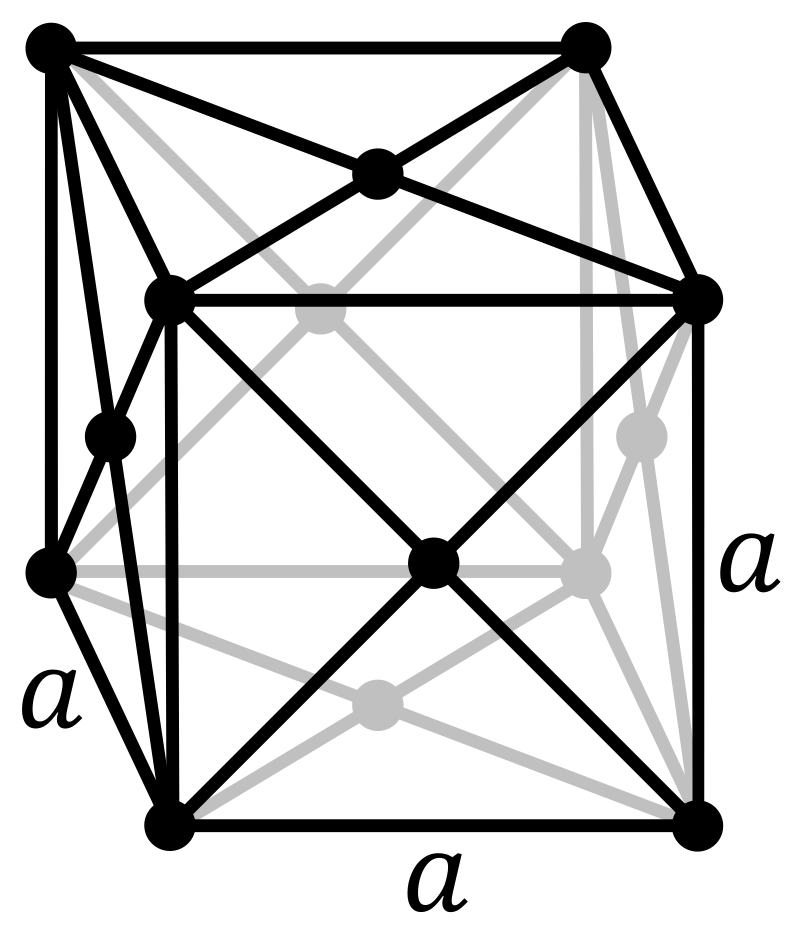
File:Cubic-face-centered.svg · Wikimedia Commons · See Wikimedia Commons
fermio
Sign in to saveAlso known as Fm, element 100, 100Fm
elemento químico radiactivo cuyo número atómico es 100, de símbolo Fm
OverviewAI-generated
Fermium is a chemical element with the symbol Fm and atomic number 100. Its IUPAC name is fermium, and it is represented by the Unicode character "鐨". The canonical SMILES notation for the element is "[Fm]". It has an electronegativity of 1.3.
The element was discovered on December 1, 1952. Its mass is 257.095, while its molecular weight is listed as 257.09511. The chemical formula is Fm. In chemical terms, it has a topological polar surface area of 0, with zero hydrogen bond donors and acceptors, and a charge of 0.
Fermium is referenced by 482 other encyclopedia articles. There are 16 PubMed records associated with the query "fermium". A Commons gallery and category exist for the subject.
Synthesized by Vinony from 22 facts across 4 sources: Wikidata, PubChem, PubMed, Vinony graph. Generated from structured data (not the Wikipedia text) and checked against those facts — may still contain errors.
Chemical data
- Formula
- Fm
- Molecular weight
- 257.09511 g/mol
- IUPAC name
- fermium
- SMILES
- [Fm]
- InChIKey
- MIORUQGGZCBUGO-UHFFFAOYSA-N
- Polar surface area
- 0 Ų
- H-bond donors
- 0
- H-bond acceptors
- 0
- Formal charge
- 0
via PubChem
Research
16 papers- Smooth trends in fermium charge radii and the impact of shell effects.Nature · 2024Warbinek J, Rickert E, Raeder S et al.DOI: 10.1038/s41586-024-08062-z
- Frantically forging fermium.Nature chemistry · 2017Thornton BF, Burdette SCDOI: 10.1038/nchem.2806
- Radioimmunotherapy with alpha-emitting nuclides.ReviewEuropean journal of nuclear medicine · 1998McDevitt MR, Sgouros G, Finn RD et al.DOI: 10.1007/s002590050306
- Investigation of the solvent extraction of californium, fermium and mendelevium.Talanta · 1966Gavrilov KA, Gvuzdz E, Starý J et al.DOI: 10.1016/0039-9140(66)80065-6
- First observation of atomic levels for the element fermium (Z=100).Physical review letters · 2003Sewtz M, Backe H, Dretzke A et al.DOI: 10.1103/PhysRevLett.90.163002
- ICRP Publication 141: Occupational Intakes of Radionuclides: Part 4.Annals of the ICRP · 2019Paquet F, Bailey MR, Leggett RW et al.DOI: 10.1177/0146645319834139
- Author Correction: Hidden hassium.Nature chemistry · 2018Tarselli MADOI: 10.1038/s41557-018-0108-6
- Review on the progress in nuclear fission-experimental methods and theoretical descriptions.Reports on progress in physics. Physical Society (Great Britain) · 2018Schmidt KH, Jurado BDOI: 10.1088/1361-6633/aacfa7
via PubMed
Wikidata facts
- Instance of
- synthetic element
- Subclass of
- actinide
- Part of
- actinide
- Named after
- Enrico Fermi
- Mass
- 257.095
- Image
- Fermium-Ytterbium Alloy.jpg
Show 13 more facts
- atomic number
- 100
- Commons gallery
- Fermium
- described by source
- Armenian Soviet Encyclopedia
- Commons category
- Fermium
- time of discovery or invention
- 1952-12-01
- topic's main category
- Category:Fermium
- element symbol
- Fm
- discoverer or inventor
- Glenn T. Seaborg
- Unicode character
- 鐨
- electronegativity
- 1.3
- canonical SMILES
- [Fm]
- chemical formula
- Fm
- on focus list of Wikimedia project
- Wikipedia:Vital articles/Level/4
via Wikidata · CC0
Article · Español
El fermio es un elemento químico radiactivo creado artificialmente cuyo número atómico es 100 y de peso atómico 254, de símbolo Fm. Existen 16 isótopos conocidos siendo el 257Fm el más estable con un periodo de semidesintegración de 100,5 días. El fermio es uno de los elementos transuránicos del grupo de los actínidos del sistema periódico. El elemento fue aislado en 1952, a partir de los restos de una explosión de bomba de hidrógeno, por el químico estadounidense Albert Ghiorso y sus colegas. Más tarde el fermio fue preparado sintéticamente en un reactor nuclear bombardeando plutonio con neutrones, y en un ciclotrón bombardeando uranio 238 con iones de nitrógeno. Se han obtenido isótopos con números másicos desde 242 a 259; el fermio 257, que es el que tiene una vida más larga, tiene una vida media de 80 días. Al elemento se le dio el nombre de fermio en 1955, en honor al físico nuclear estadounidense de origen italiano Enrico Fermi. El fermio no tiene aplicaciones industriales.
Abstract from DBpedia / Wikipedia · CC BY-SA
Gallery (23)
Available in 133 languages
- Español
- Français
- Deutsch
- 中文
- 日本語
- Русский
- Português
- Italiano
- العربية
- हिन्दी
- Afrikaans
- Albanian
- Amharic
- Angika
- Armenian
- Asturian
- Azerbaijani
- Bahasa Indonesia
Show 114 more
- Balinese
- Bangla
- Bashkir
- Basque
- be_x_old
- Belarusian
- Bhojpuri
- Bosnian
- Breton
- Bulgarian
- Burmese
- Catalan
- cdo
- Cebuano
- Central Kurdish
- Chuvash
- Cornish
- Corsican
- Croatian
- Czech
- Danish
- Egyptian Arabic
- Esperanto
- Estonian
- Faroese
- Fiji Hindi
- Filipino
- Finnish
- Friulian
- Galician
- Georgian
- Greek
- Gujarati
- Haitian Creole
- Hakka Chinese
- Hebrew
- Hungarian
- Icelandic
- Ido
- Interlingua
- Irish
- Javanese
- Kalmyk
- Kannada
- Kazakh
- kbp
- Komi
- Kyrgyz
- Latin
- Latvian
- Ligurian
- Limburgish
- Lithuanian
- Lojban
- Luxembourgish
- Macedonian
- Malay
- Malayalam
- Manx
- Marathi
- Mongolian
- Moroccan Arabic
- Nederlands
- Newari
- Northern Frisian
- Norwegian
- Norwegian Nynorsk
- Novial
- Odia
- olo
- Pashto
- Piedmontese
- Polski
- Quechua
- roa_rup
- Romanian
- Sanskrit
- Sardinian
- Saterland Frisian
- Scottish Gaelic
- Serbian
- Serbian (Latin)
- Sicilian
- simple
- Slovak
- Slovenian
- Svenska
- Swahili
- Tajik
- Tamil
- Tatar
- Telugu
- Tiếng Việt
- Türkçe
- Ukrainian
- Urdu
- Uyghur
- Uzbek
- Veps
- Volapük
- Waray
- Welsh
- Western Mari
- Western Panjabi
- Wu Chinese
- Yakut
- Yoruba
- zh_classical
- zh_min_nan
- zh_yue
- Zulu
- فارسی
- ไทย
- 한국어
via Wikidata sitelinks · CC0