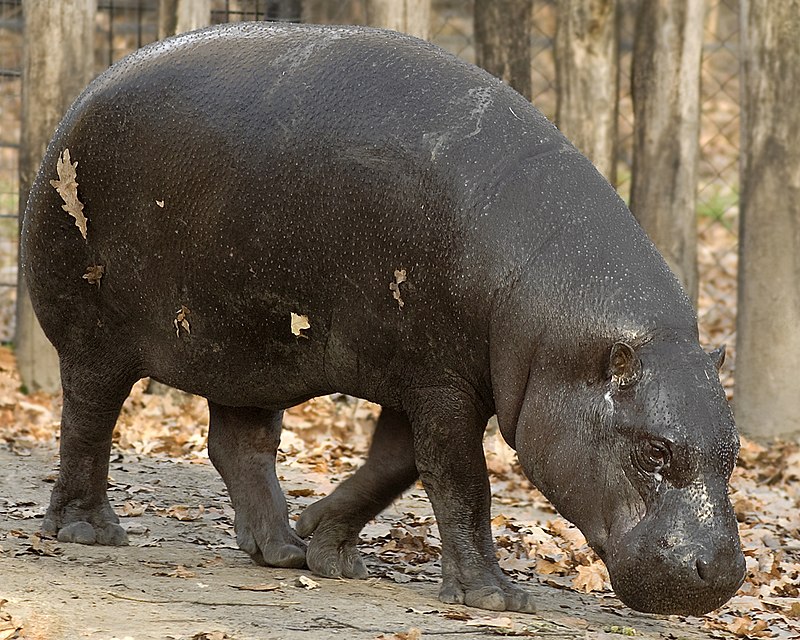
File:Choeropsis.jpg · Wikimedia Commons · See Wikimedia Commons
Hippopotamidae
Sign in to saveAlso known as hippopotamuses, hippopotami
Hippopotamidae is a family of stout, naked-skinned, and semiaquatic artiodactyl mammals, possessing three-chambered stomachs and walking on four toes on each foot. While they resemble pigs physiologically, their closest living relatives are the cetaceans. They are formally referred to as hippopotamids.
OverviewAI-generated
Hippopotamidae is a family of mammals within the order Artiodactyla, class Mammalia, and phylum Chordata. The family name was established by Gray in 1821 and is governed by the International Code of Zoological Nomenclature. It is classified under the kingdom Animalia. The taxon has an accepted status and includes the type species Hippopotamus.
This group consists of large, semi-aquatic herbivores that share a suborder with whales. The family originated in the Miocene, approximately 16 million years ago. Currently, only two species exist: the hippopotamus and the pygmy hippopotamus, both of which are found in Africa. Their habitats include marine, brackish, and freshwater environments.
Specimen records for Hippopotamidae are held by institutions such as UCMP, NHMUK, and YPM. These records originate from countries including Malawi, Tanzania, Pakistan, Egypt, and India. The family has been documented in 21,104 occurrences and is referenced by 478 other encyclopedia articles.
Synthesized by Vinony from 35 facts across 7 sources: Wikidata, GBIF, Encyclopedia of Life, Gbif Occ, WoRMS, iDigBio, Vinony graph. Generated from structured data (not the Wikipedia text) and checked against those facts — may still contain errors.
Species
Hippopotamidae
FAMILY
- KingdomAnimalia
- PhylumChordata
- ClassMammalia
- OrderArtiodactyla
- FamilyHippopotamidae
河马科(学名:Hippopotamidae)是哺乳纲偶蹄目的一科,为大型水陆两栖的草食动物,与鲸类同属河马形亚目。现存仅有河马和倭河马两种,都生活在非洲。
via GBIF
Museum specimens
- Specimen records
- 82
- With media
- 6
- Family
- Hippopotamidae
- Collections
- UCMP, NHMUK, YPM
- Recorded in
- Malawi, Tanzania, Pakistan, Egypt, India
Wikidata facts
- Instance of
- taxon
- Image
- Hippo pod edit.jpg
Show 8 more facts
- Commons category
- Hippopotamidae
- taxon rank
- family
- taxon name
- Hippopotamidae
- Code of nomenclature
- International Code of Zoological Nomenclature
- topic's main category
- Category:Hippopotamuses
- start time
- 16000000-0
- taxonomic type
- Hippopotamus
- temporal range start
- Miocene
Sources (2)
via Wikidata · CC0
~7 min read
Encyclopedic overview
11 sectionsContents
- Characteristics
- Evolution
- Taxonomy
- Analogous structures
- Species
- Recent species
- Fossil species
- See also
- Footnotes
- References
- Further reading
Hippopotamidae is a family of stout, naked-skinned, and semiaquatic artiodactyl mammals, possessing three-chambered stomachs and walking on four toes on each foot. While they resemble pigs physiologically, their closest living relatives are the cetaceans. They are formally referred to as hippopotamids.
There are two living species of hippopotamid in two genera; the pygmy hippo, Choeropsis liberiensis of the forests of west Africa, and the common hippo, Hippopotamus amphibius. The term hippopotamus can also be applied to hippopotamids in general, although it is most frequently used for the common hippo and its respective genus.
Excerpted from Wikipedia’s “Hippopotamidae” article, available under the CC BY-SA 4.0 licence.
Gallery (20)
Available in 72 languages
- Español
- Français
- Deutsch
- 中文
- 日本語
- Русский
- Português
- Italiano
- العربية
- Afrikaans
- Albanian
- Armenian
- Asturian
- Bahasa Indonesia
- Balinese
- Basque
- be_x_old
- Breton
Show 53 more
- Bulgarian
- Catalan
- Cebuano
- Chuvash
- Croatian
- Czech
- Danish
- Egyptian Arabic
- Estonian
- Filipino
- Finnish
- Galician
- Georgian
- Guarani
- Hebrew
- Hungarian
- Interlingua
- Kongo
- Kotava
- Kyrgyz
- Latin
- Latvian
- Lithuanian
- Macedonian
- Malagasy
- Navajo
- Nederlands
- Northern Frisian
- Norwegian
- Norwegian Nynorsk
- Occitan
- Ossetic
- Polski
- Quechua
- Romanian
- Scots
- Serbian (Latin)
- Sicilian
- simple
- Slovak
- Svenska
- Tajik
- Tiếng Việt
- Türkçe
- Ukrainian
- Uzbek
- Waray
- West Flemish
- Wu Chinese
- zh_min_nan
- zh_yue
- فارسی
- 한국어
via Wikidata sitelinks · CC0