Kingia · Kew POWO · Kew Plants of the World Online
Kingia
Sign in to saveKingia is a genus consisting of a single species, Kingia australis, and belongs to the plant family Dasypogonaceae. The Aboriginal name bullanock is used as a common name for the plant. It has a thick pseudo-trunk consisting of accumulated leaf-bases, with a cluster of long, slender leaves on top. The trunk is usually unbranched, but can branch if the growing tip is damaged. Flowers occur in egg-shaped clusters on the ends of up to 100 long curved stems. Kingia grows extremely slowly, the trunk increasing in height by about 1½ centimetres per year. It can live for centuries, however, so can at
Species
via · Kew POWO
Museum specimens
- Specimen records
- 4
- With media
- 3
- Family
- Dasypogonaceae
- Collections
- US, YPM
- Recorded in
- Australia
Wikidata facts
- Instance of
- taxon
- Parent taxon
- Dasypogonaceae
- Image
- BlackGins,AridGarden,RBG-CranbourneVIC.jpg
Show 6 more facts
- Commons category
- Kingia
- taxon name
- Kingia
- taxon rank
- genus
- topic's main category
- Category:Kingia
- taxonomic type
- Kingia australis
Sources (1)
via Wikidata · CC0
~4 min read
Encyclopedic overview
6 sectionsContents
- Description
- Taxonomy
- Distribution and habitat
- Uses
- Gallery
- References
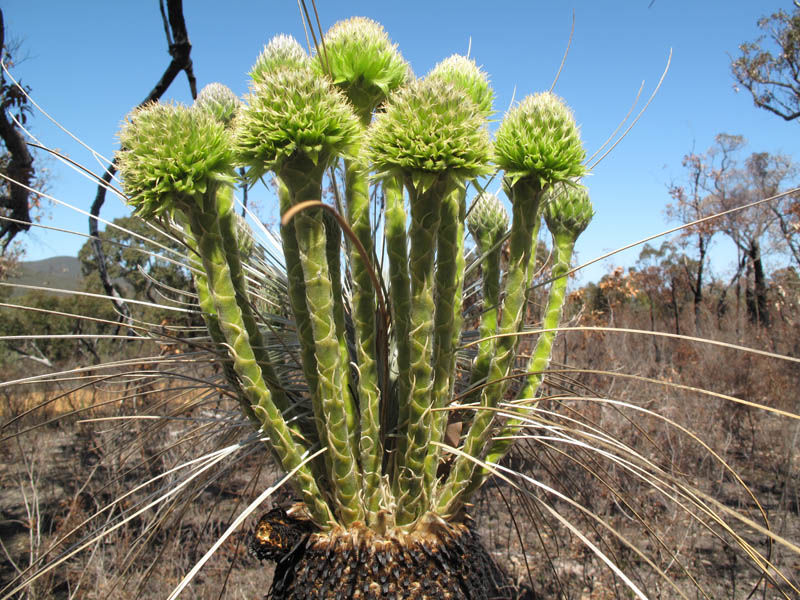
Kingia is a genus consisting of a single species, Kingia australis, and belongs to the plant family Dasypogonaceae. The Aboriginal name bullanock is used as a common name for the plant. It has a thick pseudo-trunk consisting of accumulated leaf-bases, with a cluster of long, slender leaves on top. The trunk is usually unbranched, but can branch if the growing tip is damaged. Flowers occur in egg-shaped clusters on the ends of up to 100 long curved stems. Kingia grows extremely slowly, the trunk increasing in height by about 1½ centimetres per year. It can live for centuries, however, so can attain a substantial height; 400-year-old plants with a height of six metres are not unusual.
== Description == thumb|left|K. australis flower stalk. When not flowering, Kingia australis bear a superficial similarity to species of the genus Xanthorrhoea. However, the flower stalks of Kingia australis are completely different from that of Xanthorrhoea species and the two are not closely related. For example, Xanthorrhoea have a secondary thickening meristem in the trunk (Dracaenoid secondary thickening meristem), whereas Kingia lacks this feature.
Excerpted from Wikipedia’s “Kingia” article, available under the CC BY-SA 4.0 licence.