
OverviewAI-generated
Libya, officially the State of Libya, is a country in Northern Africa. Its capital is Tripoli. The nation has a population of 7,459,000 and covers an area of 1,759,540 square kilometers. The native label for the country is دولة ليبيا. It uses the Libyan dinar and Libyan pound as currency. The internet top-level domain is .ly.
The legislative body consists of the House of Representatives and the High Council of State. The head of state includes Mohamed al-Menfi and Aguila Saleh Issa. Diplomatic relations exist with Italy, Brazil, Germany, and Yemen. The marriageable age is 20. The country has experienced several inception dates, including 1551-08-15, 1977-03-02, 1969-09-01, and 1951-12-24. It replaces the Great Socialist People's Libyan Arab Jamahiriya. The demonym for its people is Libyan.
Synthesized by Vinony from 67 facts across 9 sources: Wikidata, REST Countries, Open Meteo, Openweathermap, World Bank, OpenStreetMap, PubMed, Vinony graph, Geo. Generated from structured data (not the Wikipedia text) and checked against those facts — may still contain errors.
Weather now
7-day forecast
via Open-Meteo
Country
- Capital
- Tripoli
- Population
- 7,459,000
- Region
- Africa · Northern Africa
- Demonym
- Libyan
- Currencies
- LYD (ل.د)
- Languages
- Arabic
- Calling code
- +218
- Drives on
- Right
- FIFA code
- LBY
- TLD
- .ly
- Timezones
- UTC+01:00
- Borders
- DZA, TCD, EGY, NER, SDN, TUN
via REST Countries
Indicators · World Bank
- GDP
- $48.5B(2024)
- Population
- 7,381,023(2024)
- Life expectancy
- 71.1 yrs(2024)
- Unemployment
- 18.8 %(2025)
- Urban population
- 87.9 %(2024)
- Internet users
- 82 %(2024)
- Forest area
- 0.1 %(2023)
- Renewable energy
- 3.1 %(2021)
via World Bank Open Data · CC BY 4.0
Wikipedia views (30d)
114,431 totalvia Wikimedia Pageviews API
Key facts
- Country.conventional_long_name
- State of Libya
- Country.common_name
- Libya
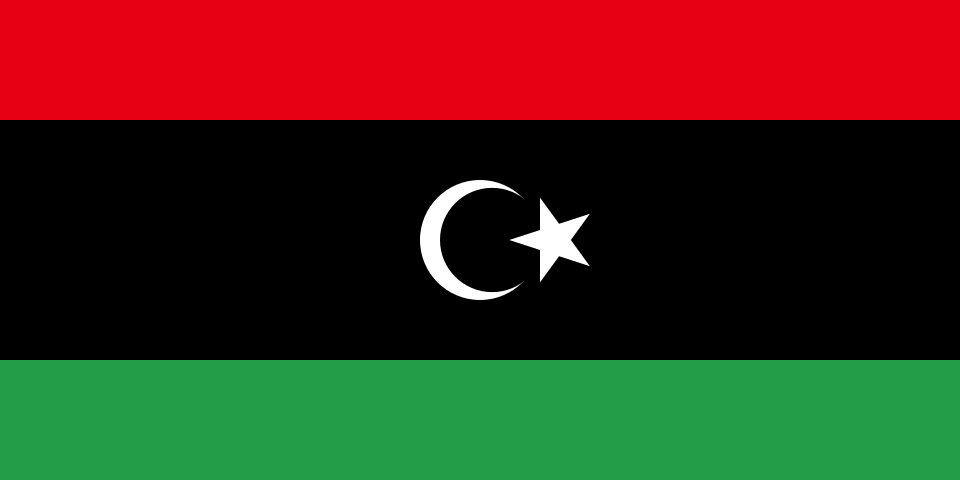
- Country.image_flag
- Flag of Libya.svg
- Country.national_anthem
- "Libya, Libya, Libya"File:Libya, Libya, Libya instrumental.ogg
- Country.map_width
- 220px
- Country.map2_width
- 250px
- Country.capital
- Tripoli
- Country.largest_city
- capital
- Country.official_languages
- Arabic
- Country.languages_type
- Local vernacular
- Country.languages
- Libyan Arabic
- Country.languages2_type
- Foreign languages
- Country.languages2
- Italian and English
- Country.ethnic_groups
- 92% Arabs 5% Berbers 3% others
- Country.ethnic_groups_year
- 1999
- Country.religion
- 96.6% Islam (official) 2.7% Christianity 0.7% others
- Country.religion_year
- 2020
- Country.demonym
- Libyan
via Wikipedia infobox
Research
6,677 papers- COVID-19 epidemic in Libya.ReviewThe Libyan journal of medicine · 2021Bredan A, Bakoush ODOI: 10.1080/19932820.2021.1871798
- The burden of tuberculosis in Libya.The Lancet. Respiratory medicine · 2022Balakrishnan VSDOI: 10.1016/S2213-2600(22)00370-8
- HIV Epidemic in Libya: Identifying Gaps.ReviewJournal of the International Association of Providers of AIDS Care · 2021Hamidi A, Regmi PR, van Teijlingen EDOI: 10.1177/23259582211053964
- Libya floods: preventing a public health crisis.Lancet (London, England) · 2023Alhudiri I, Zaghdani AA, El Meshri SE et al.DOI: 10.1016/S0140-6736(23)02343-7
- Antimicrobial resistance in Libya: 1970-2011.ReviewThe Libyan journal of medicine · 2013Ghenghesh KS, Rahouma A, Tawil K et al.DOI: 10.3402/ljm.v8i0.20567
- Libya's travesty.Nature · 2006DOI: 10.1038/443245b
- The impact of conflict on cancer care in Libya.ReviewJournal of cancer policy · 2025El-Mogassabi A, Kaziri IGDOI: 10.1016/j.jcpo.2024.100528
- Libya.Department of State publication. Background notes series · 1985United States. Department of State. Bureau of Public Affairs
via PubMed
Wikidata facts
- Instance of
- country
- Official name
- State of Libya
- Demonym
- Libiach
- Country
- Libya
- Contains
- Jabal al Gharbi District
- Continent
- Africa
- Capital
- Tripoli
- Official language
- Modern Standard Arabic
- Currency
- Libyan pound
- Population
- 7381023
- Area
- 1759541
- Body of water
- Mediterranean Sea
- Head of government
- Abd al-Hamid Dbeibeh
- Head of state
- Aguila Saleh Issa
- Form of government
- republic
- Legislature
- High Council of State
- Anthem
- Libya, Libya, Libya
- Shares border with
- Middle East
- Highest point
- Bikku Bitti
- Image
- Tripoli at night.jpg
- Life expectancy
- 71.934
- Nominal GDP
- 45752336036
- Unemployment rate
- 19
Show 60 more facts
- Calling code
- +218
- Licence plate code
- LAR
- Mains voltage
- 230
- Flag
- flag of Libya
- Coat of arms
- coat of arms of Libya
- Has parts of class
- district of Libya
- topic's main Wikimedia portal
- Portal:Libya
- speed limit
- 100
- category of associated people
- Category:Libyan people
- Unicode character
- 🇱🇾
- geography of topic
- Geography of Libya
- native label
- دولة ليبيا
- diplomatic relation
- Kosovo
- Commons gallery
- ليبيا
- inception
- 1951-12-24
- history of topic
- history of Libya
- marriageable age
- 20
- mobile country code
- 606
- total fertility rate
- 2.467
- maritime identification digits
- 642
- topic's main category
- Category:Libya
- member of
- African Continental Free Trade Area
- located in/on physical feature
- North Africa
- category for films shot at this location
- Category:Films shot in Libya
- category for people who died here
- Category:Deaths in Libya
- Commons category
- Libya
- top-level Internet domain
- .ly
- category for people born here
- Category:Births in Libya
- driving side
- right
- lowest point
- Sabkhat Ghuzayyil
- retirement age
- 65
- described by source
- Encyclopædia Britannica 11th edition
- central bank
- Central Bank of Libya
- language used
- Siwa
- compulsory education (maximum age)
- 15
- compulsory education (minimum age)
- 6
- literacy rate
- 86.1
- GS1 country code
- 624
- culture
- culture of Libya
- BTI Status Index
- 2.43
- BTI Governance Index
- 2.45
- economy of topic
- economy of Libya
- demographics of topic
- demographics of Libya
- madhhab
- Malikism
- Democracy Index
- 2.31
- Human Development Index
- 0.718
- P11012
- Tallinn
- hashtag
- libya
- on focus list of Wikimedia project
- Wikipedia:Vital articles/Level/4
- Happy Planet Index score
- 42.7
- P12749
- Kofi Annan
- birth rate
- 17.298
- male population
- 3447062
- death rate
- 5.954
- rural population
- 1273772
- female population
- 3365279
- urban population
- 5538569
- P8168
- Danny Carey
- maintained by WikiProject
- WikiProject Arab world
Sources (15)
via Wikidata · CC0
Travel guide
Get around
thumb|right|350px|Leptis Magna
See
thumb|Oasis of Ubari
Libya's colourful capital Tripoli makes for a great start to explore the country, as it still has its traditional walled medina to explore, as well as the interesting Red Castle Museum, with expositions on all parts of the region's history. Despite the development as a tourist destination, this remains a quintessentially North-African place, with a range of beautiful mosques and impressive fountains and statues to remind of its historic role in the great Ottoman Empire. Some 130 km from the capital is Leptis Magna ('Arabic: لَبْدَة), once a prominent city of the Roman Empire. Its ruins are located in Al Khums, on the coast where the Wadi Lebda meets the sea. The site is one of the most spectacular and unspoiled Roman ruins in the Mediterranean. Another must-see is Cyrene, an ancient colony founded in 630 BC as a settlement of Greeks from the Greek island of Theraand. It was then a Roman city in the time of Sulla (c. 85 BC) and now an archaeological site near the village of present-day Shahhat and Albayda.
thumb|The Grand Mosque in Ghadames
The vast Sahara makes for some excellent natural experiences, complete with picture-perfect oases like Ubari. The Unesco listed town of Ghadames was once a Phoenician trade town, and the ruins of its ancient theatre, church and temples are a major attraction today. For stunning landscapes, try the Acacus Mountains, a desert mountain range with sand dunes and impressive ravines. The varied cave paintings of animals an…
Eat
thumb|Couscous with fish thumb|right|Shakshuka (Libyan omelette)
In Tripoli, it is surprisingly hard to find a traditional Libyan restaurant. Most serve western-style cuisine, with a few Moroccan and Lebanese restaurants thrown in. There are also good Turkish restaurants, and some of the best coffee and gelato outside of Italy. There are some wonderful Libyan dishes you should taste in case you are fortunate enough to be invited to a Libyan dinner party or wedding (be prepared to be overfed!)
A favourite café for the local expatriate community is the fish restaurant in the souq. For the equivalent of a few US dollars, you can enjoy a great seafood couscous. A local speciality is the stuffed calamari.
Also recommend Al-Saraya: Food OK, but its attraction is its position, right in Martyr's Square (Gaddafi name: Green Square). Another good seafood restaurant is Al-Morgan, next to the Algiers Mosque, near 1st of September Street.
There are flashy looking big fast-food outlets in Tripoli. These are not quite the multinationals, but a close copy of them. They are springing up in the Gargaresh Road area, a big shopping area in the western suburbs of Tripoli.
Try one of the best local catch fish named "werata" grilled or baked with local herbs and spices.
Drink
Tea is the most common drink in Libya. Green tea and "red" tea are served almost everywhere from small cups, usually sweetened. Mint is sometimes mixed in with the tea, especially after meals.
Coffee is traditionally served Turkish style: strong, from small cups, no cream. Most coffee shops in the larger cities have espresso machines that will make espresso, cappuccino, and such. Quality varies, so ask locals for the best one around.
Alcohol is banned in Libya, though it is readily available through a local black market (anything from whisky to beer to wine). Penalties for unlawful purchase can be quite stiff.
Sleep
thumb|Tripoli at night
Major cities have a range of accommodations available, from shabby hotels to 4-star establishments. Prices vary accordingly.
In Tripoli, there are a couple of international-standard hotels: the Radisson Blu opened in 2009/2010 and offer excellent accommodations and services, while the older Corinthia Hotel, is located adjacent to the old city (The Medina or "Al Souq Al Qadeem"). Other hotels are Bab-Al-Bahr, Al-Kabir, and El-Mahari.
Manara Hotel, a tidy 4-star hotel in Jabal Akhdir, east of Benghazi, is next to the ancient Greek ruins of Appolonia Port.
While it seems to be diminishing with the arrival of more tourists every year, Libyans have a strong tradition of taking travellers into their own homes and lavishing hospitality on them. This is certainly true in smaller towns and villages.
There are several good hotels in Tripoli's Dhahra area, near the church like Marhaba hotel.
Youth Hostels, associated with the IYH Federation (HI), are available. Please contact the Libyan Youth Hostel Association, .
Stay safe
The security situation in Libya is fragile and unpredictable. Although some have been brave enough to enter and leave the country without any difficulties, anything can happen in this politically unstable nation.
Stay healthy
Prior to the fall of the Libyan Arab Jamahiriya, Libya had an excellent health care system. However, the civil wars that soon followed badly damaged and devastated that system. Many hospitals are in a state of disrepair and there's a shortage of medical supplies and staff.
Good quality healthcare facilities can be found in major cities such as Tripoli.
Medical care in the most remote parts of Libya is virtually non-existent.
Even if you have travel health insurance it may not be valid in the country. It's advisable to check in advance with your insurer.
Respect
Much of what is considered good manners in the Arab world is applicable to Libya.
Libyans are indirect communicators. They are tempered by the need to save face and protect their honour and they will avoid saying anything that could be construed as judgemental or negative. One's point is expressed in a roundabout way.
Never beckon a Libyan person directly, even if they've done something wrong in your opinion. Libyans in general are non-confrontational by nature and can be rather sensitive to strong, harsh comments. Under Libyan law, if you are thought to have defamed someone or violated the honour or reputation of someone, you can be taken to court. What exactly counts as "defamation" and "violating someone's honour" is open-ended and subjective, but simply put, refrain from making strong comments about people, even if your perspective happens to be true.
Respect for elders is important in Libya. You are expected to act politely around someone older than you, and it would be seen as rude manners if you attempt to challenge someone older than you. It's commonly expected for the senior-most person to make decisions in the business world. If you come across someone who is older than you, give up your seat on public transportation for them. If you're waiting for a taxi, allow someone older to take your spot. If you're in a business meeting, stand up to greet the senior person. If you've been invited to a Libyan home, greet the elders first.
Libyans take relationships very …
Travel guide from Wikivoyage (CC BY-SA 4.0)
Article · Français
La Libye, en forme longue l'État de Libye est un État d'Afrique du Nord faisant partie du Maghreb. Elle est bordée au nord par la mer de Libye en mer Méditerranée, au nord-ouest par la Tunisie, à l'ouest par l'Algérie, au sud-ouest par le Niger, au sud-sud-est par le Tchad, au sud-est par le Soudan et à l'est par l'Égypte. Elle s’étend sur 1 759 540 km2, ce qui la place au quatrième rang africain et au dix-huitième rang mondial. Sa population est estimée entre 6 et 8 millions d'habitants. Elle se concentre sur les côtes, l’intérieur du pays étant désertique. Sa capitale, Tripoli, est également sa plus grande agglomération (1,8 million d'habitants), devant Benghazi (650 000 habitants), Misrata (plus de 350 000 habitants) et El Beïda (250 000 habitants). Les Libyens sont en majorité de culture arabe et de confession musulmane sunnite. Le produit intérieur brut de la Libye est l’un des plus élevés d’Afrique. Son économie repose très largement sur l’exportation du pétrole. Elle est membre, entre autres, de la Ligue arabe, de l'Union du Maghreb arabe et de l’Organisation des pays exportateurs de pétrole (OPEP). La Libye tire son nom d'une tribu amazighe qui était nommée Libou, qui a donné le mot grec ancien Λιβύη / Libyè. Traditionnellement, on y distingue les régions de Tripolitaine, de Cyrénaïque et du Fezzan. Peuplé originellement de Berbères, son territoire est colonisé pendant l’Antiquité par les Phéniciens, puis les Grecs, avant d’être conquis par l’Empire romain. Au VIIe siècle, il est conquis par les armées arabes, qui y diffusent leur culture et leur religion. Après avoir été soumis à divers royaumes pendant le Moyen Âge, il passe sous le contrôle de l’Empire ottoman au XVIe siècle. La régence de Tripoli devient un véritable État avant d'être directement reprise en main par l'Empire ottoman en 1835. Dernière possession ottomane en Afrique, l'actuel territoire de la Libye est conquis et colonisé par le Royaume d'Italie en 1912, à l'issue de la guerre italo-turque. Durant la Seconde Guerre mondiale, la Libye italienne est envahie et occupée par les Alliés. En 1951, elle proclame son indépendance sous la forme d’une monarchie dirigée par Idris Ier. En 1969, un coup d'État militaire renverse le roi, et la République arabe libyenne est proclamée. Dès lors, et pendant près de 42 ans, la Libye est gouvernée par Mouammar Kadhafi. En 1977, le pays prend le nouveau nom de Jamahiriya arabe libyenne populaire et socialiste. En 2011, durant le Printemps arabe, une rébellion éclate et se transforme bientôt en guerre civile : avec le soutien d'une intervention militaire internationale, les rebelles renversent Kadhafi. La Libye s'avère cependant incapable de trouver la stabilité politique et de construire un État de droit : à partir de 2014, le pays sombre dans une nouvelle guerre civile tandis que le gouvernement mis en place par le processus de paix des Nations Unies fait face à une rébellion dans l'Est du pays. Un cessez-le-feu permanent est signé le 23 octobre 2020.
Abstract from DBpedia / Wikipedia · CC BY-SA
Gallery (59)
On the map
6 mapped locations
Available in 263 languages
- Español
- Français
- Deutsch
- 中文
- 日本語
- Русский
- Português
- Italiano
- العربية
- हिन्दी
- Abkhazian
- Achinese
- Adyghe
- Afrikaans
- Akan
- Albanian
- Albanian
- Amharic
Show 244 more
- ami
- Angika
- Aragonese
- Aramaic
- Armenian
- Arpitan
- Assamese
- Asturian
- azb
- Azerbaijani
- Bahasa Indonesia
- Balinese
- Bambara
- Bangla
- Banjar
- Bashkir
- Basque
- bat_smg
- Bavarian
- be_x_old
- Belarusian
- Betawi
- Bhojpuri
- Bikol
- Bishnupriya
- Bislama
- Bosnian
- Breton
- Buginese
- Bulgarian
- Buriat
- Burmese
- Catalan
- cbk_zam
- cdo
- Cebuano
- Central Kurdish
- Chechen
- Chuvash
- Cornish
- Corsican
- Crimean Tatar
- Croatian
- Czech
- dag
- Danish
- Dinka
- Divehi
- dty
- Dzongkha
- Egyptian Arabic
- Esperanto
- Estonian
- Ewe
- Extremaduran
- Faroese
- Fiji Hindi
- Filipino
- Finnish
- fiu_vro
- Frafra
- Fula
- Gagauz
- Galician
- Ganda
- gcr
- Georgian
- Gilaki
- Goan Konkani
- Gorontalo
- gpe
- Greek
- Guarani
- Gujarati
- Haitian Creole
- Hakka Chinese
- Hausa
- Hebrew
- Hungarian
- hyw
- Iban
- Icelandic
- Ido
- Igbo
- Iloko
- Inari Sami
- Interlingua
- Interlingue
- Irish
- Jamaican Creole English
- Javanese
- Jju
- Kabyle
- Kannada
- Kanuri
- Kara-Kalpak
- Kashmiri
- Kashubian
- Kazakh
- kbp
- kge
- Khmer
- Kikuyu
- Kinyarwanda
- Kongo
- Kotava
- Kurdish
- Kyrgyz
- Ladino
- Latin
- Latvian
- Ligurian
- Limburgish
- Lingala
- Lingua Franca Nova
- Lithuanian
- lld
- Lojban
- Lombard
- Low German
- Lower Sorbian
- Luxembourgish
- Macedonian
- Madurese
- Malagasy
- Malay
- Malayalam
- Maltese
- Manipuri
- Manx
- Māori
- map_bms
- Marathi
- Mazanderani
- Minangkabau
- Mingrelian
- Mirandese
- Moksha
- Mongolian
- Moroccan Arabic
- N’Ko
- Navajo
- nds_nl
- Neapolitan
- Nederlands
- Nepali
- Newari
- Northern Frisian
- Northern Sami
- Northern Sotho
- Norwegian
- Norwegian Nynorsk
- Novial
- nup
- Obolo
- Occitan
- Old English
- olo
- Oromo
- Ossetic
- Palatine German
- Pampanga
- Pangasinan
- Papiamento
- Pashto
- Piedmontese
- Polski
- Punjabi
- Quechua
- Romanian
- Rusyn
- Samoan
- Sango
- Sanskrit
- Sardinian
- Saterland Frisian
- Scots
- Scottish Gaelic
- Serbian
- Serbian (Latin)
- Shan
- Shona
- Sicilian
- Silesian
- simple
- Sindhi
- Sinhala
- Slovak
- Slovenian
- Somali
- Southern Sotho
- Standard Moroccan Tamazight
- Sundanese
- Svenska
- Swahili
- Swati
- szy
- Tachelhit
- Tajik
- Talysh
- Tamil
- Taroko
- Tatar
- tay
- Telugu
- Tibetan
- Tiếng Việt
- Tigrinya
- Toki Pona
- Tsonga
- Tumbuka
- Türkçe
- Turkmen
- Tyap
- Udmurt
- Ukrainian
- Upper Sorbian
- Urdu
- Uyghur
- Venetian
- Veps
- Volapük
- Walloon
- Waray
- Welsh
- West Flemish
- Western Frisian
- Western Mari
- Western Panjabi
- Wolof
- Wu Chinese
- Yakut
- Yiddish
- Yoruba
- Zaza
- Zeelandic
- zh_classical
- zh_min_nan
- zh_yue
- Zhuang
- Zulu
- فارسی
- ไทย
- 한국어
via Wikidata sitelinks · CC0