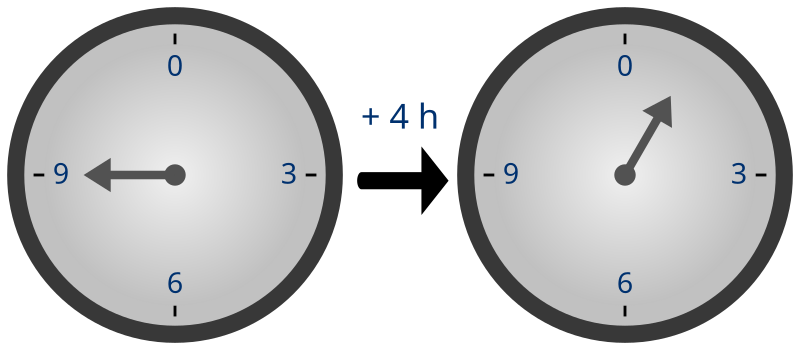
File:Clock_group.svg · Wikimedia Commons · See Wikimedia Commons
Also known as clock arithmetic, modulo arithmetic, mathematics in clocks
system of algebraic operations defined for remainders under division by a fixed positive integer; system of arithmetic for integers, where numbers "wrap around" upon reaching a certain value—the modulus
Modular arithmetic is a system where numbers wrap around when they reach a certain fixed value, called the modulus, so you only work with the remainders left after division. It's useful because it simplifies problems involving cycles and patterns, such as telling time on a clock or organizing data in computer science.
AI-generated from the Wikipedia summary — may contain errors.
Wikidata facts
- Subclass of
- mathematics
- Image
- Clock group.svg
Show 8 more facts
- topic's main category
- Category:Modular arithmetic
- Commons category
- Modular arithmetic
- Stack Exchange tag
- math.stackexchange.com/tags/modular-arithmetic
- is the study of
- congruence of integers
- different from
- modulo operation
- on focus list of Wikimedia project
- Wikipedia:Vital articles/Level/4
- maintained by WikiProject
- WikiProject Mathematics
- has characteristic
- congruence of integers
via Wikidata · CC0
Article · 中文
模算數(英語:Modular arithmetic)是一個整数的算术系統,其中數字超過一定值後(稱為模)後會「捲回」到較小的數值,模算數最早是出現在卡爾·弗里德里希·高斯在1801年出版的《算术研究》一書中。 模算數常見的應用是在十二小時制,將一天分為二個以十二小時計算的單位。假設現在七點,八小時後會是三點。用一般的算術加法,會得到7 + 8 = 15,但在十二小時制中,超過十二小時會歸零,不存在「十五點」。類似的情形,若時鐘目前是十二時,二十一小時後會是九點,而不是三十三點。小時數超過十二後會再回到一,為模12的模算數系統。依照上述的定義,12和12本身同餘,也和0同餘,因此12:00的時間也可以稱為是0:00,因為模12時,12和0同餘。
Abstract from DBpedia / Wikipedia · CC BY-SA