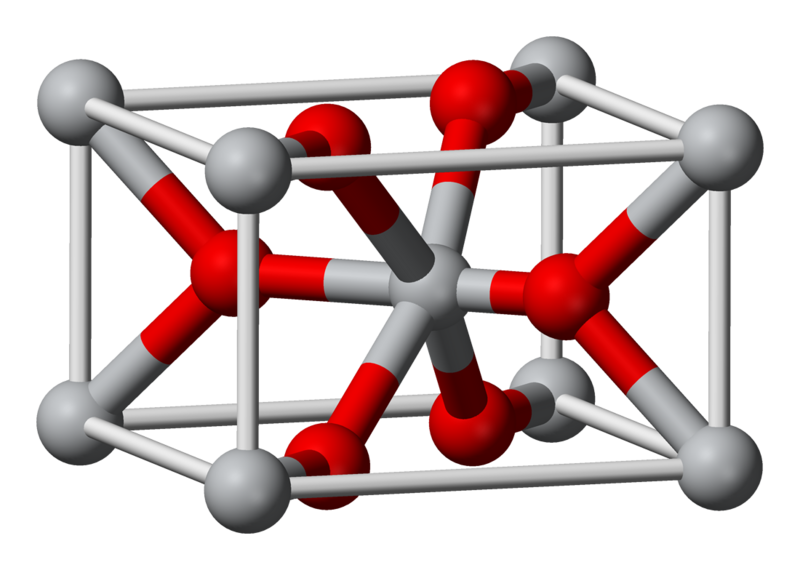
File:Rutile-unit-cell-3D-balls.png · Wikimedia Commons · See Wikimedia Commons
oxide
Sign in to saveAlso known as oxide compound, oxides
thumb|right|The Crystal structure#Unit cell|unit cell of [[rutile, an important oxide of titanium. Ti(IV) centers are grey; oxygen centers are red. Notice that oxygen forms three bonds to titanium and titanium forms six bonds to oxygen.]] An oxide () is a chemical compound containing at least one oxygen atom and one other element in its chemical formula. "Oxide" itself is the dianion (anion bearing a net charge of −2) of oxygen, an O2− ion with oxygen in the oxidation state of −2. Most of the Earth's crust consists of oxides. Even materials considered pure elements often develop an oxide coati
An oxide is a chemical compound that contains at least one oxygen atom bonded with another element, with oxygen carrying a negative charge of −2 in the compound. Oxides are extremely important because they make up most of the Earth's crust, and even materials that seem like pure elements typically develop oxide coatings.
AI-generated from the Wikipedia summary — may contain errors.
Research
1,914,457 papers- Detection and quantification of nitric oxide-derived oxidants in biological systems.ReviewThe Journal of biological chemistry · 2019Möller MN, Rios N, Trujillo M et al.DOI: 10.1074/jbc.REV119.006136
- Neuroprotective properties of nitric oxide.ReviewAnnals of the New York Academy of Sciences · 1999Chiueh CCDOI: 10.1111/j.1749-6632.1999.tb08007.x
- Nitric oxide and superoxide, a deadly cocktail.ReviewAnnals of the New York Academy of Sciences · 2002Estévez AG, Jordán JDOI: 10.1111/j.1749-6632.2002.tb04069.x
- Nitric oxide and its role in lipid peroxidation.ReviewDiabetes/metabolism research and reviews · 1999Violi F, Marino R, Milite MT et al.DOI: 10.1002/(sici)1520-7560(199907/08)15:4<283::aid-dmrr42>3.0.co;2-u
- Superoxide, nitric oxide and peroxynitrite production by macrophages under different physiological oxygen tensions.Free radical biology & medicine · 2024Casella AC, Prolo C, Pereyra J et al.DOI: 10.1016/j.freeradbiomed.2023.12.024
- Interaction between reactive oxygen metabolites and nitric oxide in oxidant tolerance.ReviewFree radical biology & medicine · 2002Cepinskas G, Rui T, Kvietys PRDOI: 10.1016/s0891-5849(02)00962-0
- Subcellular localization of oxidants and redox modulation of endothelial nitric oxide synthase.ReviewCirculation journal : official journal of the Japanese Circulation Society · 2012Maron BA, Michel TDOI: 10.1253/circj.cj-12-1207
- Oxidant-mediated impairment of nitric oxide signaling in sickle cell disease--mechanisms and consequences.ReviewCellular and molecular biology (Noisy-le-Grand, France) · 2004Aslan M, Freeman BA
via PubMed
Wikidata facts
- Subclass of
- oxygen compound
- Image
- Water drop 001.jpg
Show 5 more facts
- described by source
- Brockhaus and Efron Encyclopedic Dictionary
- topic has template
- Template:Oxides
- Commons category
- Oxides
- topic's main category
- Category:Oxides
- on focus list of Wikimedia project
- Wikipedia:Vital articles/Level/4
via Wikidata · CC0
~7 min read
Encyclopedic overview
12 sectionsContents
- Stoichiometry
- Formation
- Metal oxides
- Non-metal oxides
- Structure
- Molecular oxides
- Reactions
- Reduction
- Hydrolysis and dissolution
- Nomenclature and formulas
- See also
- References
thumb|right|The Crystal structure#Unit cell|unit cell of [[rutile, an important oxide of titanium. Ti(IV) centers are grey; oxygen centers are red. Notice that oxygen forms three bonds to titanium and titanium forms six bonds to oxygen.]] An oxide () is a chemical compound containing at least one oxygen atom and one other element in its chemical formula. "Oxide" itself is the dianion (anion bearing a net charge of −2) of oxygen, an O2− ion with oxygen in the oxidation state of −2. Most of the Earth's crust consists of oxides. Even materials considered pure elements often develop an oxide coating. For example, aluminium foil develops a thin skin of (called a passivation layer) that protects the foil from further oxidation.
==Stoichiometry== Oxides are extraordinarily diverse in terms of stoichiometries (the measurable relationship between reactants and chemical equations of an equation or reaction) and in terms of the structures of each stoichiometry. Most elements form oxides of more than one stoichiometry. A well known example is carbon monoxide and carbon dioxide. This applies to binary oxides, that is, compounds containing only oxide and another element. Far more common than binary oxides are oxides of more complex stoichiometries. Such complexity can arise by the introduction of other cations (a positively charged ion, i.e. one that would be attracted to the cathode in electrolysis) or other anions (a negatively charged ion). Iron silicate, Fe2SiO4, the mineral fayalite, is one of many examples of a ternary oxide. For many metal oxides, the possibilities of polymorphism and nonstoichiometry exist as well. The commercially important dioxides of titanium exists in three distinct structures, for example. Many metal oxides exist in various nonstoichiometric states. Many molecular oxides exist with diverse ligands as well.
Excerpted from Wikipedia’s “oxide” article, available under the CC BY-SA 4.0 licence.
Gallery (8)
Available in 85 languages
- Español
- Français
- Deutsch
- 中文
- 日本語
- Русский
- Português
- Italiano
- العربية
- हिन्दी
- Afrikaans
- Albanian
- Armenian
- Asturian
- azb
- Azerbaijani
- Bahasa Indonesia
- Bangla
Show 66 more
- Bashkir
- Basque
- be_x_old
- Belarusian
- Bosnian
- Bulgarian
- Catalan
- Chuvash
- Croatian
- Czech
- Danish
- Esperanto
- Estonian
- Finnish
- Galician
- Georgian
- Greek
- Hebrew
- Hungarian
- Ido
- Irish
- Kannada
- Kazakh
- Latin
- Latvian
- Lithuanian
- Low German
- Macedonian
- Malagasy
- Malay
- Malayalam
- Nederlands
- Northern Frisian
- Norwegian
- Norwegian Nynorsk
- Occitan
- Oromo
- Pashto
- Polski
- Punjabi
- Quechua
- Romanian
- Serbian
- Serbian (Latin)
- Shona
- simple
- Slovak
- Slovenian
- Svenska
- Swahili
- Tamil
- Tiếng Việt
- Türkçe
- Ukrainian
- Urdu
- Uzbek
- Waray
- Western Panjabi
- Wu Chinese
- Yakut
- zh_classical
- zh_yue
- Zulu
- فارسی
- ไทย
- 한국어
via Wikidata sitelinks · CC0