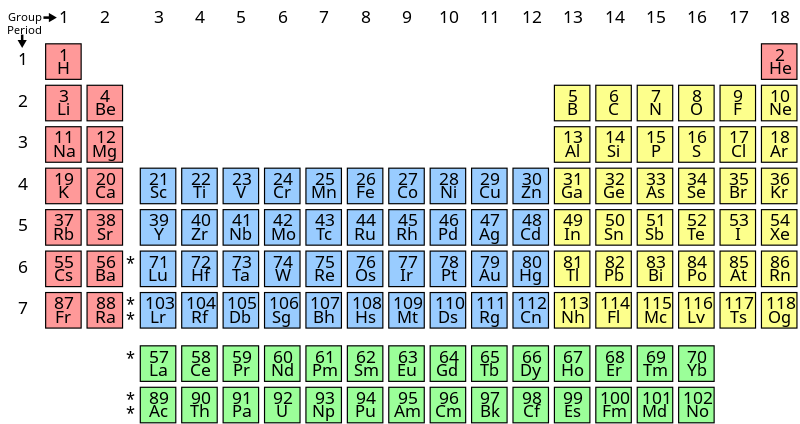
File:Simple_Periodic_Table_Chart-blocks.svg · Wikimedia Commons · See Wikimedia Commons
period 1
Sign in to saveAlso known as period 1 element
first row (or period) of the periodic table of the chemical elements
Period 1 is the first row of the periodic table, containing only the two lightest elements: hydrogen and helium. It matters because these elements are the most abundant in the universe and form the foundation for understanding how all other, heavier elements are organized and behave.
AI-generated from the Wikipedia summary — may contain errors.
In the Vinony graph
Vinony's link graph records 376 inbound references to period 1, and connects out to block, noble gases and salt.
It is catalogued under the topic Periods (periodic table).
Vinony links it to 61 Wikipedia language editions.
Wikidata facts
- Instance of
- period
- Has part
- chemical element
- Followed by
- period 2
- Image
- Helium discharge tube.jpg
Show 3 more facts
- Commons category
- Periodic table row 1
- topic's main category
- Category:Periodic table row 1
- on focus list of Wikimedia project
- Wikipedia:Vital articles/Level/4
Sources (1)
via Wikidata · CC0
~11 min read
Encyclopedic overview
Period 1 in the periodic table
A period 1 element is one of the chemical elements in the first row (or period) of the periodic table of the chemical elements. The periodic table is laid out in rows to illustrate periodic (recurring) trends in the chemical behaviour of the elements as their atomic number increases: a new row is begun when chemical behaviour begins to repeat, meaning that analog elements fall into the same vertical columns. The first period contains fewer elements than any other row in the table, with only two: hydrogen and helium. This situation can be explained by modern theories of atomic structure. In a quantum mechanical description of atomic structure, this period corresponds to the filling of the 1s orbital. Period 1 elements obey the duet rule in that they need two electrons to complete their valence shell.
Excerpted from Wikipedia’s “period 1” article, available under the CC BY-SA 4.0 licence.
Gallery (4)
Available in 61 languages
- Español
- Français
- Deutsch
- 中文
- 日本語
- Русский
- Português
- Italiano
- العربية
- Angika
- Aragonese
- Asturian
- Azerbaijani
- Bahasa Indonesia
- Bangla
- Bashkir
- Basque
- Bhojpuri
Show 42 more
- Bulgarian
- Catalan
- Czech
- Danish
- Esperanto
- Finnish
- Georgian
- Greek
- Icelandic
- Interlingua
- Latin
- Lithuanian
- Lombard
- Luxembourgish
- Macedonian
- Malay
- Malayalam
- Nederlands
- Northern Frisian
- Polski
- Punjabi
- Romanian
- Serbian
- Serbian (Latin)
- simple
- Sinhala
- Slovak
- Slovenian
- Tamil
- Telugu
- Tiếng Việt
- Türkçe
- Ukrainian
- Welsh
- West Flemish
- Western Frisian
- Wu Chinese
- zh_min_nan
- zh_yue
- فارسی
- ไทย
- 한국어
via Wikidata sitelinks · CC0