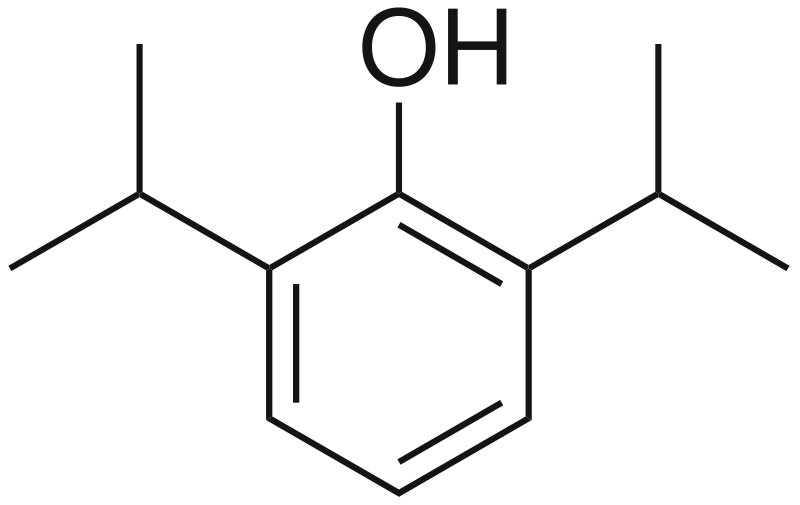
File:Propofol.svg · Wikimedia Commons · See Wikimedia Commons
propofol
Sign in to saveAlso known as 2,6-diisopropylphenol, ICI 35868, 2,6-bis(1-methylethyl)phenol, 2,6-di(propan-2-yl)phenol
Propofol is the active component of an intravenous anesthetic formulation used for induction and maintenance of general anesthesia. The formulation was approved under the brand name Diprivan. Numerous generic versions have since been released. Intravenous administration is used to induce unconsciousness, after which anesthesia may be maintained using a combination of medications. It is manufactured as part of a sterile injectable emulsion formulation using soybean oil and lecithin, giving it a white milky coloration.
OverviewAI-generated
Propofol is a chemical compound with the formula C₁₂H₁₈O. Its IUPAC name is 2,6-di(propan-2-yl)phenol. The substance has a mass of 178.136 and a density of 0.955. Physical properties include a melting point of 18, a boiling point of 247, and a refractive index of 1.5140.
Chemical analysis indicates that propofol has an xlogp of 3.8 and a tpsa of 20.2. It contains one hydrogen bond donor and one hydrogen bond acceptor, with a charge of 0. The canonical SMILES representation is CC(C)C1=C(C(=CC=C1)C(C)C)O.
The compound is referenced by 1,153 other encyclopedia articles. A search for propofol in PubMed yields a count of 29528.
Synthesized by Vinony from 22 facts across 4 sources: Wikidata, PubMed, PubChem, Vinony graph. Generated from structured data (not the Wikipedia text) and checked against those facts — may still contain errors.
Key facts
- Drug.Watchedfields
- changed
- Drug.verifiedrevid
- 456484691
- Drug.image
- Propofol.svg
- Drug.image_class
- skin-invert-image
- Drug.image2
- Propofol ball-and-stick model from xtal 2014.png
- Drug.image_class2
- bg-transparent
- Drug.alt2
- Ball-and-stick model of propofol
- Drug.tradename
- Diprivan, others
- Drug.DailyMedID
- Propofol
- Drug.pregnancy_AU
- C
- Drug.addiction_liability
- Moderate
- Drug.dependency_liability
- Physical: Very high Psychological: no data
- Drug.routes_of_administration
- Intravenous
- Drug.class
- GABAA receptor agonist;sedative;general anesthetic
- Drug.ATC_prefix
- N01
- Drug.ATC_suffix
- AX10
- Drug.legal_AU
- S4
- Drug.legal_BR
- C1
via Wikipedia infobox
Chemical data
- Formula
- C12H18O
- Molecular weight
- 178.27 g/mol
- IUPAC name
- 2,6-di(propan-2-yl)phenol
- SMILES
- CC(C)C1=C(C(=CC=C1)C(C)C)O
- InChIKey
- OLBCVFGFOZPWHH-UHFFFAOYSA-N
- XLogP
- 3.8
- Polar surface area
- 20.2 Ų
- H-bond donors
- 1
- H-bond acceptors
- 1
- Formal charge
- 0
via PubChem
Drug data · ChEMBL
- Max clinical phase
- Approved
- Molecule type
- Small molecule
- First approval
- 1989
- Admin. routes
- parenteral
- Indications
- leukemia, morbid obesity, pain, hypertension
via ChEMBL · EBI
Research
29,528 papers- Propofol: Milk of Amnesia.Cell · 2018
- Propofol infusion syndrome: a structured literature review and analysis of published case reports.British journal of anaesthesia · 2019
- Propofol: A Medication That Changed Pediatric Anesthesia Practice.Paediatric anaesthesia · 2025
- Propofol.Dimensions of critical care nursing : DCCN · 2001
- [Propofol: use, toxicology and assay features].Sudebno-meditsinskaia ekspertiza · 2022
via PubMed
Wikidata facts
- Subclass of
- chemical compound
- Mass
- 178.136
- Manufacturer
- Pfizer
- Has use
- medication
Show 10 more facts
- Commons category
- Propofol
- chemical formula
- C₁₂H₁₈O
- medical condition treated
- anaesthesia
- canonical SMILES
- CC(C)C1=C(C(=CC=C1)C(C)C)O
- World Health Organisation international non-proprietary name
- propofolum
- melting point
- 18
- boiling point
- 247
- density
- 0.955
- refractive index
- 1.5140
- subject has role
- essential medicine
via Wikidata · CC0
~17 min read
Encyclopedic overview
21 sectionsContents
- Uses
- Anesthesia
- Routine procedural sedation
- COVID-19
- Status epilepticus
- Other uses
- Assisted death in Canada
- Capital punishment
- Recreational use
- Manufacturing
- Side effects
- Propofol infusion syndrome
- Interactions
- Pharmacology
- Pharmacodynamics
- Pharmacokinetics
- History
- Developments
- Veterinary uses
- References
- External links
Propofol is the active component of an intravenous anesthetic formulation used for induction and maintenance of general anesthesia. The formulation was approved under the brand name Diprivan. Numerous generic versions have since been released. Intravenous administration is used to induce unconsciousness, after which anesthesia may be maintained using a combination of medications. It is manufactured as part of a sterile injectable emulsion formulation using soybean oil and lecithin, giving it a white milky coloration.
Compared to other anesthetic agents, recovery from propofol-induced anesthesia is generally rapid and associated with less frequent side effects (e.g., drowsiness, nausea, vomiting). Propofol may be used prior to diagnostic procedures requiring anesthesia, in the management of refractory status epilepticus, and for induction or maintenance of anesthesia prior to and during surgeries. It may be administered as a bolus or an infusion, or as a combination of the two.
Excerpted from Wikipedia’s “propofol” article, available under the CC BY-SA 4.0 licence.