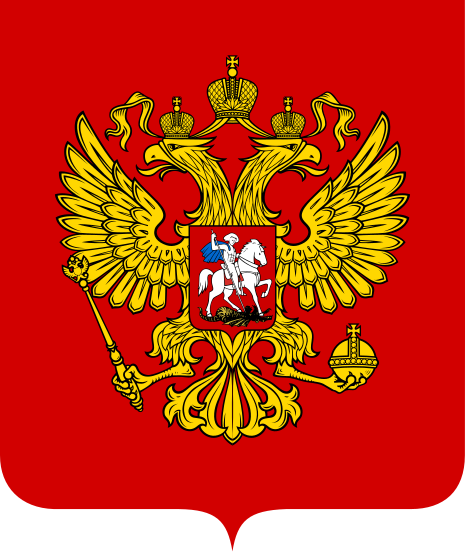
Also known as Russian Federation, Federation of Russia
ヨーロッパ・アジアの国
Russia is the world's largest country, spanning Eastern Europe and North Asia across eleven time zones and bordering fourteen nations, with a population of over 140 million people. It matters globally due to its enormous size, significant population, and major cities like Moscow—Europe's most populous metropolitan area—which serve as centers of political, economic, and cultural influence.
AI-generated from the Wikipedia summary — may contain errors.
via Open-Meteo
{| style="float:right; clear:right;margin-left: 1em; width:280px;" cellpadding=8 cellspacing=1 border=0 |- |align=left width=100% style="color: #333; background-color:#f3f3ff; border:1px solid; padding-left: 0.5em; padding-right: 0.5em"| Russia, by mind, one can't understand,Nor measure by common yardstick.She has of herself a build unique:In Russia you only believe.
«Умом Россию не понять, Аршином общим не измерить: У ней особенная стать — В Россию можно только верить.»,Fyodor Tyutchev, 1866 |}
Russia was the most senior of the 15 republics of the Soviet Union, and still bears scars from its dissolution in the 1990s, with tensions with neighbours, as well as within the country itself. While the country is officially styled the Russian Federation (Russian: Российская Федерация, Rossiskaya Federatsia) and the federal subjects and autonomous republic have some nominal self-government, power has always been centered around Moscow. Out of the nearly 150 million inhabitants, around 30 million have an ethnicity other than Russian; see Minority cultures of Russia.
Russia has exceptionally onerous visa requirements. In most cases, you have to obtain a notarised letter of invitation from a Russian citizen or organisation before you can apply for a visa.
Some parts of the country ― for example, Chukotka and Norilsk, and many of the border regions ― are closed to foreigners unless they acquire special permits from the government. In most cases, you will need a local sponsor in the region to issue you an invitation through the local FSB office before you can apply for the permit, but some of these regions can be visited by foreigners on package tours, in which case your tour company will obtain all the relevant permits for you.
Although Russia has an open border with Belarus, third country nationals are not permitted to cross the border between Russia and Belarus overland; they are required to fly to travel directly between the two countries.
thumb|Visa policy of Russia: countries in turquoise have access to e-Visa, countries in grey normally require a normal visa to enter Russia, other colours mean visa-free for different periods.|400px
The enormous distances hamper all forms of transportation. While the Russian government has tried to make the vast space more accessible since tsarist times much of the country is still hard to reach and even where trains and roads go, travel time is often measured in days not hours. Consider flying for far-off destinations — domestic flight routes cover the country pretty well.
ロシア連邦(ロシアれんぽう、ロシア語: Российская Федерация、通称ロシア、Россия)は、ユーラシア大陸北部に位置する連邦共和制国家である。首都はモスクワ市。 領土は旧ロシア帝国およびソビエト連邦の大半を引き継いでおり、ヨーロッパからシベリア・極東に及ぶ。面積は1709万平方キロメートル以上と世界最大である。
Abstract from DBpedia / Wikipedia · CC BY-SA
6 mapped locations
Discovered by embedding cosine similarity (sentence-transformers MiniLM, 384-dim).
via REST Countries
via World Bank Open Data · CC BY 4.0
via Wikimedia Pageviews API
via Wikipedia infobox
via PubMed
via Wikidata · CC0
Due to Western sanctions on Russia, Google Maps and Apple Maps may be outdated and unreliable. Instead, most Russians use local app Yandex Maps, which is also available in English, for navigation.
thumb|280px|Russian folk singers performing songs in a traditionally-decorated room
Music — Russia has a long musical tradition and is well known for its composers and performers. There is no doubt you will find more orchestra performances the bigger the city. Classical music is played in various theaters, where domestic and guest concerts are scheduled for weeks ahead. Russia has one of the world's strongest classical music traditions, having give rise to numerous great composers such as Tchaikovsky, Mussorgsky, Rachmaninoff and Prokofiev, and even today the Moscow Conservatory is regarded as one of the best in the world, with Russia producing many of the world's top instrumentalists and opera singers. Besides that, the state supports folk ensembles in smaller towns or even villages and singing babushkas gatherings are still a well-established tradition in many areas. In areas traditionally inhabited by ethnic minorities, you may encounter ethnic music of every possible sound, like throat singing in Tuva or rare instruments of Chukotka. Sometimes only specialists can distinguish the Cossack songs of the Urals from the Cossack songs of Krasnodar. Professional jazz players meet at Jazz over Volga festival in Yaroslavl. Walking along the main street on a Sunday will definitely enable you to hear guitar, saxophone, harmonium or flute in any city. Military Parade on the Victory Day, which is celebrated on the 9th of May is commonly all-Russia holiday with city squares getting fu…
Most foreign credit and debit cards no longer work in Russia. Your access to funds may be hindered as Russian banks have been shut out of the international monetary system. Wire transfers are not possible. As a result, you will need to bring physical cash into Russia and open a Russian bank account, which is relatively easy with Sber or Tinkoff Online.
thumb|280px|Bliny buckwheat pancakes with salmon roe (ikra), sour cream (smetana) and chopped onion
The foundations of the Russian cuisine was laid by the peasant food in an often harsh climate, with a combination of fish, poultry, game, mushrooms, berries, and honey. Crops of rye, wheat, buckwheat, barley, and millet provided the ingredients for a plethora of breads, pancakes, cereals, kvass, beer, and vodka. Flavourful soups and stews centred on seasonal or storable produce, fish, and meats. Russia's renowned caviar is easily obtained, however prices can exceed the expenses of your entire trip. Dishes such as beef Stroganov and chicken kiev, from the pre-revolutionary era are available but mainly aimed at tourists as they lost their status and visibility during Soviet times.
Russia has for many decades suffered a negative reputation for its food, and Russian cuisine was known for being bland and overly stodgy. However, the food scene has improved in the past years and Russia has also been known and famous for delicacies like caviar.
Russian specialities include:
Ikra (sturgeon or salmon caviar) Pelmeni (meat-filled dumplings, similar to pot-stickers, especially popular in Ural and Siberian regions) Bliny (white flour or buckwheat pancakes, may be thin, or thick and airy baked), blinchiki (thin white flour pancakes, similar to French crêpes) Black bread (rye bread, somewhat similar to one used by North American delis and not as dense as German variety) Pirozhki (small pi…
Vodka, imported liquors (rum, gin, etc.), imported (Pepsi, Coca-Cola, Fanta, etc.) and local soft drinks (Tarkhun, Buratino, Baikal, etc.), distilled water, kvass (sour-sweet non-alcoholic naturally carbonized drink made from fermented dark bread) and mors (traditional wild berry drink).
Beer (пиво) is cheap in Russia and the varieties are endless of both Russian and international brands. It is found for sale at any street vendor (warm) or stall (varies) in the centre of any city and costs (costs double and triple the closer you are to the centre) from about to for a bottle or can. "Small" bottles and cans ( and thereabouts) are also widely sold, and there are also plastic bottles of or even more, similar to those in which soft carbonated drinks are usually sold — many cheaper beers are sold that way and, being even cheaper due to large volume, are quite popular, despite some people say it can have a "plastic" taste. Corner stores/cafés, selling draft beer (highly recommended) also exist, but you have to seek them out. The highest prices (especially in the bars and restaurants) are traditionally in Moscow; Saint-Petersburg, on the other hand, is known for the cheaper and often better beers. Smaller cities and towns generally have similar prices if bought in the shop, but significantly lower ones in the bars and street cafés. Popular local brands of beer are Baltika, Stary Mel'nik, Bochkareff, Zolotaya Bochka, Tin'koff and many others. Locally made (mainly except some Czech a…
thumb|250px|Hotel in [[Vladivostok, a city in the Russian Far East]] In most cities, quality hotels are really scarce: most were built in Soviet times decades ago and have been renovated in decor, but rarely in service and attitude. Even for a local, it's quite a problem to find a good hotel without a recommendation from a trusted person. For the same reason, it may be really hard to find a hotel during mass tourist-oriented events like St. Petersburg's anniversary.
Generally chained-brand hotels provide better service than independents.
thumb|left|250px|Modern apartments in [[Yekaterinburg]] Hotels in Russia may be quite expensive in metropolises and touristy areas. If you do speak a bit of Russian and are not entirely culture shocked, it is much smarter to seek out and rent a room in a private residence. Most Russians are looking to make extra money and, having space to spare, will rent it out to a tourist gladly. Native Moscovites or residents of Saint Petersburg would rather rent out to tourists than their own countrymen: foreigners are considered more trustworthy and orderly. Breakfast is usually prepared by your host and the accommodations will certainly be very clean and proper if not modern. When it comes to home/family life, Russian culture is very warm and inviting.
Another useful option is short-term apartment rental offered by small companies or individuals. This means that certain flats in regular living buildings are permanently rented out on a daily basis. T…
thumb|right|270px|'Sobriety is a Standard of Our Life!'.A Soviet-time mosaic on the wall of a hospital in [[Kaliningrad]] Medical facilities in general vary. A majority of hospitals are extremely well equipped, clean, and possess all of the latest technologies, while there are some that are well below Western standards, with shortages in medication and neglected equipment.
Ensure that all of your vaccinations are up to date, and you have sufficient amounts of any prescription medicine you may be taking. Pharmacies are common in major cities and carry quality Western medications.
Quality of tap water varies around the country, and may even be variable within cities. In old buildings tap water can be non-potable. In the big cities of European Russia, the water is clean of biological contaminants, but often suffers from the presence of heavy metals, due to outdated city plumbing. If you can't buy bottled water, boil water before drinking, or better yet use a special filter for tap water, which you could buy in any supermarket. Bottled water costs only about for .
Besides local doctors (generally good quality but often working in poor facilities) there are several Western-styled medical centres in major Russian cities. These all have different policies for payment so make sure you know what you are paying for (and when and how) before you agree to any services.
Be careful not to buy fake vodka, which can be dangerous (seriously here, 'dangerous' doesn't mean 'strong'; it can …
Russians are generally reserved and well-mannered, and tend to be more traditional than other Europeans. This is partly due to the influence of the Russian Orthodox Church, which is a major force in Russian society.
Travel guide from Wikivoyage (CC BY-SA 4.0)
via Wikidata sitelinks · CC0