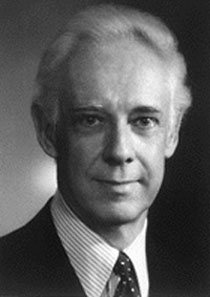
File:Stanford_Moore.jpg · Wikimedia Commons · See Wikimedia Commons
Stanford Moore
Sign in to saveAmerican biochemist (1913-1982)
Stanford Moore was an American biochemist who lived from 1913 to 1982 and made important contributions to the study of proteins and amino acids. His work helped scientists better understand the chemical composition of living organisms, which has applications in medicine and biological research.
AI-generated from the Wikipedia summary — may contain errors.
Key facts
- Born
- ( 1913-09-04 ) September 4, 1913, Chicago , Illinois
- Died
- August 23, 1982 (1982-08-23) (aged 68), New York City , New York
- Education
- Vanderbilt University , University of Wisconsin–Madison , University School of Nashville
- Known for
- Ribonuclease
- Awards
- Nobel Prize in Chemistry in 1972
- Fields
- Biochemistry
- Institutions
- Rockefeller University
- Thesis
- The identification of carbohydrates as benzimidazole derivatives (1938)
- Doctoral advisor
- Karl Paul Link
via Wikipedia infobox
Nobel Prize
- The Nobel Prize in Chemistry1972
“for their contribution to the understanding of the connection between chemical structure and catalytic activity of the active centre of the ribonuclease molecule”
Shared · 1/4 portion
Wikidata facts
- Instance of
- human
- Family name
- Moore
- Gender
- male
- Citizenship
- United States
- Place of birth
- Chicago
- Place of death
- New York City
- Occupation
- university teacher
- Languages spoken
- English language
- Doctoral advisor
- Karl Paul Link
- Student of
- Max Bergmann
- Field of work
- chromatography
Show 6 more facts
- member of
- National Academy of Sciences
- date of birth
- 1913-09-04
- date of death
- 1982-08-23
- nominated for
- Nobel Prize in Physiology or Medicine
- name in native language
- Stanford Moore
- interested in
- biochemistry
Sources (7)
via Wikidata · CC0
~2 min read
Encyclopedic overview
Stanford Moore (September 4, 1913 – August 23, 1982) was an American biochemist. He shared a Nobel Prize in Chemistry in 1972, with Christian B. Anfinsen and William Howard Stein, for work done at Rockefeller University on the structure of the enzyme ribonuclease and for contributing to the understanding of the connection between the chemical structure and catalytic activity of the ribonuclease molecule.
Moore attended Peabody Demonstration School, now known as University School of Nashville, and in 1935 graduated summa cum laude from Vanderbilt University, where he was a member of Phi Kappa Sigma. He earned his doctorate in Organic Chemistry from the University of Wisconsin–Madison in 1938. Moore then joined the staff of the Rockefeller Institute, later Rockefeller University, where he spent his entire professional career, with the exception of a period of government service during World War II. He became Professor of Biochemistry in 1952.
Excerpted from Wikipedia’s “Stanford Moore” article, available under the CC BY-SA 4.0 licence.