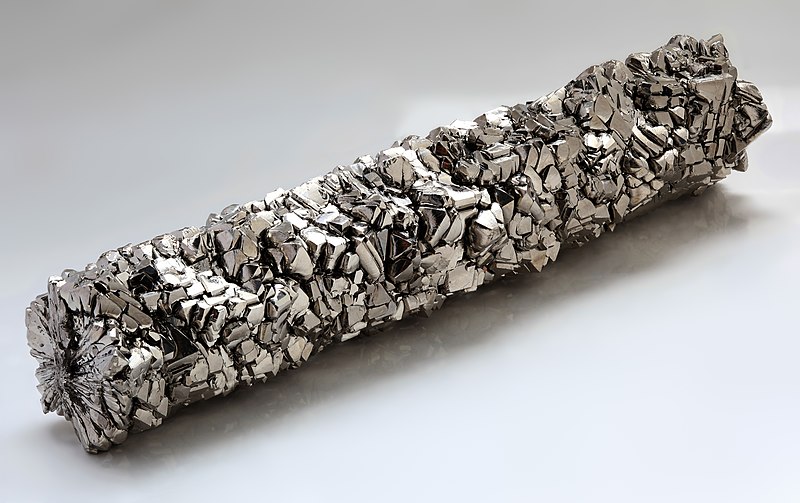
File:Titan-crystal_bar.JPG · Wikimedia Commons · See Wikimedia Commons
OverviewAI-generated
Titanium is a chemical element with the symbol Ti and atomic number 22. Its standard atomic weight is 47.867. The element exhibits oxidation states of -1, 1, 2, and 4. It has an electronegativity of 1.54 and an ionic radius of 0.86. The Unicode character for titanium is "鈦".
Titanium was discovered in 1791. It has a melting point of 1941 and a boiling point of 3286.85. The speed of sound in the material is 5090. Its thermal conductivity is 21.9, and its specific heat capacity is 520. The tensile modulus of elasticity is 116, with a shear modulus of 41.4 and a Poisson's ratio of 0.32.
The Mohs' hardness is 6, and the hardness value is 2125. The chemical formula is Ti. In chemical databases, it is identified by CID 23963 and IUPAC name titanium. It has zero hydrogen bond donors and acceptors, with a topological polar surface area of 0. The element is referenced by 2,716 other encyclopedia articles.
Synthesized by Vinony from 34 facts across 4 sources: Wikidata, PubChem, PubMed, Vinony graph. Generated from structured data (not the Wikipedia text) and checked against those facts — may still contain errors.
Chemical data
- Formula
- Ti
- Molecular weight
- 47.867 g/mol
- IUPAC name
- titanium
- SMILES
- [Ti]
- InChIKey
- RTAQQCXQSZGOHL-UHFFFAOYSA-N
- Polar surface area
- 0 Ų
- H-bond donors
- 0
- H-bond acceptors
- 0
- Formal charge
- 0
via PubChem
Research
92,166 papers- Titanium mesh for bone augmentation in oral implantology: current application and progress.ReviewInternational journal of oral science · 2020Xie Y, Li S, Zhang T et al.DOI: 10.1038/s41368-020-00107-z
- Titanium Dioxide: Structure, Impact, and Toxicity.ReviewInternational journal of environmental research and public health · 2022Racovita ADDOI: 10.3390/ijerph19095681
- Type IV Titanium Hypersensitivity: Rare, or Rarely Detected?ReviewActa chirurgiae orthopaedicae et traumatologiae Cechoslovaca · 2023Voves J, Měrka O, Čabanová K et al.
- Blood titanium level as a biomarker of orthopaedic implant wear.ReviewJournal of trace elements in medicine and biology : organ of the Society for Minerals and Trace Elements (GMS) · 2019Swiatkowska I, Martin N, Hart AJDOI: 10.1016/j.jtemb.2019.02.013
- Titanium corrosion products from dental implants and their effect on cells and cytokine release: A review.ReviewJournal of trace elements in medicine and biology : organ of the Society for Minerals and Trace Elements (GMS) · 2024Kandaswamy E, Harsha M, Joshi VMDOI: 10.1016/j.jtemb.2024.127464
- Titanium dioxide.ReviewIARC monographs on the evaluation of carcinogenic risks to humans · 1989
- [Progress in antibacterial coatings of titanium implants surfaces].ReviewSheng wu yi xue gong cheng xue za zhi = Journal of biomedical engineering = Shengwu yixue gongchengxue zazhi · 2024He X, Guo C, Liu X et al.DOI: 10.7507/1001-5515.202209051
- Titanium--the material of choice?ReviewPeriodontology 2000 · 1998Steinemann SGDOI: 10.1111/j.1600-0757.1998.tb00119.x
via PubMed
Article · Español
El titanio es un elemento químico de símbolo Ti y número atómico 22 que se sitúa en el grupo 4 de la tabla periódica de los elementos. Es un metal de transición de color gris, baja densidad y gran dureza. Es muy resistente a la corrosión por agua del mar, agua regia y cloro. Fue descubierto independientemente en 1791 por William Gregor en una mina de Cornualles, Gran Bretaña, y en 1795 por Martin Heinrich Klaproth, que lo nombró «titanio» por los titanes de la mitología griega.[cita requerida] Este elemento abunda en depósitos de minerales, principalmente en forma de óxidos como el rutilo y la ilmenita, ampliamente distribuidos en la corteza terrestre y la litosfera; también se encuentra en los seres vivos, cuerpos de agua y objetos extraterrestres. La extracción de este metal a partir del mineral se realiza mediante el método de Kroll o por el método de Hunter. El compuesto más común es el dióxido de titanio, utilizado para la fotocatálisis y la fabricación de pigmentos de color blanco. Otros compuestos habituales incluyen el tetracloruro de titanio (TiCl4), un componente catalizador, y el (TiCl3), que se utiliza como catalizador en la producción de polipropileno. En estado puro, presenta una elevada resistencia a la corrosión y la mayor proporción de dureza-densidad de todos los elementos metálicos. El titanio es tan fuerte como algunos aceros, pero su densidad es menor. Tiene dos formas alotrópicas y cinco isótopos naturales que van desde 46Ti hasta 50Ti, siendo 48Ti el más abundante de ellos. El titanio puede formar aleaciones con el hierro, el aluminio, el vanadio y el molibdeno entre otros elementos, idóneas por sus propiedades de ligereza y resistencia para la construcción de maquinaria para aplicaciones aeroespaciales —motores de reacción, misiles y naves espaciales—, militares, industriales —almacenamiento y transporte de productos químicos y petroquímicos, y plantas de desalinización—, en la automoción, para prótesis médicas e implantes ortopédicos, instrumentos e implantes dentales, aparatos deportivos, joyería o teléfonos móviles.
Abstract from DBpedia / Wikipedia · CC BY-SA
Gallery (45)
Available in 164 languages
- Español
- Français
- Deutsch
- 中文
- 日本語
- Русский
- Português
- Italiano
- العربية
- हिन्दी
- abstract
- Afrikaans
- Albanian
- Amharic
- Angika
- Aragonese
- Armenian
- Asturian
Show 145 more
- Awadhi
- azb
- Azerbaijani
- Bahasa Indonesia
- Balinese
- Bangla
- Bashkir
- Basque
- be_x_old
- Belarusian
- Bhojpuri
- Bikol
- blk
- Bosnian
- Breton
- Bulgarian
- Burmese
- Catalan
- cdo
- Cebuano
- Central Kurdish
- Cherokee
- Chuvash
- Cornish
- Corsican
- Croatian
- Czech
- Danish
- Egyptian Arabic
- Erzya
- Esperanto
- Estonian
- Faroese
- Fiji Hindi
- Fijian
- Filipino
- Finnish
- Friulian
- Galician
- Gan Chinese
- Georgian
- Greek
- Gujarati
- Haitian Creole
- Hakka Chinese
- Hawaiian
- Hebrew
- Hungarian
- Icelandic
- Ido
- Interlingua
- Irish
- Javanese
- Kalmyk
- Kannada
- Kazakh
- kbp
- Kikuyu
- Komi
- Kotava
- Kurdish
- Kyrgyz
- Latin
- Latvian
- Ligurian
- Limburgish
- Lithuanian
- Lojban
- Lombard
- Low German
- Luxembourgish
- Macedonian
- Malagasy
- Malay
- Malayalam
- Manx
- Marathi
- Minangkabau
- Moksha
- Mongolian
- Moroccan Arabic
- Navajo
- Nederlands
- Newari
- Northern Frisian
- Norwegian
- Norwegian Nynorsk
- Novial
- nup
- Occitan
- Odia
- olo
- Ossetic
- Papiamento
- Pashto
- Piedmontese
- Polski
- Punjabi
- Quechua
- roa_rup
- Romanian
- Sanskrit
- Sardinian
- Saterland Frisian
- Scots
- Scottish Gaelic
- Serbian
- Serbian (Latin)
- Sicilian
- simple
- Sindhi
- Sinhala
- Slovak
- Slovenian
- Somali
- Sundanese
- Svenska
- Swahili
- Tajik
- Tamil
- Tatar
- Telugu
- Tibetan
- Tiếng Việt
- Toki Pona
- Türkçe
- Ukrainian
- Urdu
- Uyghur
- Uzbek
- Veps
- Waray
- Welsh
- Western Mari
- Western Panjabi
- Wu Chinese
- Yiddish
- Yoruba
- zh_classical
- zh_min_nan
- zh_yue
- Zulu
- فارسی
- ไทย
- 한국어
via Wikidata sitelinks · CC0