Category
page 1Transition metals

gold
Gold is a chemical element; its chemical symbol is Au (from Latin ) and atomic number 79. In its pure form, it is a bright-metallic-yellow, dense, soft, malleable, and ductile metal. Chemically, gold is a transition metal, a group 11 element, and one of the noble metals. It is one of the least reactive chemical elements, being the second lowest in the reactivity series, with only platinum ranked as less reactive. Gold is solid under standard conditions.

iron
Iron is a chemical element; it has symbol Fe () and atomic number 26. It is a metal that belongs to the first transition series and group 8 of the periodic table. It is, by mass, the most common element on Earth, forming much of Earth's outer and inner core. It is the fourth most abundant element in the Earth's crust. In its metallic state it was mainly deposited by meteorites.

silver
Silver is a chemical element; it has symbol Ag () and atomic number 47. A soft, whitish-gray, lustrous transition metal, it exhibits the highest electrical conductivity, thermal conductivity, and reflectivity of any metal. Silver is found in the Earth's crust in the pure, free elemental form ("native silver"), as an alloy with gold and other metals, and in minerals such as argentite and chlorargyrite. Most silver is produced as a byproduct of copper, gold, lead, and zinc refining.

copper
Copper is a chemical element; it has symbol Cu (from Latin ) and atomic number 29. It is a soft, malleable, and ductile metal with very high thermal and electrical conductivity. A freshly exposed surface of pure copper has a pinkish-orange color. Copper is used as a conductor of heat and electricity, as a building material, and as a constituent of various metal alloys, such as sterling silver used in jewelry, cupronickel used to make marine hardware and coins, and constantan used in strain gauges and thermocouples for temperature measurement.

mercury
chemical element with symbol Hg and atomic number 80

zinc
Zinc is a chemical element; it has symbol Zn and atomic number 30. It is a slightly brittle metal at room temperature and has a shiny blue whitish appearance when surface oxidation is removed. It is the first element in group 12 (IIB) of the periodic table. Zinc is the 24th most abundant element in Earth's crust, with an average concentration of 70 grams per ton. Zinc also has five stable isotopes; the most abundant of which, Zn-64, comprises nearly half of zinc's total abundance. In some respects, zinc is chemically similar to magnesium: both elements exhibit only one normal oxidation state (

titanium
Titanium is a chemical element; it has symbol Ti and atomic number 22. Found in nature only as an oxide, it can be reduced to produce a lustrous transition metal with a silver color, low density, and high strength that is resistant to corrosion in sea water, aqua regia, and chlorine.

cobalt
Cobalt is a chemical element; it has symbol Co and atomic number 27. As with nickel, cobalt is found in the Earth's crust only in a chemically combined form, save for small deposits found in alloys of natural meteoric iron. The free element, produced by reductive smelting, is a hard, lustrous, somewhat brittle, gray metal.

manganese
Manganese is a chemical element; it has the symbol Mn and atomic number 25. It is a hard, brittle, silvery metal, often found in minerals in combination with iron. First isolated in the 1770s, manganese is a transition metal with many industrial alloy uses, particularly in stainless steels in which it improves strength, workability, and resistance to wear. Manganese oxide is used as an oxidising agent, as a rubber additive, and in glass making, fertilizers, and ceramics. Manganese sulfate can be used as a fungicide.

nickel
Nickel is a chemical element; it has symbol Ni and atomic number 28. It is a silvery-white lustrous metal with a slight golden tinge. Nickel is a hard and ductile transition metal. Pure nickel is chemically reactive, but large pieces are slow to react with air under standard conditions because a passivation layer of nickel oxide that prevents further corrosion forms on the surface. Even so, pure native nickel is found in Earth's crust only in tiny amounts, usually in ultramafic rocks, and in the interiors of larger nickel–iron meteorites that were not exposed to oxygen when outside Earth's atm

platinum
Platinum is a chemical element; it has symbol Pt and atomic number 78. It is a dense, malleable, ductile, highly unreactive, precious, silverish-white transition metal. Its name originates from Spanish , a diminutive of "silver".

vanadium
Vanadium is a chemical element; it has symbol V and atomic number 23. It is a hard, silvery-grey, malleable transition metal. The elemental metal is rarely found in nature, but once isolated artificially, the formation of an oxide layer (passivation) somewhat stabilizes the free metal against further oxidation.

cadmium
Cadmium is a chemical element; it has symbol Cd and atomic number 48. This soft, silvery-white metal is chemically similar to the two other stable metals in group 12, zinc and mercury. Like zinc, it demonstrates oxidation state +2 in most of its compounds, and like mercury, it has a lower melting point than the transition metals in groups 3 through 11. Cadmium and its congeners in group 12 are often not considered transition metals, in that they do not have partly filled d or f electron shells in the elemental or common oxidation states. The average concentration of cadmium in Earth's crust is

scandium
Scandium is a chemical element; it has symbol Sc and atomic number 21. It is a silvery-white metallic element found in the d-block of the periodic table. Usually, it is classified as a rare-earth element, together with yttrium and the lanthanides. It was discovered in 1879 by spectral analysis of the minerals euxenite and gadolinite from Scandinavia.

tungsten
Tungsten (also called wolfram) is a chemical element which has the symbol W (from ) and atomic number 74. It is a metal found naturally on Earth almost exclusively in compounds with other elements. It was identified as a distinct element in 1781 and first isolated as a metal in 1783. Its important ores include scheelite and wolframite, the latter lending the element its alternative name.
.jpg)
niobium
Niobium is a chemical element; it has symbol Nb (formerly columbium, Cb) and atomic number 41. It is a light grey, crystalline transition metal. Pure niobium has a Mohs hardness rating similar to pure titanium, and it has similar ductility to iron. Niobium oxidizes in Earth's atmosphere very slowly, hence its application in jewelry as a hypoallergenic alternative to nickel. Niobium is found in the minerals pyrochlore and columbite, as well as other minerals. Its name comes from Greek mythology: Niobe, daughter of Tantalus, the namesake of tantalum. The name reflects the great similarity betwee

iridium
Iridium is a chemical element; it has the symbol Ir and atomic number 77. This very hard, brittle, silvery-white transition metal of the platinum group is considered the second-densest naturally occurring metal (after osmium), with a density of as defined by experimental X-ray crystallography. 191Ir and 193Ir are the only two naturally occurring isotopes of iridium, as well as the only stable isotopes; the latter is the more abundant. It is one of the most corrosion-resistant metals, even at temperatures as high as .
2.jpg)
palladium
Palladium is a chemical element; it has the symbol Pd and atomic number 46. It is a rare and lustrous silvery-white metal discovered in 1802 by the English chemist William Hyde Wollaston. He named it after the asteroid Pallas (formally 2 Pallas), which was itself named after the epithet of the Greek goddess Athena, acquired by her when she slew Pallas. Palladium, platinum, rhodium, ruthenium, iridium and osmium form together a group of elements referred to as the platinum group metals. They have similar chemical properties, but palladium has the lowest melting point and is the least dense of t

molybdenum
Molybdenum is a chemical element; it has symbol Mo and atomic number 42. The name is derived from Ancient Greek '''', meaning lead, since its ores were sometimes confused with those of lead. Molybdenum minerals have been known throughout history, but the element was discovered (in the sense of differentiating it as a new entity from the mineral salts of other metals) in 1778 by Carl Wilhelm Scheele. The metal was first isolated in 1781 by Peter Jacob Hjelm.

yttrium
thumb|upright=0.7|Piece of Yttrium
Yttrium is a chemical element; it has symbol Y and atomic number 39. It is a silvery-metallic transition metal chemically similar to the lanthanides and has often been classified as a rare-earth element. Yttrium is almost always found in combination with lanthanide elements in rare-earth minerals and is never found in nature as a free element. 89Y is the only stable isotope and the only isotope found in the Earth's crust.

osmium
Osmium () is a chemical element; it has symbol Os and atomic number 76. It is a hard, brittle, bluish-white transition metal in the platinum group. Osmium has the highest density of any stable element and one of the lowest abundances in the Earth's crust. Manufacturers use alloys of osmium with platinum, iridium, and other platinum-group metals for fountain pen nib tipping, electrical contacts, and other applications that require extreme durability and hardness.
.jpg)
technetium
Technetium is a chemical element; it has symbol Tc and atomic number 43. It is the lightest element whose isotopes are all radioactive. Technetium and promethium are the only radioactive elements whose neighbours in the sense of atomic number are both stable. All available technetium is produced as a synthetic element. Naturally occurring technetium is a spontaneous fission product in uranium ore and thorium ore (the most common source), or the product of neutron capture in molybdenum ores. This silvery gray, crystalline transition metal lies between manganese and rhenium in group 7 of th
tantalum
Tantalum is a chemical element; it has symbol Ta and atomic number 73. It is named after Tantalus, a figure in Greek mythology. Tantalum is a very hard, ductile, lustrous, blue-gray transition metal that is highly corrosion-resistant. It is part of the refractory metals group, which are widely used as components of strong high-melting-point alloys. It is a group 5 element, along with vanadium and niobium, and it always occurs in geologic sources together with the chemically similar niobium, mainly in the mineral groups tantalite, columbite, and coltan.

rhodium
Rhodium is a chemical element; it has symbol Rh and atomic number 45. It is a very rare, dark silvery-white, hard, corrosion-resistant transition metal. It is a noble metal and a member of the platinum group. It has only one naturally occurring isotope, which is 103Rh. Naturally occurring rhodium is usually found as a free metal or as an alloy with similar metals and rarely as a chemical compound in minerals such as bowieite and rhodplumsite. It is one of the rarest and most valuable precious metals. Rhodium is a group 9 element (cobalt group). It is used for the enhancement of jewelry.

zirconium
Zirconium is a chemical element; it has symbol Zr and atomic number 40. First identified in 1789, isolated in impure form in 1824, and manufactured at scale by 1925, pure zirconium is a lustrous transition metal with a greyish-white color that closely resembles hafnium and, to a lesser extent, titanium. It is solid at room temperature, ductile, malleable and corrosion-resistant. The name zirconium is derived from the name of the mineral zircon, the most important source of zirconium. The word is related to Persian zargun (zircon; zar-gun, "gold-like" or "as gold"). Besides zircon, zirconium oc

hafnium
Hafnium is a chemical element; it has symbol Hf and atomic number 72. A lustrous, silvery gray, tetravalent transition metal, hafnium chemically resembles zirconium and is found in many zirconium minerals. Its existence was predicted by Dmitri Mendeleev in 1869, though it was not identified until 1922, by Dirk Coster and George de Hevesy. Hafnium is named after , the Latin name for Copenhagen, where it was discovered. The element is obtained only by separation from zirconium, with most of the world's hafnium production coming from processes that also produce zirconium. These processes make use

ruthenium
Ruthenium is a chemical element; it has symbol Ru and atomic number 44. It is a rare transition metal belonging to the platinum group of the periodic table. Like the other metals of the platinum group, ruthenium is unreactive to most chemicals. Karl Ernst Claus, a Russian scientist of Baltic-German ancestry, discovered the element in 1844 at Kazan State University and named it in honor of Russia, using the Latin name Ruthenia. Ruthenium is usually found as a minor component of platinum ores; the annual production has risen from about 19 tonnes in 2009 to 35.5 tonnes in 2017. Mos

rhenium
Rhenium is a chemical element; it has symbol Re and atomic number 75. It is a silvery-gray, heavy, third-row transition metal in group 7 of the periodic table. With an estimated average concentration of 1 part per billion (ppb), rhenium is one of the rarest elements in the Earth's crust. It has one of the highest melting and boiling points of any element. It resembles manganese and technetium chemically and is mainly obtained as a by-product of the extraction and refinement of molybdenum and copper ores. It shows in its compounds a wide variety of oxidation states ranging from −3 to +7.

hassium
Hassium is a synthetic chemical element; it has symbol Hs and atomic number 108. It is highly radioactive: its most stable known isotopes have half-lives of about ten seconds. One of its isotopes, Hs, has magic numbers of protons and neutrons for deformed nuclei, giving it greater stability against spontaneous fission. Hassium is a superheavy element; it has been produced in a laboratory in very small quantities by fusing heavy nuclei with lighter ones. Natural occurrences of hassium have been hypothesized but never found.

rutherfordium
Rutherfordium is a synthetic chemical element; it has symbol Rf and atomic number 104. It is named after physicist Ernest Rutherford. As a synthetic element, it is not found in nature and can only be made in a particle accelerator. It is radioactive; the most stable known isotope, 267Rf, has a half-life of about 48 minutes.

lutetium
Lutetium is a chemical element; it has symbol Lu and atomic number 71. It is a silvery white metal, which resists corrosion in dry air, but not in moist air. Lutetium is the last element in the lanthanide series, and it is traditionally counted among the rare earth elements; it can also be classified as the first element of the sixth-period transition metals.

seaborgium
Seaborgium is a synthetic chemical element; it has symbol Sg and atomic number 106. It is named after the American nuclear chemist Glenn T. Seaborg. As a synthetic element, it can be created in a laboratory but is not found in nature. It is also radioactive; the most stable known isotopes have half-lives on the order of several minutes.

dubnium
Dubnium is a synthetic chemical element; it has symbol Db and atomic number 105. It is highly radioactive: the most stable known isotope, dubnium-268, has a half-life of about 16 hours. This greatly limits extended research on the element.
%2C%20lecturing%20at%20Catholic%20University%2C%20Washington%2C%20D.C.%2C%201946.jpg)
meitnerium
Meitnerium is a synthetic chemical element; it has symbol Mt and atomic number 109. It is an extremely radioactive synthetic element (not naturally occurring, but can be created in a laboratory). The most stable known isotope, meitnerium-278, has a half-life of 4.5 seconds, although the unconfirmed meitnerium-282 may have a longer half-life of 67 seconds. The element was first synthesized in August 1982 by the GSI Helmholtz Centre for Heavy Ion Research near Darmstadt, Germany, and it was named after the Austrian-Swedish nuclear physicist Lise Meitner in 1997.

bohrium
Bohrium is a synthetic chemical element; it has symbol Bh and atomic number 107. It is named after Danish physicist Niels Bohr. As a synthetic element, it can be created in particle accelerators but is not found in nature. All known isotopes of bohrium are highly radioactive; the most stable known isotope is 270Bh with a half-life of approximately 2.4 minutes, though the unconfirmed 278Bh may have a longer half-life of about 11.5 minutes.

lawrencium
Lawrencium is a synthetic chemical element; it has symbol Lr (formerly Lw) and atomic number 103. It is named after Ernest Lawrence, inventor of the cyclotron, a device used to discover many artificial radioactive elements. A radioactive metal, lawrencium is the eleventh transuranium element, the third transfermium, and the last member of the actinide series. Like all elements with atomic number over 100, lawrencium can only be produced in particle accelerators by bombarding lighter elements with charged particles. Fourteen isotopes of lawrencium are known; the most stable is 266Lr with half-l

darmstadtium
Darmstadtium is a synthetic chemical element; it has symbol Ds and atomic number 110. It is extremely radioactive: the most stable known isotope, darmstadtium-281, has a half-life of approximately 14 seconds. Darmstadtium was first created in November 1994 by the GSI Helmholtz Centre for Heavy Ion Research in Darmstadt, Germany, after which it was named.
%2C%2088374%20p.jpg)
roentgenium
Roentgenium () is a synthetic chemical element; it has symbol Rg and atomic number 111. It is extremely radioactive and can only be created in a laboratory. The most stable known isotope, roentgenium-282, has a half-life of 130 seconds, although the unconfirmed roentgenium-286 may have a longer half-life of about 10.7 minutes. Roentgenium was first created in December 1994 by the GSI Helmholtz Centre for Heavy Ion Research near Darmstadt, Germany. It is named after the physicist Wilhelm Röntgen (also spelled Roentgen), who discovered X-rays. Only a few roentgenium atoms have ever been syn

copernicium
Copernicium is a synthetic chemical element; it has symbol Cn and atomic number 112. Its known isotopes are extremely radioactive, and have only been created in a laboratory. The most stable known isotope, copernicium-285, has a half-life of approximately 30 seconds. Copernicium was first created in February 1996 by the GSI Helmholtz Centre for Heavy Ion Research near Darmstadt, Germany. It was named after the astronomer Nicolaus Copernicus on his 537th anniversary.
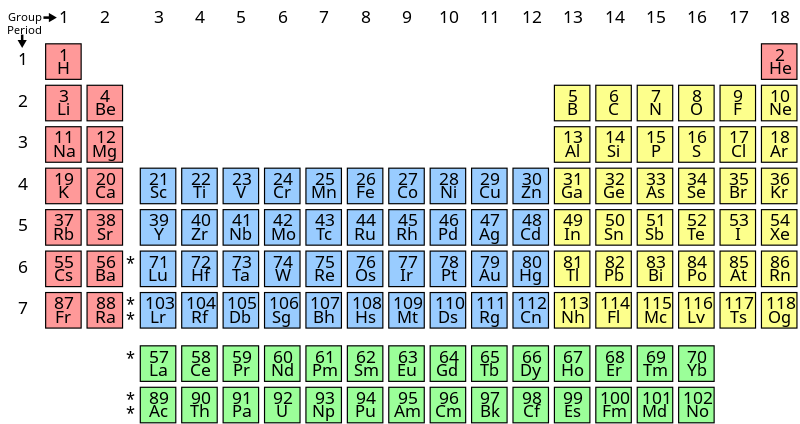
transition metal
series of chemical elements

coordination complex
molecule or ion containing ligands datively bonded to a central metallic atom
metal carbonyl
coordination complexes of transition metals with carbon monoxide ligands
crystal field theory
model that describes the breaking of degeneracies of electron orbital states, usually d or f orbitals, due to a static electric field produced by a surrounding charge distribution (anion neighbors)
carbonation
Carbonation is the chemical reaction of carbon dioxide to give carbonates, bicarbonates, and carbonic acid. In chemistry, the term is sometimes used in place of carboxylation, which refers to the formation of carboxylic acids.
ligand field theory
molecular orbital theory applied to transition metal complexes
Tanabe–Sugano diagram
method of predicting a chemical complex's absorption spectrum
Dihydrogen complex
containing intact H2 as a ligand
Orgel diagram
energy diagrams for transition metal complexes
Irving-Williams series
Series in chemistry
Nanomesh
thumb|Perspective view of nanomesh, whose structure ends at the back of the figure. The distance between two pore centers is 3.2nm, and the pores are 0.05nm deep.