File:Rust_Bolt.JPG · Wikimedia Commons · See Wikimedia Commons
corrosion
Sign in to saveAlso known as corroding, rusting, metal corrosion
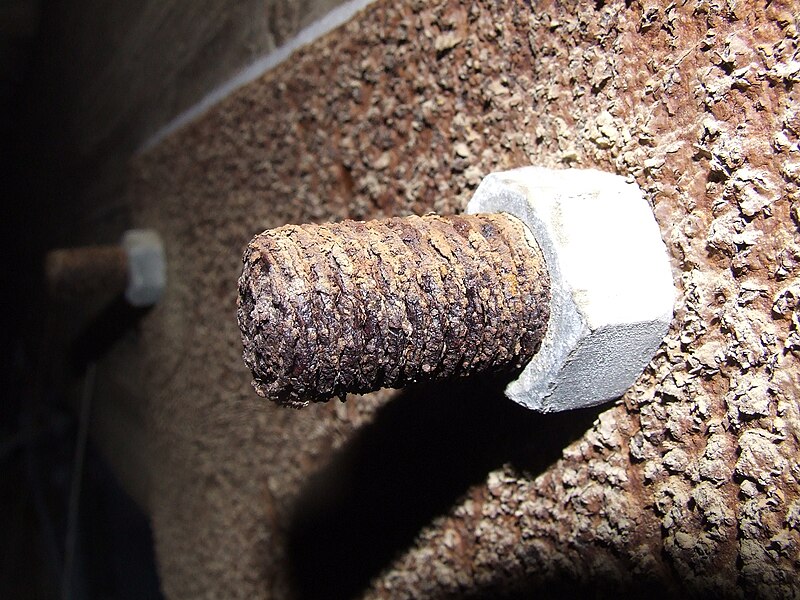
thumb|Corrosion on exposed metal, including a bolt (fastener)|bolt and nut
Corrosion is the process where metal gradually breaks down and deteriorates when exposed to elements like air and moisture, as seen in the rust and decay visible on bolts and other metal fasteners. It matters because corrosion can weaken structures and equipment, potentially causing them to fail or become unsafe over time.
AI-generated from the Wikipedia summary — may contain errors.
Research
49,878 papers- Microbially mediated metal corrosion.ReviewNature reviews. Microbiology · 2023Xu D, Gu T, Lovley DRDOI: 10.1038/s41579-023-00920-3
- Caustic ingestion.ReviewLancet (London, England) · 2017Chirica M, Bonavina L, Kelly MD et al.DOI: 10.1016/S0140-6736(16)30313-0
- Microbial Corrosion in Orthodontics.The journal of contemporary dental practice · 2022Gopalakrishnan U, Felicita S, Ronald B et al.
- Burning question: Are there sustainable strategies to prevent microbial metal corrosion?ReviewMicrobial biotechnology · 2023Wang D, Zhou E, Xu D et al.DOI: 10.1111/1751-7915.14347
- Human-relevant approaches to assess eye corrosion/irritation potential of agrochemical formulations.ReviewCutaneous and ocular toxicology · 2021Clippinger AJ, Raabe HA, Allen DG et al.DOI: 10.1080/15569527.2021.1910291
- Evaluation of Corrosion Performance of AZ31 Mg Alloy in Physiological and Highly Corrosive Solutions.ACS applied bio materials · 2024Yavuzyegit B, Karali A, De Mori A et al.DOI: 10.1021/acsabm.3c01169
- Fretting corrosion behavior of Ti6Al4V alloy against zirconia-toughened alumina ceramic in simulated body fluid.Journal of the mechanical behavior of biomedical materials · 2023Pu J, Zhang Y, Zhang X et al.DOI: 10.1016/j.jmbbm.2023.105860
- Scanning electron microscopy of vascular corrosion casts--standard method for studying microvessels.ReviewRomanian journal of morphology and embryology = Revue roumaine de morphologie et embryologie · 2007Giuvărăşteanu I
via PubMed
Wikidata facts
- Has part
- oxidation
- Image
- Rust Bolt.JPG
Show 6 more facts
- topic's main category
- Category:Corrosion
- Commons category
- Corrosion
- Commons gallery
- Corrosion
- different from
- abrasion
- has cause
- corrosive substance
- on focus list of Wikimedia project
- Wikipedia:Vital articles/Level/4
via Wikidata · CC0
~37 min read
Encyclopedic overview
34 sectionsContents
- Galvanic corrosion
- Galvanic series
- Corrosion removal
- Resistance to corrosion
- Intrinsic chemistry
- Passivation
- Corrosion in passivated materials
- Pitting corrosion
- Weld decay and knifeline attack
- Crevice corrosion
- Hydrogen grooving
- High-temperature corrosion
- Microbial corrosion
- Metal dusting
- Protection from corrosion
- Surface treatments
- Applied coatings
- Reactive coatings
- Anodization
- Biofilm coatings
- Controlled permeability formwork
- Cathodic protection
- Sacrificial anode protection
- Impressed current cathodic protection
- Anodic protection
- Rate of corrosion
- Economic impact
- Corrosion in nonmetals
- Corrosion of polymers
- Corrosion of glass
- Glass corrosion tests
- See also
- References
- Further reading
thumb|Corrosion on exposed metal, including a bolt (fastener)|bolt and nut
Corrosion is a natural process that converts a refined metal into a more chemically stable oxide. It is the gradual deterioration of materials (usually a metal) by chemical or electrochemical reaction with their environment. Corrosion engineering is the field dedicated to controlling and preventing corrosion. thumb|left|Riveted connection of elements of the cooling tower of a power plant from 1904. Increased material volume caused by corrosion. In the most common use of the word, this means electrochemical oxidation of a metal reacting with an oxidant such as oxygen (, gaseous or dissolved), or ions (, hydrated protons) present in aqueous solution. Rusting, the formation of red-orange iron oxides, is perhaps the most familiar example of electrochemical corrosion. This type of corrosion typically produces oxides or salts of the original metal and results in a distinctive coloration. Corrosion can also occur in materials other than metals, such as ceramics or polymers, although, in this context, the term degradation is more common. Corrosion degrades the useful properties of materials and structures including mechanical strength, appearance, and permeability to liquids and gases.
Excerpted from Wikipedia’s “corrosion” article, available under the CC BY-SA 4.0 licence.
Gallery (48)
Available in 80 languages
- Español
- Français
- Deutsch
- 中文
- 日本語
- Русский
- Português
- Italiano
- العربية
- हिन्दी
- Afrikaans
- Albanian
- Albanian
- Armenian
- Asturian
- azb
- Azerbaijani
- Bahasa Indonesia
Show 61 more
- Basque
- Belarusian
- Bosnian
- Bulgarian
- Catalan
- cdo
- Central Kurdish
- Croatian
- Czech
- Danish
- Erzya
- Esperanto
- Estonian
- Finnish
- Galician
- Georgian
- Greek
- Hebrew
- Hungarian
- Icelandic
- Ido
- Irish
- Javanese
- Kazakh
- Kurdish
- Kyrgyz
- Latvian
- Lithuanian
- Macedonian
- Malay
- Malayalam
- Mongolian
- Nederlands
- Norwegian
- Norwegian Nynorsk
- Occitan
- Polski
- Punjabi
- Romanian
- Serbian
- Serbian (Latin)
- Shona
- simple
- Slovak
- Slovenian
- Sundanese
- Svenska
- Tamil
- Tiếng Việt
- Türkçe
- Ukrainian
- Uzbek
- Welsh
- Western Frisian
- Wu Chinese
- zh_min_nan
- zh_yue
- Zhuang
- فارسی
- ไทย
- 한국어
via Wikidata sitelinks · CC0