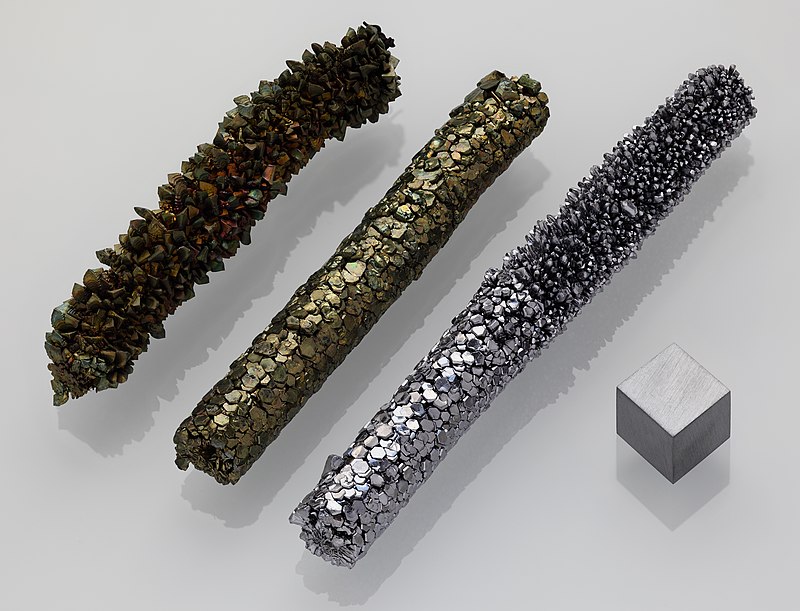
File:Vanadium_crystal_bar_and_1cm3_cube.jpg · Wikimedia Commons · See Wikimedia Commons
vanadium
Sign in to saveAlso known as V, element 23, 23V
Vanadium is a chemical element; it has symbol V and atomic number 23. It is a hard, silvery-grey, malleable transition metal. The elemental metal is rarely found in nature, but once isolated artificially, the formation of an oxide layer (passivation) somewhat stabilizes the free metal against further oxidation.
Vanadium is a hard, silvery-grey metal (element V) that doesn't naturally occur in pure form but becomes more stable once artificially isolated and develops a protective oxide coating. It's a transition metal with useful properties, though it's rarely encountered as elemental metal in nature.
AI-generated from the Wikipedia summary — may contain errors.
Chemical data
- Formula
- V
- Molecular weight
- 50.9415 g/mol
- IUPAC name
- vanadium
- SMILES
- [V]
- InChIKey
- LEONUFNNVUYDNQ-UHFFFAOYSA-N
- Polar surface area
- 0 Ų
- H-bond donors
- 0
- H-bond acceptors
- 0
- Formal charge
- 0
via PubChem
Research
16,020 papers- Vanadium.ReviewJournal of toxicology. Clinical toxicology · 1999Barceloux DGDOI: 10.1081/clt-100102425
- Vanadium Compounds with Antidiabetic Potential.ReviewInternational journal of molecular sciences · 2023Amaral LMPF, Moniz T, Silva AMN et al.DOI: 10.3390/ijms242115675
- Trends in vanadium neurotoxicity.ReviewBrain research bulletin · 2019Fatola OI, Olaolorun FA, Olopade FE et al.DOI: 10.1016/j.brainresbull.2018.03.010
- Vanadium and diabetes.ReviewBioFactors (Oxford, England) · 1999Thompson KHDOI: 10.1002/biof.5520100105
- Vanadium extraction from steel slag: Generation, recycling and management.ReviewEnvironmental pollution (Barking, Essex : 1987) · 2024Yang MQ, Yang JYDOI: 10.1016/j.envpol.2023.123126
- Vanadium in Biosphere and Its Role in Biological Processes.ReviewBiological trace element research · 2018Tripathi D, Mani V, Pal RPDOI: 10.1007/s12011-018-1289-y
- Vanadium sustainability in the context of innovative recycling and sourcing development.ReviewWaste management (New York, N.Y.) · 2020Petranikova M, Tkaczyk AH, Bartl A et al.DOI: 10.1016/j.wasman.2020.04.007
- Vanadium in cancer treatment.ReviewCritical reviews in oncology/hematology · 2002Evangelou AMDOI: 10.1016/s1040-8428(01)00221-9
via PubMed
Wikidata facts
- Mass
- 50.9415
- Image
- Vanadium 1.jpg
Show 14 more facts
- electronegativity
- 1.63
- oxidation state
- 5
- element symbol
- V
- Commons category
- Vanadium
- atomic number
- 23
- Commons gallery
- Vanadium
- canonical SMILES
- [V]
- melting point
- 1887
- chemical formula
- V
- boiling point
- 3377
- Unicode character
- 釩
- time of discovery or invention
- 1801-00-00
- ionic radius
- 0.54
- electron configuration
- [Ar] 3d³ 4s²
via Wikidata · CC0
~24 min read
Article
26 sectionsContents
- History
- Characteristics
- Isotopes
- Compounds
- Oxyanions
- Halide derivatives
- Coordination compounds
- Organometallic compounds
- Occurrence
- Production
- Applications
- Alloys
- Catalysts
- Other uses
- Proposed
- Biological role
- Vanadoenzymes
- Vanadium accumulation in tunicates
- Fungi
- Mammals
- Research
- Safety
- See also
- References
- Further reading
- External links
Vanadium is a chemical element; it has symbol V and atomic number 23. It is a hard, silvery-grey, malleable transition metal. The elemental metal is rarely found in nature, but once isolated artificially, the formation of an oxide layer (passivation) somewhat stabilizes the free metal against further oxidation.
Spanish-Mexican scientist Andrés Manuel del Río discovered compounds of vanadium in 1801 by analyzing a new lead-bearing mineral he called "brown lead". Though he initially presumed its qualities were due to the presence of a new element, he was later erroneously convinced by French chemist Hippolyte Victor Collet-Descotils that the element was just chromium. Then in 1830, Nils Gabriel Sefström generated chlorides of vanadium, thus proving there was a new element, and named it "vanadium" after the Scandinavian goddess of beauty and fertility, Vanadís (Freyja). The name was based on the wide range of colors found in vanadium compounds. Del Río's lead mineral was ultimately named vanadinite for its vanadium content. In 1867, Henry Enfield Roscoe obtained the pure element.
Gallery (45)
Available in 157 languages
- Español
- Français
- Deutsch
- 中文
- 日本語
- Русский
- Português
- Italiano
- العربية
- हिन्दी
- abstract
- Afrikaans
- Albanian
- Amharic
- Angika
- Aragonese
- Armenian
- Asturian
Show 138 more
- Awadhi
- Azerbaijani
- Bahasa Indonesia
- Balinese
- Bangla
- Bashkir
- Basque
- be_x_old
- Belarusian
- Bhojpuri
- Bikol
- blk
- Bosnian
- Breton
- Bulgarian
- Burmese
- Catalan
- cdo
- Cebuano
- Central Kurdish
- Cherokee
- Chuvash
- Cornish
- Corsican
- Croatian
- Czech
- Danish
- Divehi
- Egyptian Arabic
- Esperanto
- Estonian
- Fiji Hindi
- Filipino
- Finnish
- Friulian
- Galician
- Georgian
- Greek
- Gujarati
- Haitian Creole
- Hakka Chinese
- Hawaiian
- Hebrew
- Hungarian
- hyw
- Icelandic
- Ido
- Interlingua
- Irish
- Javanese
- Kalmyk
- Kannada
- Kazakh
- kbp
- Komi
- Kotava
- Kurdish
- Kyrgyz
- Latin
- Latvian
- Ligurian
- Limburgish
- Lithuanian
- Lojban
- Lombard
- Low German
- Luxembourgish
- Macedonian
- Malagasy
- Malay
- Malayalam
- Manx
- Marathi
- Moksha
- Mongolian
- Moroccan Arabic
- nah
- Nederlands
- Newari
- Northern Frisian
- Norwegian
- Norwegian Nynorsk
- Novial
- Occitan
- Odia
- olo
- Ossetic
- Papiamento
- Pashto
- Piedmontese
- Polski
- Punjabi
- Quechua
- roa_rup
- Romanian
- Sanskrit
- Sardinian
- Saterland Frisian
- Scottish Gaelic
- Serbian
- Serbian (Latin)
- Sicilian
- simple
- Sindhi
- Slovak
- Slovenian
- Somali
- Standard Moroccan Tamazight
- Sundanese
- Svenska
- Swahili
- Tajik
- Tamil
- Tatar
- Telugu
- Tibetan
- Tiếng Việt
- Toki Pona
- Türkçe
- Ukrainian
- Urdu
- Uyghur
- Uzbek
- Veps
- Waray
- Welsh
- Western Mari
- Western Panjabi
- Wu Chinese
- Yiddish
- Yoruba
- zh_classical
- zh_min_nan
- zh_yue
- Zulu
- فارسی
- ไทย
- 한국어
via Wikidata sitelinks · CC0