Category
page 1Cooking techniques

fire
Fire is the rapid oxidation of a fuel in the exothermic chemical process of combustion, releasing heat, light, and various reaction products.
Flames, the most visible portion of the fire, are produced in the combustion reaction when the fuel reaches its ignition point temperature. Flames from hydrocarbon fuels consist primarily of carbon dioxide, water vapor, oxygen, and nitrogen. If hot enough, the gases may become ionized to produce plasma. The color and intensity of the flame depend on the type of fuel and composition of the surrounding gases.

cooking
thumb|upright=1.0|A man cooking in a restaurant kitchen, [[Morocco]]

boiling
thumb|right|Rolling boil of water in an electric kettle

pressure cooker
utensil for cooking food under high pressure steam

smoking
exposing food to the smoke to flavour or preserve it

fondue
Fondue ( , , , ; ) is a Swiss dish of melted cheese and wine served in a communal pot ( or fondue pot) over a portable stove () heated with a candle or spirit lamp, and eaten by dipping bread and sometimes vegetables or other foods into the cheese using long-stemmed forks. It was promoted as a Swiss national dish by the Swiss Cheese Union () in the 1930s.

stew
A stew is a combination of solid food ingredients that have been cooked in liquid and served in the resultant gravy. Ingredients can include any combination of vegetables and may include meat, especially tougher meats suitable for slow-cooking, such as beef, pork, venison, rabbit, lamb, poultry, sausages, and seafood. While water can be used as the stew-cooking liquid, stock is also common. A small amount of red wine or other alcohol is sometimes added for flavour. Seasonings and flavourings may also be added. Stews are typically cooked at a relatively low temperature (simmered, not boiled), a

frying
thumb|Fried plantain
Frying is the cooking of food in oil or another fat. Similar to sautéing, pan-fried foods are generally turned over once or twice during cooking to ensure that the food is evenly cooked, using tongs or a spatula, whereas sautéed foods are cooked by "tossing in the pan". A large variety of foods may be fried. Frying is a dehydration process which involves the transfer of mass and heat. Different chemical changes take place during the frying process such as protein denaturation, starch gelatinization, surface browning, rapid water evaporation and oil absorption.

barbecue
thumb|upright=1.35|Meat being barbecued at The Salt Lick restaurant

teriyaki
Teriyaki () is a cooking technique in which foods are broiled or grilled with a glaze of soy sauce, mirin, and sugar. Although commonly associated with Japanese cuisine, the technique was adapted for use in fast food meals in Seattle.

pickling
thumb|A jar of pickled cucumbers (front) and a jar of [[pickled onions (back)]]
Pickling is the process of preserving or extending the shelf life of food by either anaerobic fermentation in brine or immersion in vinegar. The pickling procedure typically affects the food's texture and flavor. The resulting food is called a pickle, or, if named, the name is prefaced with the word "pickled". Foods that are pickled include vegetables, fruits, mushrooms, meats, fish, dairy and eggs.

marinating
thumb|275x275px|Raw chicken marinating
Marinating is the process of soaking foods in a seasoned, often acidic, liquid before cooking. This sauce, called the marinade, can be either acidic (made with ingredients such as vinegar, lemon juice, or wine), or enzymatic (made with ingredients such as pineapple, papaya, yogurt, or ginger), or have a neutral pH. In addition to these ingredients, a marinade often contains oil, salt, herbs, and spices to further flavor the food items. It is commonly used to flavor foods and to tenderize tougher cuts of meat; the process may last seconds or days.

baking
thumb|upright=1.35|Freshly baked bread
thumb|upright=1.35|Anders Zorn – Bread baking (1889)

steaming
thumb|Traditional rice steamers in Laos
Steaming is a method of cooking using steam. In steaming, the food is fully immersed in steam, with no air present, so that the steam condenses on the food, and then the condensate drips down away from the food. This is often achieved in a food steamer, a kitchen appliance made specifically to cook food with steam, but food can also be steamed in a wok. In the American Southwest, steam pits used for cooking have been found dating back about 5,000 years. Steaming is considered a healthy cooking technique that can be used for many kinds of foods.
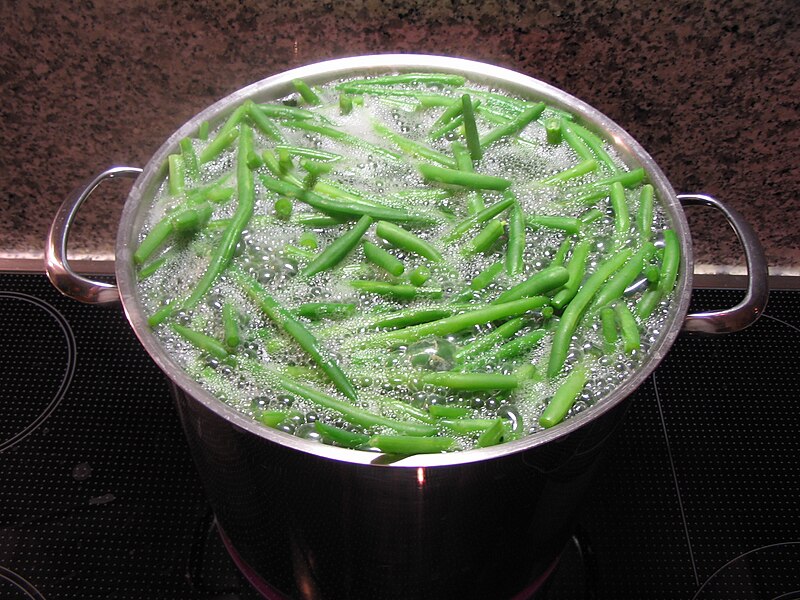
blanching
cooking process
deep frying
cooking method in which food is submerged in hot fat

grilling
thumb|right|Steaks and chicken breasts being grilled over charcoal
thumb|Hamburgers being grilled over a [[charcoal fire]]
thumb|Grilling Mangal (barbecue)|mangals and [[kebabs]]

sautéing
thumb|Leeks being sautéed
Sautéing or sauteing (, ; , in reference to tossing while cooking) is a method of cooking that uses a relatively small amount of oil or fat in a shallow pan over relatively high heat. Various sauté methods exist.

meatloaf
thumb|American meatloaf with tomato ketchup

purée
thumb|right|180px|Cauliflower purée

roasting
thumb|upright=1.35|Slow-roasting pig on a rotisserie
thumb|upright=1.35|Tudor style roasting meat on a spit
Roasting is a cooking method that uses dry heat where hot air covers the food, cooking it evenly on all sides with temperatures of at least from an open flame, oven, or other heat source. Roasting can enhance the flavor through caramelization and Maillard browning on the surface of the food. Roasting uses indirect, diffused heat (as in an oven), and is suitable for slower cooking of meat in a larger, whole piece. Meats and most root and bulb vegetables can be roasted. Any piece of meat,

braising
thumb|right|Braised ox cheek in star anise and [[soy sauce]]
Braising (from the French word ) is a combination cooking method that uses both wet and dry heats: typically, the food is first browned at a high temperature, then simmered in a covered pot in cooking liquid (such as wine, broth, coconut milk, or beer). It is similar to stewing, but braising is done with less liquid and usually used for larger cuts of meat. Braising of meat is often referred to as pot roasting, though some authors make a distinction between the two methods, based on whether additional liquid is added. Osso buco and c
stir frying
cooking technique

stuffing
thumb|Stuffing a domesticated turkey|turkey
thumb|Stuffed Turkey as food|turkey
thumb|right|Chilean empanada with ground meat stuffing
food drying
method of food preservation in which food is dried
sous vide
method of cooking food in an enclosed container using prolonged mild heat
poaching
cooking technique

flambé
thumb|right|Bananas Foster includes a flambé.
thumb|right|Roasted quails flambéed with Cognac

caramelization
Caramelization (or caramelisation) is a process of browning of sugar used extensively in cooking for the resulting butter-like flavor and brown color. The brown colors are produced by three groups of polymers: (C24H36O18), (C36H50O25), and (C125H188O80). As the process occurs, volatile chemicals such as diacetyl (known for its intense butter-like taste) are released, producing the characteristic caramel flavor.
adobo
Filipino dish composed of chicken/pork cooked in soy sauce and vinegar

infusion
Infusion is the process of extracting chemical compounds or flavors from plant material in a solvent such as water, oil, or alcohol, by allowing the material to remain suspended in the solvent over time (a process often called steeping). An infusion is also the name for the resultant liquid. The process of infusion is distinct from both decoction—a method of extraction involving boiling the plant material—and percolation, in which water is passed through the material (as in a coffeemaker).
slow cooker
electrical cooking appliance used to prepare food by simmering for several hours, mostly unattended

casserole
thumb|Vegetable casserole

simmering
thumb|right|250px|Meatball soup simmering on a stove
curing
food preservation with salt

tataki
thumb|
Two methods of preparing fish or meat in Japanese cuisine are called '''''' or . In Japanese, means "pounded" or "hit into pieces".
Joule heating
heating of a resistive electrical conductor due to current passing through it
breading
REDIRECT Breadcrumbs#Breading

seasoning
thumb|upright=1.15|The ingredients for Recado rojo|achiote paste: oregano, ground cloves, ground cumin, minced garlic, and ground annatto
Seasoning is the process of supplementing food via herbs, spices, and/or salts, intended to enhance a particular flavour.
reduction
process of thickening and intensifying the flavor of a liquid mixture such as a soup, sauce, wine, or juice by simmering or boiling
.jpg)
confit
thumb|upright=1.35|Duck confit
Confit (, ; ) (from the French word confire, literally "to preserve") is any type of food that is cooked slowly over a long period as a method of preservation.
dishwasher salmon
American fish dish
dry roasting
food preparation method

rotisserie
thumb|upright=1.35|Rotisserie chicken cooking on a horizontal rotisserie

hibachi
thumb|A porcelain
thumb|North American "hibachi" cast iron grill
glaze
coating of a glossy, often sweet, sometimes savoury, substance applied to food typically by dipping, dripping, or with a brush
pan frying
Cooking technique

Jugging
Jugging is the process of stewing whole animals, mainly game or fish, for an extended period in a tightly covered container such as a casserole or an earthenware jug.
In France a similar stew of a game animal (historically thickened with the animal's blood) is known as a ''''''.
earth oven
simple pit for cooking

steeping
thumb|right|200px|Green tea leaves steeping in a gaiwan (type of tea cup)
Steeping is the soaking of an organic solid, such as leaves, in a liquid (usually water) to extract flavours or to soften it. The specific process of teas being prepared for drinking by leaving the leaves in heated water to release the flavour and nutrients is known as steeping. Herbal teas may be prepared by decoction, infusion, or maceration. Some solids are soaked to remove an ingredient, such as salt, where the solute is not the desired product.

parboiling
thumb|Parboiling peaches to remove their skin
sweating
cooking technique

brining
Brining is treating food with brine or coarse salt which preserves and seasons the food while enhancing tenderness. Flavor can be further developed with additions such as herbs, spices, sugar, caramel or vinegar. Meat and fish are typically brined for less than twenty-four hours while vegetables, cheeses and fruit are brined in a much longer process known as pickling. Brining is similar to marination, except that a marinade usually includes a significant amount of acid, such as vinegar or citrus juice. Brining is also similar to curing, which usually involves significantly drying the food, and
conching
upright=1.35|thumb|Conche (in the Imhoff-Schokoladenmuseum)
thumb|Granite roller and granite base of a conche
deglazing
cooking technique that dissolves browned food residue from a pan

nixtamalization
right|thumb|250px|An 1836 lithograph of [[tortilla production in rural Mexico]]
thumb|right|200px|Bowl of hominy (nixtamalized corn kernels)
Chaunk
South Asian cooking technique
en papillote
baked in folded pouch
Biomass briquettes
Fuel source made from green waste

pre-ferment
thumb|300px|Pain pouliche, a pre-ferment