Category
page 1Molecular genetics

genetic engineering
direct manipulation of an organism's genome using biotechnology

meiosis
thumb|300x300px|In meiosis, the chromosomes duplicate (during [[interphase) and homologous chromosomes exchange genetic information (chromosomal crossover) during the first division, called meiosis I. The daughter cells divide again in meiosis II, splitting up sister chromatids to form haploid gametes. Two gametes fuse during fertilization, forming a diploid cell (zygote) with a complete set of paired chromosomes.]]

standard genetic code
rules by which information encoded within genetic material is translated into proteins

messenger RNA
large family of RNA molecules that convey genetic information from DNA to the ribosome, where they specify the amino acid sequence of the protein products of gene expression

chromatin
thumb|358x358px|The major structures in DNA compaction: DNA, the [[nucleosome, the 11 nm beads on a string chromatin fibre and the metaphase chromosome.]]

molecular genetics
scientific study of genes at the molecular level
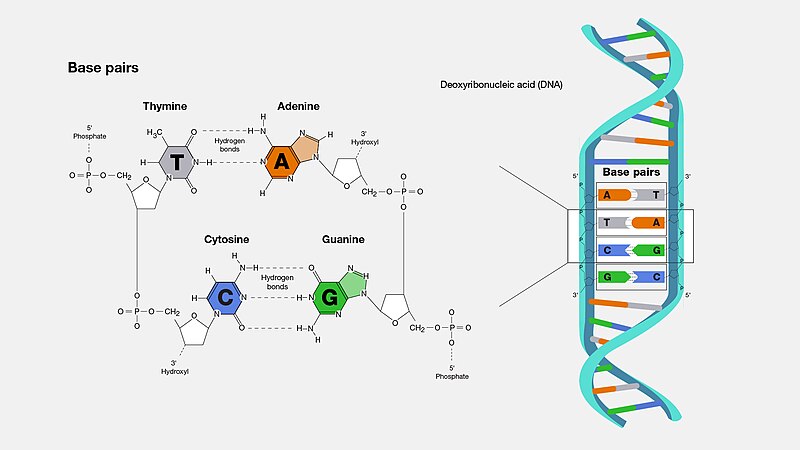
base pair
unit consisting of two nucleobases bound to each other by hydrogen bonds: either adenine–thymine or guanine–cytosine in natural DNA (additional types occur in RNA)
gene therapy
genetic modification of a patient's cells to produce a therapeutic effect

DNA repair
process of restoring DNA after damage

central dogma of molecular biology
explanation of the flow of genetic information within a biological system
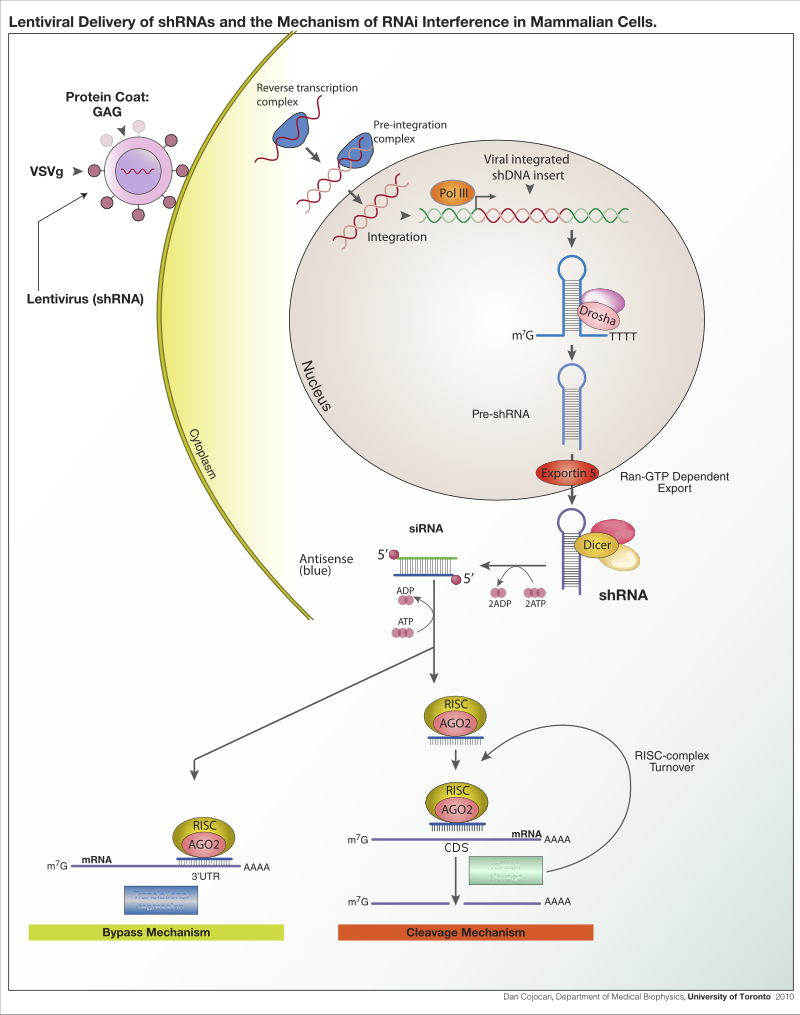
RNA interference
any process of posttranscriptional gene inactivation mediated by small RNA molecules that may trigger mRNA degradation or down-regulate translation

biopolymer
Biopolymers are natural polymers produced by the cells of living organisms. Like other polymers, biopolymers consist of monomeric units that are covalently bonded in chains to form larger molecules. There are three main classes of biopolymers, classified according to the monomers used and the structure of the biopolymer formed: polynucleotides, polypeptides, and polysaccharides. The polynucleotides, RNA and DNA, are long polymers of nucleotides. Polypeptides include proteins and shorter polymers of amino acids; some major examples include collagen, actin, and fibrin. Polysaccharides are linear

chromatid
thumb|In the diagram, (1) refers to a chromatid: 1-half of two identical threadlike strands of a replicated chromosome. During cell division, the identical copies (called a "sister chromatid pair") are joined at the region called the [[centromere (2). Once the paired sister chromatids have separated from one another (in the anaphase of mitosis) each is known as a daughter chromosome. The short arm of the right chromatid (3), and the long arm of the right chromatid (4), are also marked.]]
thumb|220px|Schematic karyogram of the human chromosomes, showing their usual state in the G0 and G1 phase
crossing over
cellular process
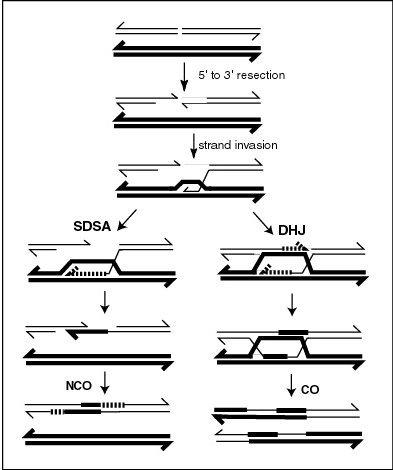
genetic recombination
production of offspring with combinations of traits that differ from those found in either parent
molecular clock
technique to deduce the time in prehistory when two or more life forms diverged

microRNA
thumb|400px|Pre-miRNA instead of Pri-miRNA in the first point of mechanism. Diagram of microRNA (miRNA) action with mRNA
thumb|400px|Examples of miRNA hairpins (stem-loops), with the mature miRNAs shown in red
recombinant DNA
DNA molecules formed by laboratory methods
synthetic biology
interdisciplinary branch of biology and engineering
non-coding RNA
class of RNA that is not translated into proteins
genomic imprinting
phenomenon that causes genes to be expressed in a parent-of-origin-specific manner
.jpg)
X-inactivation
thumb|right|The coloration of tortoiseshell cats is a visible manifestation of X-inactivation. The black and orange [[alleles of a fur coloration gene reside on the X chromosome. For any given patch of fur, the inactivation of an X chromosome that carries one allele results in the fur color of the other, active allele.]]
thumb|The process and possible outcomes of random X-chromosome inactivation in female human embryonic cells undergoing [[mitosis.
1.Early stage embryonic cell of a female human
2.Maternal X chromosome
3.Paternal X chromosome
4.Mitosis and random X-chromosome inactivation e
molecular cloning
insertion of recombinant DNA molecules, by means of a replicating vehicle, into recipient cells without altering their viability
stop codon
a codon that marks the end of a sequence
open reading frame
DNA section marked with start and stop codon of different length

heterochromatin
Heterochromatin is a tightly packed form of chromatin, which comes in multiple varieties. These varieties lie on a continuum between the two extremes of constitutive heterochromatin and facultative heterochromatin. Both play a role in the expression of genes, and correlate with late replication timing. Importantly, heterochromatin was once thought to be tightly coupled with structural compactness, phase separation and also deterministic transcriptional silencing. However, these notions have been increasingly challenged in recent years.
small nuclear RNA
class of RNA molecules, found in splicing speckles and Cajal bodies, about 150 nucleotides long
directionality
End-to-end chemical orientation of a single strand of nucleic acid
gene knockout
genetic technique
Holliday junction
Branched nucleic acid structure containing four double-stranded arms

biopunk
thumb|right|200px|Cover of Ribofunk by Paul Di Filippo, a seminal biopunk story collection
Biopunk (a portmanteau of "biotechnology" or "biology" and "punk") is a subgenre of science fiction that focuses on biotechnology. It is derived from cyberpunk, but focuses on the implications of biotechnology rather than mechanical cyberware and information technology. Biopunk is concerned with synthetic biology. It is derived from cyberpunk and often involves bio-hackers, biotech megacorporations, and oppressive organizations that engineer DNA. Most often keeping with the dark atmosphere of cyberpunk,
start codon
first codon of a messenger RNA transcript translated by a ribosome

euchromatin
thumb|300x300px|Distinction between Euchromatin and Heterochromatin
Euchromatin (also called "open chromatin") is a lightly packed form of chromatin (DNA, RNA, and protein) that is enriched in genes, and is often (but not always) under active transcription. Euchromatin stands in contrast to heterochromatin, which is tightly packed and less accessible for transcription. 92% of the human genome is euchromatic.
gene gun
device
viral vector
biotechnology to deliver genetic material into a cell
whole genome sequencing
sequencing all the DNA of an individual at once

replisome
thumb|600px|right|A representation of the structures of the replisome during DNA replication The replisome is a complex molecular machine that carries out replication of DNA. The replisome first unwinds double stranded DNA into two single strands. For each of the resulting single strands, a new complementary sequence of DNA is synthesized. The total result is formation of two new double stranded DNA sequences that are exact copies of the original double stranded DNA sequence.
reverse genetics
method in molecular genetics
pseudoautosomal region
region of sexual chromosomes exhibiting an autosomal inheritance pattern
CpG site
bacterial DNA fragments
synaptonemal complex
proteinaceous scaffold found between homologous chromosomes during meiosis
conserved sequence
similar DNA, RNA or protein sequences within genomes or among species
small nucleolar RNA
class of small RNA molecules that guide chemical modifications of other RNAs
DNA-binding protein
proteins that have DNA-binding domains and thus have a specific or general affinity for single- or double-stranded DNA
nuclear matrix
the dense fibrillar network lying on the inner side of the nuclear membrane
nucleic acid analogue
compound which is analogous (structurally similar) to naturally occurring RNA and DNA, used in medicine and in molecular biology research
Morpholino
chemical compound
site-directed mutagenesis
molecular biology technique

auxotrophy
thumb|500x500px|This is a visual depiction of what conditions would allow for an auxotroph (top row of media: Colonies Auxotrophic to Arginine) compared to colonies that exhibit prototrophy (bottom row of media).
Auxotrophy ( "to increase"; τροφή "nourishment") is the inability of an organism to synthesize a particular organic compound required for its growth (as defined by IUPAC). An auxotroph is an organism that displays this characteristic; auxotrophic is the corresponding adjective. Auxotrophy is the opposite of prototrophy, which is characterized by the ability to synthesize all the compo
long terminal repeat
DNA sequence
nuclear localization sequence
type of amino acid sequence

depurination
Depurination is a chemical reaction of purine deoxyribonucleosides, deoxyadenosine and deoxyguanosine, and ribonucleosides, adenosine or guanosine, in which the β-N-glycosidic bond is hydrolytically cleaved releasing a nucleic base, adenine or guanine, respectively. The second product of depurination of deoxyribonucleosides and ribonucleosides is sugar, 2'-deoxyribose and ribose, respectively. More complex compounds containing nucleoside residues, nucleotides and nucleic acids, also suffer from depurination. Deoxyribonucleosides and their derivatives are substantially more prone to depurinatio
DNA condensation
process of compacting DNA molecules
nucleolus organizer region
region of a chromosome where nucleoli form during interphase, and where genes encoding the largest rRNA precursor transcript are tandemly arrayed
inteins
REDIRECT Protein splicing#Intein
genetic screen
biological lab technique

fertility factor
The F-plasmid (first named F by one of its discoverers Esther Lederberg;also called the sex factor in E. coli,the F sex factor, the fertility factor, or simply the F factor) allows genes to be transferred from one bacterium carrying the factor to another bacterium lacking the factor by conjugation. The F factor was the first plasmid to be discovered. Unlike other plasmids, F factor is constitutive for transfer proteins due to a mutation in the gene finO. The F plasmid belongs to F-like plasmids, a class of conjugative plasmids that control sexual functions of bacteria with a fertility inhibiti
artificial gene synthesis
fully artificial DNA production method based on solid-phase DNA synthesis
electrophoretic mobility shift assay
molecular biology technique for determining protein-nucleic acid interactions in vitro

Argonaute protein family
The Argonaute protein family, first discovered for its evolutionarily conserved stem cell function, plays a central role in RNA silencing processes as essential components of the RNA-induced silencing complex (RISC). RISC is responsible for the gene silencing phenomenon known as RNA interference (RNAi). Argonaute proteins bind different classes of small non-coding RNAs, including microRNAs (miRNAs), small interfering RNAs (siRNAs) and piwi-interacting RNAs (piRNAs). Small RNAs guide Argonaute proteins to their specific targets through sequence complementarity (base pairing), which then leads t