Category
page 1Nucleotides

nucleotide
thumb|275px|class=skin-invert-image|This nucleotide contains the five-carbon sugar deoxyribose (at center), a [[nucleobase called adenine (upper right), and one phosphate group (left). The deoxyribose sugar joined only to the nitrogenous base forms a Deoxyribonucleoside called deoxyadenosine, whereas the whole structure along with the phosphate group is a nucleotide, a constituent of DNA with the name deoxyadenosine monophosphate.]]
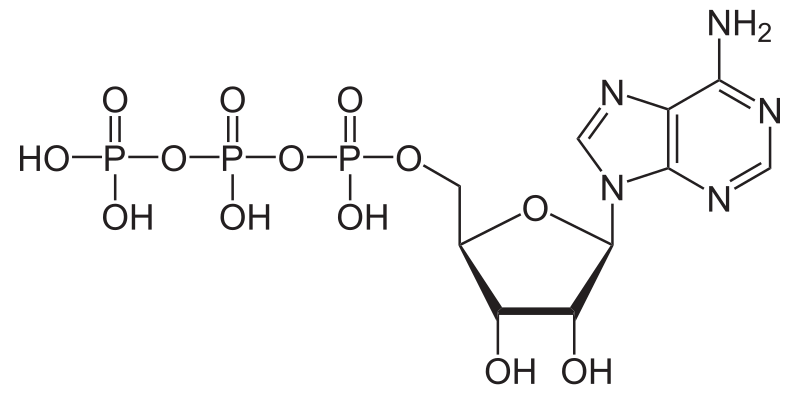
adenosine triphosphate
the energy-carrying molecule in living cells

remdesivir

adenosine diphosphate
chemical compound

nicotinamide adenine dinucleotide
coenzyme NAD in any of its oxidation states
nicotinamide adenine dinucleotide phosphate
coenzyme acting as an electron carrier in biochemical redox reactions (oxidation state unspecified), any of NADP+, NADPH, or NADP zwitterion
adenosine cyclic phosphate
chemical compound
guanosine triphosphate
chemical compound
flavin adenine dinucleotide
redox cofactor, more specifically a prosthetic group, involved in several important reactions in metabolism; can exist in three (or four: flavin-N(5)-oxide) different redox states; converted between these states by accepting or donating electrons
adenosine monophosphate
chemical compound
guanosine 5'-diphosphate (RRSR form)
chemical compound
guanosine cyclic 3',5'-phosphate
chemical compound

diphosphate
In chemistry, pyrophosphates are phosphorus oxyanions that contain two phosphorus atoms in a linkage. A number of pyrophosphate salts exist, such as disodium pyrophosphate () and tetrasodium pyrophosphate (), among others. Often pyrophosphates are called diphosphates. The parent pyrophosphates are derived from partial or complete neutralization of pyrophosphoric acid. The pyrophosphate bond is also sometimes referred to as a phosphoanhydride bond, a naming convention which emphasizes the loss of water that occurs when two phosphates form a new bond, and which mirrors the nomenclature for anhyd
guanosine monophosphate
chemical compound
cytidine triphosphate
chemical compound
deoxyribonucleotide
A deoxyribonucleotide is a nucleotide that contains deoxyribose. They are the monomeric units of the informational biopolymer, deoxyribonucleic acid (DNA). Each deoxyribonucleotide comprises three parts: a deoxyribose sugar (monosaccharide), a nitrogenous base, and one phosphoryl group. The nitrogenous bases are either purines or pyrimidines, heterocycles whose structures support the specific base-pairing interactions that allow nucleic acids to carry information. The base is always bonded to the 1'-carbon of the deoxyribose, an analog of ribose in which the hydroxyl group of the 2'-carbon is
[5-(2,4-Dioxopyrimidin-1-yl)-3,4-dihydroxyoxolan-2-yl]methyl dihydrogen phosphate
chemical compound
uridine 5'-triphosphoric acid
chemical compound
cytidine monophosphate
chemical compound
polynucleotide
In molecular biology, a polynucleotide () is a biopolymer composed of nucleotide monomers that are covalently bonded in a chain. DNA (deoxyribonucleic acid) and RNA (ribonucleic acid) are examples of polynucleotides with distinct biological functions. DNA consists of two chains of polynucleotides, with each chain in the form of a helix (like a spiral staircase).
uridine 5'-diphosphate
chemical compound
inosinic acid
chemical compound
uridine diphosphate glucose
chemical compound
thymidine monophosphate
anion
2'-deoxyadenosine triphosphate
chemical compound
nucleoside triphosphate
class of chemical compounds
disodium 5'-inosinate
chemical compound

citicoline
Citicoline (INN), also known as cytidine diphosphate-choline (CDP-choline) or '''cytidine 5'-diphosphocholine''' is an intermediate in the generation of phosphatidylcholine from choline, a common biochemical process in cell membranes. Citicoline is naturally occurring in the cells of human and animal tissue, in particular the organs.
disodium 5'-guanylate
chemical compound
deoxyguanosine triphosphate
chemical compound
cytidine 5'-diphosphate
chemical compound
dCTP
chemical compound
thymidine triphosphate
chemical compound
deoxyadenosine 5'-monophosphate
chemical compound
deoxyuridine monophosphate
chemical compound
deoxyguanosine monophosphate
chemical compound
deoxycytidine dihydrogen phosphate
chemical compound
deoxycytidine diphosphate
chemical compound
Xanthosine monophosphate
chemical compound
UDP-α-D-galactose
chemical compound
3'-phosphoadenosine 5'-phosphosulfate
3′-Phosphoadenosine-5′-phosphosulfate (PAPS) is a derivative of adenosine monophosphate (AMP) that is phosphorylated at the 3′ position and has a sulfate group attached to the 5′ phosphate. It is the most common coenzyme in sulfotransferase reactions and hence part of sulfation pathways. It is endogenously synthesized by organisms via the phosphorylation of adenosine 5′-phosphosulfate (APS), an intermediary metabolite. In humans such reaction is performed by bifunctional 3′-phosphoadenosine 5′-phosphosulfate synthases (PAPSS1 and PAPSS2) using ATP as the phosphate donor.
dADP
chemical compound
nicotinamide ribotide
chemical compound
adenosine diphosphate ribose
chemical compound
dTDP
chemical compound
guanosine diphosphate mannose
chemical compound
deoxyguanosine diphosphate
chemical compound

dideoxynucleotide
thumb|Molecular structure of 2',3'-dideoxyadenosine triphosphate (ddATP)
nucleotide salvage
Any process which produces a nucleotide, a compound consisting of a nucleoside that is esterified with (ortho)phosphate or an oligophosphate at any hydroxyl group on the glycose moiety, from derivatives of it without de novo synthesis.
cyclic ADP-ribose
chemical compound
cangrelor
Cangrelor, sold under the brand name Kengreal among others, is a P2Y12 inhibitor FDA approved as of June 2015 as an antiplatelet drug for intravenous application. Some P2Y12 inhibitors are used clinically as effective inhibitors of adenosine diphosphate-mediated platelet activation and aggregation.
orotidine 5'-phosphate
chemical compound
xanthosine triphosphate
group of stereoisomers
uridine diphosphate glucuronic acid
chemical compound
aicar
chemical compound
internal ribosome entry site
sequence in the 5′ UTR of some mRNAs where a ribosome can bind
cyclic nucleotide
biological compound
faicar
chemical compound
thymidine diphosphate glucose anion
chemical compound
saicar
Phosphoribosylaminoimidazolesuccinocarboxamide (SAICAR) is an intermediate in the formation of purines. The conversion of ATP, L-aspartate, and 5-aminoimidazole-4-carboxyribonucleotide (CAIR) to 5-aminoimidazole-4-(N-succinylcarboxamide) ribonucleotide, ADP, and phosphate by phosphoribosylaminoimidazolesuccinocarboxamide synthetase (SAICAR synthetase) represents the eighth step of de novo purine nucleotide biosynthesis.