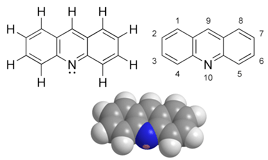
File:Acridine_chemical_structure.png · Wikimedia Commons · See Wikimedia Commons
acridine
Sign in to saveAlso known as Akridin, 2,3-benzoquinoline, 2,3,5,6-dibenzopyridine, 9-azaanthracene, 10-azaanthracene, dibenzo[b,e]pyridine, acrydine, benzo[b]quinoline
Acridine is an organic compound and a nitrogen heterocycle with the formula C13H9N. Acridines are substituted derivatives of the parent ring. It is a planar molecule that is structurally related to anthracene with one of the central CH groups replaced by nitrogen. Like the related molecules pyridine and quinoline, acridine is mildly basic. It is an almost colorless solid, which crystallizes in needles. There are few commercial applications of acridines; at one time acridine dyes were popular, but they are now relegated to niche applications, such as with acridine orange. The name is a referenc
OverviewAI-generated
Acridine is a chemical compound with the formula C₁₃H₉N. Its molecular mass is 179.073, and it has a density of 1.016. The substance melts at 109 and boils at 346.
Chemical properties include an xlogp value of 3.4 and a topological polar surface area of 12.9. The molecule has no hydrogen bond donors and one hydrogen bond acceptor, with a charge of 0. Its canonical SMILES representation is C1=CC=C2C(=C1)C=C3C=CC=CC3=N2.
Acridine is referenced by 302 other encyclopedia articles. A search for the term yields 25752 results in the PubMed database.
Synthesized by Vinony from 21 facts across 4 sources: Wikidata, PubMed, PubChem, Vinony graph. Generated from structured data (not the Wikipedia text) and checked against those facts — may still contain errors.
Chemical data
- Formula
- C13H9N
- Molecular weight
- 179.22 g/mol
- IUPAC name
- acridine
- SMILES
- C1=CC=C2C(=C1)C=C3C=CC=CC3=N2
- InChIKey
- DZBUGLKDJFMEHC-UHFFFAOYSA-N
- XLogP
- 3.4
- Polar surface area
- 12.9 Ų
- H-bond donors
- 0
- H-bond acceptors
- 1
- Formal charge
- 0
via PubChem
Drug data · ChEMBL
- Max clinical phase
- Phase 2
- Molecule type
- Small molecule
- Indications
- Central Nervous System Neoplasm, lung cancer
via ChEMBL · EBI
Research
25,752 papers- Acridine derivatives as inhibitors/poisons of topoisomerase II.Journal of applied toxicology : JAT · 2022
- Acridine as an Anti-Tumour Agent: A Critical Review.Molecules (Basel, Switzerland) · 2022
- Acridine derivatives as chemotherapeutic agents.Current medicinal chemistry · 2002
- Acridine/Acridone Derivatives as Catalytic Inhibitors of Topoisomerase I.Journal of applied toxicology : JAT · 2026
- Acridine and its derivatives: a patent review (2009 - 2013).Expert opinion on therapeutic patents · 2014
via PubMed
Wikidata facts
- Has part
- carbon
- Mass
- 179.073
Show 7 more facts
- Commons category
- Acridine
- described by source
- Encyclopædia Britannica 11th edition
- chemical formula
- C₁₃H₉N
- melting point
- 109
- canonical SMILES
- C1=CC=C2C(=C1)C=C3C=CC=CC3=N2
- density
- 1.016
- boiling point
- 346
via Wikidata · CC0
~6 min read
Encyclopedic overview
13 sectionsContents
- Isolation and syntheses
- Reactions
- Basicity
- Reduction and oxidation
- Applications
- Dyes
- Molecular biology
- Structure
- Safety
- See also
- References
- Literature
- External links
Acridine is an organic compound and a nitrogen heterocycle with the formula C13H9N. Acridines are substituted derivatives of the parent ring. It is a planar molecule that is structurally related to anthracene with one of the central CH groups replaced by nitrogen. Like the related molecules pyridine and quinoline, acridine is mildly basic. It is an almost colorless solid, which crystallizes in needles. There are few commercial applications of acridines; at one time acridine dyes were popular, but they are now relegated to niche applications, such as with acridine orange. The name is a reference to the acrid odour and acrid skin-irritating effect of the compound.
== Isolation and syntheses == Carl Gräbe and Heinrich Caro first isolated acridine in 1870 from coal tar. Acridine is separated from coal tar by extracting with dilute sulfuric acid. Addition of potassium dichromate to this solution precipitates acridine bichromate. The bichromate is decomposed using ammonia.
Excerpted from Wikipedia’s “acridine” article, available under the CC BY-SA 4.0 licence.