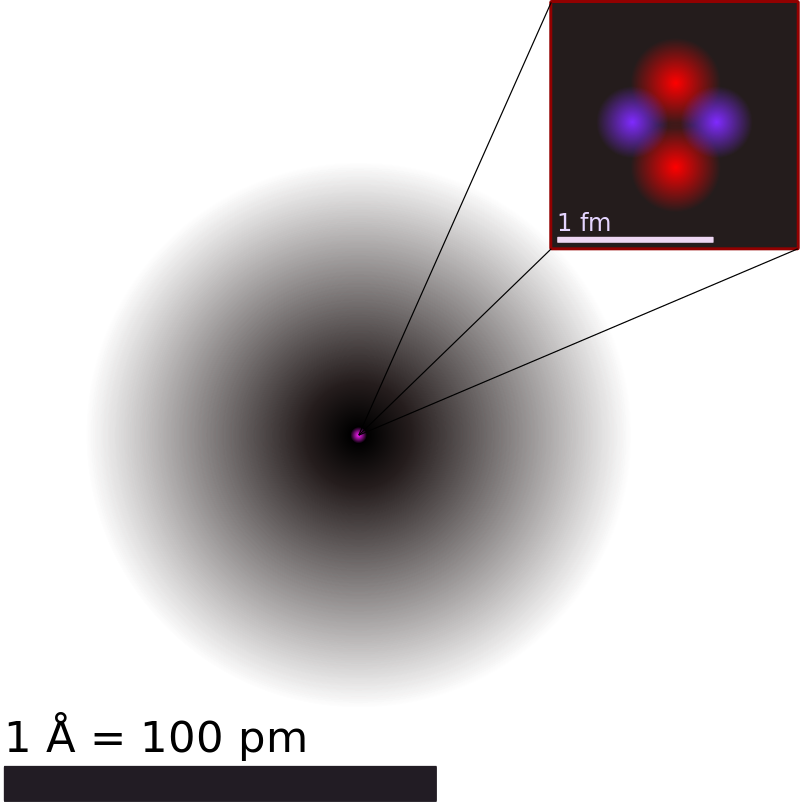
File:Helium_atom_QM.svg · Wikimedia Commons · See Wikimedia Commons
AI overview
Atomic radius is a measurement of how big an atom is, typically measured from its center to its outer edge. It matters because understanding atomic size helps explain how atoms interact with each other, how they bond together, and what properties materials will have.
AI-generated from the Wikipedia summary — may contain errors.
Wikidata facts
- Subclass of
- approximation
- Image
- Atomic size periodic table.svg
Show 1 more fact
- on focus list of Wikimedia project
- Wikipedia:Vital articles/Level/4
Sources (2)
via Wikidata · CC0
Article · 日本語
原子半径(げんしはんけい、atomic radius)とは、分子、結晶内などに存在するそれぞれの原子を剛体球とみなした場合の半径のこと。 同じ原子でも置かれた、あるいは取り得る状況(分子、結晶内での結合様式など)によって異なった定義があり、複数の値が使い分けられる。定義の違いは結合様式によるもので、ファンデルワールス半径、共有結合半径、、イオン半径などが、主に用いられる原子半径である。構造化学あるいは計算化学で取り扱われる。 同周期内の原子同士では、原子番号が大きくなるほど半径は小さくなる。
Abstract from DBpedia / Wikipedia · CC BY-SA
Gallery (3)
Available in 72 languages
- Español
- Français
- Deutsch
- 中文
- 日本語
- Русский
- Português
- Italiano
- العربية
- हिन्दी
- Afrikaans
- Aragonese
- Armenian
- Asturian
- Bahasa Indonesia
- Bangla
- Basque
- Belarusian
Show 53 more
- Bosnian
- Bulgarian
- Burmese
- Catalan
- Central Kurdish
- Chuvash
- Croatian
- Czech
- Danish
- Esperanto
- Estonian
- Finnish
- Galician
- Georgian
- Greek
- Hebrew
- Hungarian
- Irish
- Kazakh
- Kyrgyz
- Latvian
- Lithuanian
- Lombard
- Low German
- Macedonian
- Malay
- Malayalam
- Mongolian
- Moroccan Arabic
- Nederlands
- Norwegian
- Norwegian Nynorsk
- Occitan
- Polski
- Romanian
- Serbian
- Serbian (Latin)
- simple
- Sinhala
- Slovak
- Slovenian
- Svenska
- Tamil
- Tiếng Việt
- Türkçe
- Ukrainian
- Urdu
- Uzbek
- Wu Chinese
- zh_yue
- فارسی
- ไทย
- 한국어
via Wikidata sitelinks · CC0