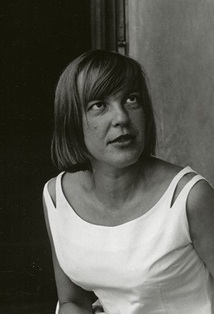
File:Ingeborg-Bachmann-1962_(cropped).jpg · Wikimedia Commons · See Wikimedia Commons
OverviewAI-generated
Ingeborg Bachmann was an Austrian poet, writer, journalist, and screenwriter born in Klagenfurt am Wörthersee in 1926. She wrote in German and Italian and worked in Vienna. Her notable works include the novel *Malina*, as well as *Gedichte, die glücklich machen*, *Seçmeler*, *Psalm*, *Die Zikaden*, and *The Other Persuasion*. She was influenced by Ilse Aichinger and worked in the fields of poetry and essay.
Bachmann was a member of Group 47 and the German Academy for Language and Literature. She received the Anton Wildgans Prize, the Georg Büchner Prize, and the Literaturpreis der Stadt Bremen. She was nominated for the Nobel Prize in Literature. Her archives are held at the Austrian National Library. She died in Rome in 1973 from accidental death. Her unmarried partners were Max Frisch and Paul Celan.
Synthesized by Vinony from 36 facts across 6 sources: Wikidata, Open Library, MusicBrainz, Last.fm, Europeana Sparql, TMDb. Generated from structured data (not the Wikipedia text) and checked against those facts — may still contain errors.
Person · Open Library
- Born
- 1926
- Died
- 1973
- Works
- 140
Top works
- Gedichte, die glücklich machen
- Seçmeler
- Psalm
- Die Zikaden
- The Other Persuasion
via Open Library + Wikidata
Music · MusicBrainz
- Type
- Person
- Gender
- Female
- Country
- Austria
- Active from
- 1926
- Active to
- 1973
via MusicBrainz · CC0
Listeners · Last.fm
- Listeners
- 574
- Total plays
- 6,241
Ingeborg Bachmann (June 25, 1926 - October 17, 1973) was an Austrian poet and author. Bachmann's work primarily focuses on themes like personal boundaries, establishment of the truth, and philosophy of language, the latter in the tradition of Austrian philosopher Ludwig Wittgenstein. Her doctoral dissertation expresses her growing disillusionment with Heidegerrian Existentialism, which was in part resolved through her growing interest in Wittgenstein, whose Tractatus Logico-Philosophicus signif
Wikidata facts
- Instance of
- human
- Given name
- Ingeborg
- Family name
- Bachmann
- Gender
- female
- Citizenship
- Austria
- Place of birth
- Klagenfurt am Wörthersee
- Place of death
- Rome
- Languages spoken
- Italian
- Field of work
- essay
- Image
- Ingeborg-Bachmann-1962 (cropped).jpg
- Work location
- Vienna
- Residence
- Rome
Show 13 more facts
- Commons category
- Ingeborg Bachmann
- date of birth
- 1926-00-00
- date of death
- 1973-00-00
- manner of death
- accidental death
- nominated for
- Nobel Prize in Literature
- influenced by
- Ilse Aichinger
- archives at
- Austrian National Library
- unmarried partner
- Paul Celan
- writing language
- German
- start of work period
- 1950-00-00
- P12674
- Pseudoludia
- end of work period
- 1973-00-00
via Wikidata · CC0
Works in European collections
22 objects attributed to Ingeborg Bachmann, held across European museums, libraries & archives · via Europeana


~20 min read
Encyclopedic overview
Ingeborg Bachmann ( Austrian German: [ˈɪŋəbɔrɡ ˈbaxman]; 25 June 1926 – 17 October 1973) was an Austrian poet and author. She is regarded as one of the major voices of German-language literature in the 20th century. In 1963, she was nominated for the Nobel Prize in Literature by German philologist Harald Patzer.
Early life and education
Excerpted from Wikipedia’s “Ingeborg Bachmann” article, available under the CC BY-SA 4.0 licence.