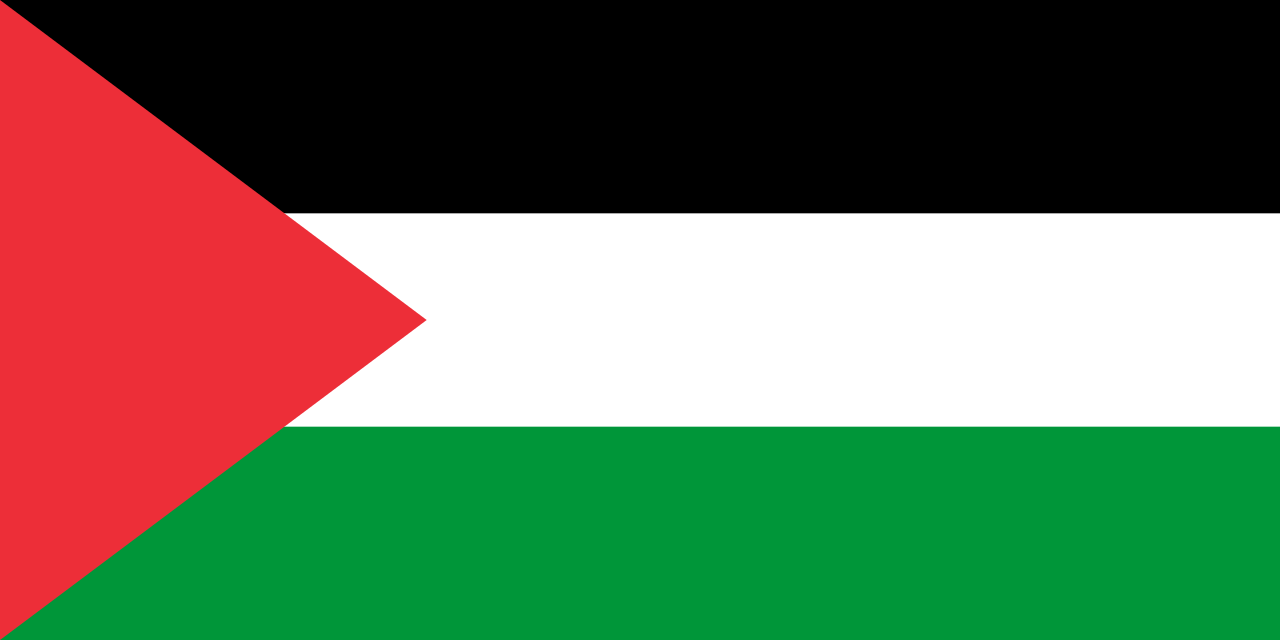
Palestina
Also known as PSE, State of Palestine, Palestinian Authority, Palestinian National Authority
republik i Mellanöstern
AI overview
Palestine, officially the State of Palestine, is a country in West Asia comprising the West Bank (including East Jerusalem) and the Gaza Strip, with a population exceeding five million and borders primarily with Israel, Jordan, and Egypt. It matters because it is a significant geopolitical entity whose status, governance, and relationship with Israel are central to Middle Eastern politics and international relations.
AI-generated from the Wikipedia summary — may contain errors.
Weather now
cached 8h ago23°broken clouds
76% 4.5 m/s OpenWeatherMap
7-day forecast
via Open-Meteo
Country

- Capital
- Ramallah, Jerusalem
- Population
- 5,483,450
- Region
Travel guide
Get in
Get into the West Bank Get into Gaza
Get around
thumb|Getting around [[Jericho]]
See
thumb|Church of Nativity in [[Bethlehem]] thumb|Market in [[Hebron]] Palestine is home to some of the most important religious places in history and a number of fabulous, humbling sights. Here, you follow the footsteps of millions of pilgrims, you stand on grounds that saw some of the most influential fights of all time and visit some of the most important biblical and historic sites in the world.
Famous as the birth place of Jesus, the small town of Bethlehem is a must-see for most visitors of the Palestinian territories. The Church of Nativity, built over the cave where – according to tradition – Jesus of Nazareth was born, is a sacred destination for Christians and Muslims alike. From here, it's a short walk to the Shepherd's Field, where the birth of the holy child is believed to be announced to a group of shepherds when they saw the Star of Nativity. Or head to Solomon's Pools, just a few kilometres out of town. Bethlehem is also famous for its Banksy Art, four graffiti can be found here. Around the city visit the stunning Monastery of Mar Saba.
Where Bethlehem is known as a place of birth, Hebron is famous as the burial place for the great patriarchs and matriarchs. A holy destination for both the Islamic and Jewish people, this city is home to the Tomb of the Patriarchs and Matriarchs and was once the capital of the Kingdom of Israel. Hebron has a delightful old town, full of winding alleys and bustling bazaars and is locally known for its pottery worksho…
Eat
thumb|Knafeh
Shawarma and falafel sandwiches are really popular foods for Palestinians, as well as olives and hummus. It is traditional to eat with bread and not a spoon or fork. It is unusual to eat a meal without bread.
Palestinian cuisine is generally similar to that of neighbouring Jordan. As in Jordan, mansaf is a popular dish of rice with meat, usually lamb. Knafeh is a popular dessert made of cheese, soaked in a sweet sugar-based syrup and topped with shredded filo pastry. Nablus is famous for their variety of knafeh Nabulsiyeh.
Drink
In cities such as Ramallah, alcohol is often available at restaurants. Be aware that most residents of the West Bank are Muslims who do not drink alcohol. As such, public intoxication can be seen as rude.
Article · Svenska
Palestina (arabiska: فلسطين, filastin), officiellt deklarerad som Staten Palestina (arabiska: دولة فلسطين, dawlat filastin) är en stat som proklamerades genom den av PLO 15 november 1988 utropade och är erkänd av 135 av världens 193 suveräna FN-stater samt många internationella organ, inklusive Förenta nationernas generalförsamling, som 2012 röstade för att Palestina som stat skulle få observatörsstatus i FN. PLO utövade inte kontrollen över något territorium vid tiden för självständighetsförklaringen och områdena som tas i anspråk står under israelisk ockupation med enbart en begränsad palestinsk kontroll, bland annat över städer och andra bebodda platser (Area A och B). Dessa områden utgörs av Gazaremsan, Västbanken och Östra Jerusalem. "Palestina" används officiellt som en kortform av Staten Palestina men också homonymt för såväl Palestinska myndigheten, PLO som FN-observatör, Palestina som biblisk, geografisk och historisk region som för andra förslag gällande en Palestinsk stat.
Abstract from DBpedia / Wikipedia · CC BY-SA
Gallery (59)
On the map
3 mapped locations
Connections
Categories
1988 establishments in AsiaCitation overkillCountries and territories where Arabic is an official languageCountries in AsiaCountries in West AsiaEastern MediterraneanLevantMember states of the Organisation of Islamic CooperationPalestineRepublicsStates and territories established in 1988States with limited recognition