File:Prokaryote_cell.svg · Wikimedia Commons · See Wikimedia Commons
prokaryotes
Sign in to saveAlso known as Prokaryota
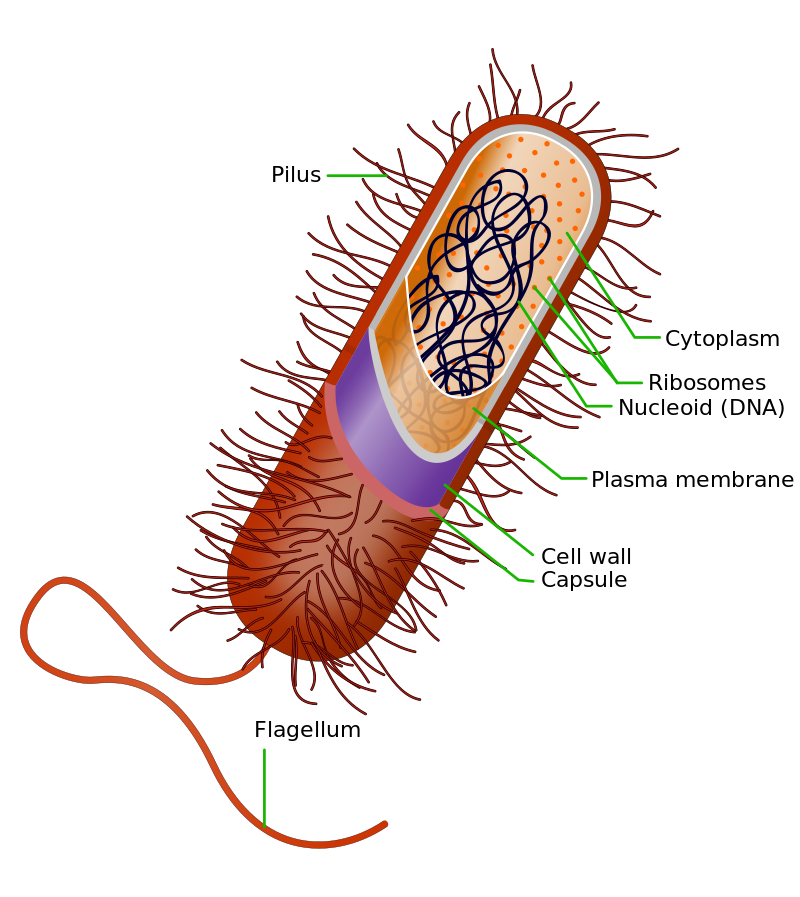
thumb|upright=1.35|alt=image of prokaryotic cell|Diagram of a prokaryotic cell, a Bacteria|bacterium with a flagellum
Prokaryotes are single-celled organisms, like bacteria, that lack a nucleus and other membrane-bound structures found in more complex cells. They are among the most abundant life forms on Earth and play crucial roles in breaking down organic matter, cycling nutrients, and living in nearly every environment from soil to ocean depths.
AI-generated from the Wikipedia summary — may contain errors.
Wikidata facts
- Subclass of
- organism
- Has part
- prokaryotic cell
- Parent taxon
- Biota
- Image
- Diversidad procariota.PNG
Show 7 more facts
- start time
- 3500000000
- taxon name
- Prokaryota
- Commons category
- Procaryota
- topic's main category
- Category:Prokaryotes
- means of locomotion
- rolling
- temporal range start
- Paleoarchean
Sources (7)
via Wikidata · CC0
~17 min read
Encyclopedic overview
12 sectionsContents
- Structure
- Reproduction and DNA transfer
- Colonies and biofilms
- Environment
- The first organisms
- Evolution
- Taxonomy and phylogeny
- As distinct from eukaryotes
- Eukaryotes as Archaea
- See also
- References
- External links
thumb|upright=1.35|alt=image of prokaryotic cell|Diagram of a prokaryotic cell, a Bacteria|bacterium with a flagellum
A prokaryote (; less commonly spelled procaryote) is a microorganism whose usually single cell lacks a nucleus or other membrane-bound organelles. The word prokaryote comes from the Ancient Greek (), meaning "before", and (), meaning "nut" or "kernel". In the earlier two-empire system, prokaryotes formed the empire Prokaryota. In the three-domain system, based upon molecular phylogenetics, prokaryotes are divided into two domains: Bacteria and Archaea. A third domain, Eukaryota, consists of organisms with cell nuclei.
Excerpted from Wikipedia’s “prokaryotes” article, available under the CC BY-SA 4.0 licence.
Gallery (15)
Available in 108 languages
- Español
- Français
- Deutsch
- 中文
- 日本語
- Русский
- Português
- Italiano
- العربية
- हिन्दी
- Afrikaans
- Albanian
- Albanian
- Aragonese
- Armenian
- Assamese
- Azerbaijani
- Bahasa Indonesia
Show 89 more
- Bangla
- Basque
- Bavarian
- Belarusian
- Bosnian
- Breton
- Bulgarian
- Burmese
- Catalan
- Central Kurdish
- Chechen
- Croatian
- Czech
- Danish
- Egyptian Arabic
- Esperanto
- Estonian
- Filipino
- Finnish
- Galician
- Georgian
- Greek
- Haitian Creole
- Hebrew
- Hungarian
- Icelandic
- Interlingua
- Irish
- Javanese
- Kara-Kalpak
- Kashmiri
- Kazakh
- Kyrgyz
- Lao
- Latin
- Latvian
- Limburgish
- lld
- Low German
- Luxembourgish
- Macedonian
- Malagasy
- Malay
- Malayalam
- Manx
- Moroccan Arabic
- Neapolitan
- Nederlands
- Nepali
- Northern Frisian
- Norwegian
- Norwegian Nynorsk
- Occitan
- Odia
- Oromo
- Pampanga
- Polski
- Punjabi
- Romanian
- Sardinian
- Scots
- Serbian
- Serbian (Latin)
- simple
- Sindhi
- Slovak
- Slovenian
- Svenska
- Swahili
- Tajik
- Tamil
- Tiếng Việt
- Türkçe
- Turkmen
- Ukrainian
- Urdu
- Uzbek
- Waray
- Welsh
- Western Panjabi
- Wu Chinese
- Yakut
- Yiddish
- Yoruba
- zh_yue
- Zulu
- فارسی
- ไทย
- 한국어
via Wikidata sitelinks · CC0