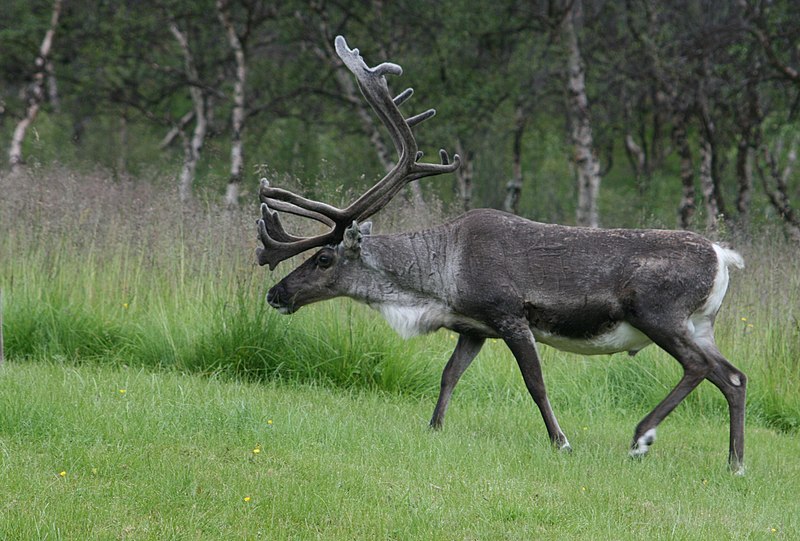
File:Reinbukken_på_frisk_grønt_beite._-_panoramio.jpg · Wikimedia Commons · See Wikimedia Commons
Rangifer tarandus
Sign in to saveAlso known as caribou, reindeer
The reindeer or caribou (Rangifer tarandus) is a species of deer with circumpolar distribution, native to Arctic, subarctic, tundra, boreal, and mountainous regions of Northern Europe, Siberia, and North America. It is the only representative of the genus Rangifer. More recent studies suggest the splitting of reindeer and caribou (North American terminology). "All caribou and reindeer throughout the world are considered to be the same species, but there are 7 subspecies."
OverviewAI-generated
Rangifer tarandus, commonly known as caribou or reindeer, is a species of mammal in the family Cervidae. It is the only animal in the genus Rangifer. The taxon belongs to the kingdom Animalia, phylum Chordata, class Mammalia, and order Artiodactyla. The scientific name was established by Linnaeus in 1758.
The species has a status of Vulnerable as recorded in 2016. Its range includes the United States and Canada. Observations of the animal are documented in various databases, with occurrence counts reaching 79,734. The gestation period is 228 days, and the longest observed lifespan is 21.8 years. The lineage dates back to about 620 thousand years ago.
Synthesized by Vinony from 39 facts across 9 sources: Wikidata, GBIF, iNaturalist, Encyclopedia of Life, Gbif Occ, IUCN Red List, iDigBio, WoRMS, Vinony graph. Generated from structured data (not the Wikipedia text) and checked against those facts — may still contain errors.
Species
Vulnerablereindeer
Rangifer tarandus
SPECIES
- KingdomAnimalia
- PhylumChordata
- ClassMammalia
- OrderArtiodactyla
- FamilyCervidae
在瑞典拉普兰山谷中奔跑的驯鹿 驯鹿(學名Rangifer tarandus),又名角鹿。是鹿科驯鹿属下的唯一一種動物。
via GBIF · IUCN
Museum specimens
- Specimen records
- 6,583
- With media
- 280
- Family
- Cervidae
- Collections
- UAM, CM, MSB, UWBM
- Recorded in
- United States, Canada
Bird sounds
- mating call, Hoof Clicking· United States· quality A
- mating call, Hoof Clicking· United States· quality A
- mating call, Hoof Clicking· United States· quality A
- Hoof Clicking· United States· quality A
via Xeno-canto
Wikidata facts
Show 17 more facts
- main food source
- fish
- taxon rank
- species
- IUCN conservation status
- Vulnerable
- taxon name
- Rangifer tarandus
- Commons category
- Rangifer tarandus
- topic's main category
- Category:Reindeer
- Commons gallery
- Rangifer tarandus
- taxon common name
- rein
- gestation period
- 228
- longest observed lifespan
- 21.8
- start time
- 620000-00-
- habitat
- forest
- on focus list of Wikimedia project
- Wikipedia:Vital articles/Level/4
- different from
- Ren
- short name
- R. tarandus
- Digital Atlas of Idaho URL
- digitalatlas.cose.isu.edu/bio/mammal/Hoofed/woca/wocafrm.htm
- taxon range
- Greenland
Sources (2)
via Wikidata · CC0
~93 min read
Encyclopedic overview
47 sectionsContents
- Description
- Status
- Naming
- Evolution
- Taxonomy
- Naming and research on museum collections
- Biological exploration expeditions
- Reclassification
- Ecotypes
- Genetic, molecular, and archaeological evidence
- Novel genetics-based clades
- Species and subspecies
- Physical characteristics
- Antlers
- Pelt
- Heat exchange
- Hooves
- Size
- Clicking sound
- Eyes
- Biology and behaviors
- Seasonal body composition
- Reproduction and life cycle
- Social structure, migration and range
- Ecology
- Distribution and habitat
- Diet
- Predators
- Other threats
- Conservation
- Current status
- Boreal woodland caribou
- Peary caribou
- Relationship with humans
- Indigenous North Americans
- Indigenous Eurasians
- Husbandry
- History
- Santa Claus
- Mythology and art
- Heraldry and symbols
- See also
- Notes
- References
- Bibliography
- External links
- Caribou-specific links (North America)
The reindeer or caribou (Rangifer tarandus) is a species of deer with circumpolar distribution, native to Arctic, subarctic, tundra, boreal, and mountainous regions of Northern Europe, Siberia, and North America. It is the only representative of the genus Rangifer. More recent studies suggest the splitting of reindeer and caribou (North American terminology). "All caribou and reindeer throughout the world are considered to be the same species, but there are 7 subspecies."
Reindeer occur in both migratory and sedentary populations, and their herd sizes vary greatly in different regions. The tundra subspecies are adapted for extreme cold, and some are adapted for long-distance migration.
Excerpted from Wikipedia’s “Rangifer tarandus” article, available under the CC BY-SA 4.0 licence.
Gallery (57)
Available in 116 languages
- Español
- Français
- Deutsch
- 中文
- 日本語
- Русский
- Português
- Italiano
- العربية
- हिन्दी
- Afrikaans
- Amharic
- Aragonese
- Asturian
- Atikamekw
- azb
- Azerbaijani
- Bahasa Indonesia
Show 97 more
- Balinese
- Bangla
- Banjar
- Basque
- be_x_old
- Belarusian
- Breton
- Bulgarian
- Burmese
- Catalan
- Cebuano
- Central Kurdish
- Cherokee
- Chuvash
- Croatian
- Czech
- Danish
- Egyptian Arabic
- Esperanto
- Estonian
- Faroese
- Filipino
- Finnish
- Galician
- Georgian
- Gilaki
- Goan Konkani
- Greek
- Hebrew
- Hungarian
- Icelandic
- Ido
- Inuktitut
- Inupiaq
- Irish
- Javanese
- Kabyle
- Kashubian
- Kazakh
- Kotava
- Kurdish
- Latgalian
- Latin
- Latvian
- Lingua Franca Nova
- Lithuanian
- Macedonian
- Malagasy
- Malay
- Malayalam
- Marathi
- Mazanderani
- Mongolian
- Navajo
- Nederlands
- Nepali
- Newari
- Northern Frisian
- Northern Sami
- Norwegian
- Norwegian Nynorsk
- nrm
- Occitan
- Old English
- olo
- Ossetic
- Polski
- Romanian
- Romansh
- Scots
- Scottish Gaelic
- Serbian
- Serbian (Latin)
- simple
- Slovak
- Slovenian
- Southern Altai
- Svenska
- Swahili
- Tamil
- Telugu
- Tiếng Việt
- Türkçe
- Tuvinian
- Ukrainian
- Urdu
- Uyghur
- Uzbek
- Waray
- Welsh
- Western Panjabi
- Wu Chinese
- zh_yue
- Zulu
- فارسی
- ไทย
- 한국어
via Wikidata sitelinks · CC0