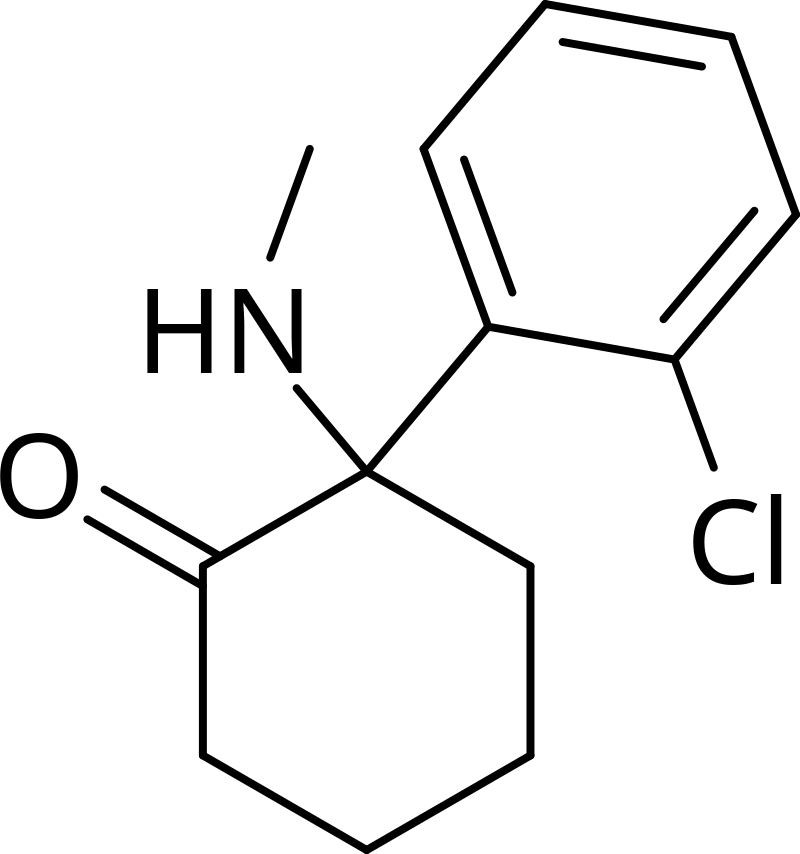
File:Ketamine2DCSD.svg · Wikimedia Commons · See Wikimedia Commons
(RS)-ketamine
Sign in to saveAlso known as DL-ketamine, 2-(o-chlorophenyl)-2-(methylamino)-cyclohexanone, 2-(methylamino)-2-(2-chlorophenyl)cyclohexanone, (±)-ketamine, 2-(2-chloro-phenyl)-2-methylamino-cyclohexanone, (+-)-ketamine, special K, Special K
Ketamine is a cyclohexanone-derived general anesthetic and NMDA receptor antagonist with analgesic and hallucinogenic properties, used medically for anesthesia, depression, and pain management. Ketamine exists as its two enantiomers, S- (esketamine) and R- (arketamine), and has antidepressant action likely involving other mechanisms in addition to NMDA antagonism.
OverviewAI-generated
(RS)-ketamine is a chemical compound with the formula C₁₃H₁₆ClNO. Its IUPAC name is 2-(2-chlorophenyl)-2-(methylamino)cyclohexan-1-one. The substance has a mass of 237.092042 and a weight of 237.72.
Chemical properties include an xlogp of 2.2 and a topological polar surface area of 29.1. The molecule contains one hydrogen bond donor and two hydrogen bond acceptors, with a charge of 0. Its canonical SMILES notation is CNC1(CCCCC1=O)C2=CC=CC=C2Cl.
The compound is associated with a Commons category titled "Ketamine" and has been referenced by 3,514 other encyclopedia articles.
Synthesized by Vinony from 17 facts across 4 sources: Wikidata, PubChem, PubMed, Vinony graph. Generated from structured data (not the Wikipedia text) and checked against those facts — may still contain errors.
Key facts
- Drug.C
- 13
- Drug.Watchedfields
- changed
- Drug.verifiedrevid
- 477168837
- Drug.image
- Ketamine2DCSD.svg
- Drug.image_class
- skin-invert-image
- Drug.width
- 150px
- Drug.image2
- S-ketamine-from-HCl-xtal-3D-balls.png
- Drug.image_class2
- bg-transparent
- Drug.width2
- 175px
- Drug.alt2
- (S)-Ketamine ball-and-stick model
- Drug.tradename
- Ketalar, others
- Drug.DailyMedID
- Ketamine
- Drug.pregnancy_AU
- B3
- Drug.addiction_liability
- Moderate–high
- Drug.routes_of_administration
- Any
- Drug.class
- NMDA receptor antagonist; general anesthetic; dissociative hallucinogen; analgesic; antidepressant
- Drug.ATC_prefix
- N01
- Drug.ATC_suffix
- AX03
via Wikipedia infobox
Chemical data
- Formula
- C13H16ClNO
- Molecular weight
- 237.72 g/mol
- IUPAC name
- 2-(2-chlorophenyl)-2-(methylamino)cyclohexan-1-one
- SMILES
- CNC1(CCCCC1=O)C2=CC=CC=C2Cl
- InChIKey
- YQEZLKZALYSWHR-UHFFFAOYSA-N
- XLogP
- 2.2
- Polar surface area
- 29.1 Ų
- H-bond donors
- 1
- H-bond acceptors
- 2
- Formal charge
- 0
via PubChem
Research
6 papers- Pharmacokinetics of S-ketamine and R-ketamine and their active metabolites after racemic ketamine or S-ketamine intravenous administration in dogs sedated with medetomidine.Veterinary anaesthesia and analgesia · 2020Romagnoli N, Bektas RN, Kutter APN et al.DOI: 10.1016/j.vaa.2019.08.048
- Stereoselective Ketamine Metabolism by Genetic Variants of Cytochrome P450 CYP2B6 and Cytochrome P450 Oxidoreductase.Anesthesiology · 2018Wang PF, Neiner A, Kharasch EDDOI: 10.1097/ALN.0000000000002371
- Subarachnoid ketamine and ketamine s (+) associated with lidocaine in sheep and goats anesthesia.Veterinary and animal science · 2021Dória RGS, Ferraz GRL, Filippo PAD et al.DOI: 10.1016/j.vas.2020.100148
- Differential role of nitric oxide in the psychedelic symptoms induced by racemic ketamine and esketamine in human volunteers.British journal of anaesthesia · 2018Jonkman K, van der Schrier R, van Velzen M et al.DOI: 10.1016/j.bja.2018.01.022
- Cognitive Impairment That Is Induced by (R)-Ketamine Is Abolished in NMDA GluN2D Receptor Subunit Knockout Mice.The international journal of neuropsychopharmacology · 2019Ide S, Ikekubo Y, Mishina M et al.DOI: 10.1093/ijnp/pyz025
- Role of NMDA receptor GluN2D subunit in the antidepressant effects of enantiomers of ketamine.Journal of pharmacological sciences · 2017Ide S, Ikekubo Y, Mishina M et al.DOI: 10.1016/j.jphs.2017.11.001
via PubMed
Wikidata facts
- Mass
- 237.092042
Show 7 more facts
- Commons category
- Ketamine
- chemical formula
- C₁₃H₁₆ClNO
- medical condition treated
- substance abuse
- canonical SMILES
- CNC1(CCCCC1=O)C2=CC=CC=C2Cl
- World Health Organisation international non-proprietary name
- 氯胺酮
- subject has role
- Dissociative
- different from
- esketamine
Sources (9)
via Wikidata · CC0
~33 min read
Encyclopedic overview
30 sectionsContents
- Medical uses
- Anesthesia
- Pain
- Depression
- Seizures
- Asthma
- Contraindications
- Adverse effects
- Liver toxicity and urologic disease
- Near-death experience
- Addiction and tolerance
- Brain damage
- Interactions
- Pharmacology
- Pharmacodynamics
- Mechanism of action
- Molecular targets
- Relationships between levels and effects
- Pharmacokinetics
- Chemistry
- Structure
- Detection
- History
- Society and culture
- Legal status
- Recreational use
- Research
- Veterinary uses
- References
- External links
Ketamine is a cyclohexanone-derived general anesthetic and NMDA receptor antagonist with analgesic and hallucinogenic properties, used medically for anesthesia, depression, and pain management. Ketamine exists as its two enantiomers, S- (esketamine) and R- (arketamine), and has antidepressant action likely involving other mechanisms in addition to NMDA antagonism.
At anesthetic doses, ketamine induces a state of dissociative anesthesia, a trance-like state providing pain relief, sedation, and amnesia. Its distinguishing features as an anesthetic are preserved breathing and airway reflexes, stimulated heart function with increased blood pressure, and moderate bronchodilation. As an anesthetic, it is used especially in trauma, emergency, and pediatric cases. At lower, sub-anesthetic doses, it is used as a treatment for pain and treatment-resistant depression.
Excerpted from Wikipedia’s “(RS)-ketamine” article, available under the CC BY-SA 4.0 licence.
Gallery (20)
Available in 72 languages
- Español
- Français
- Deutsch
- 中文
- 日本語
- Русский
- Português
- Italiano
- العربية
- हिन्दी
- Afrikaans
- Armenian
- azb
- Bahasa Indonesia
- Bangla
- Basque
- Belarusian
- Bulgarian
Show 53 more
- Catalan
- Central Kurdish
- Croatian
- Czech
- dag
- Danish
- Esperanto
- Estonian
- Finnish
- Georgian
- gpe
- Greek
- Hausa
- Hebrew
- Hungarian
- Irish
- Kashmiri
- Latin
- Latvian
- Lithuanian
- Macedonian
- Malagasy
- Malay
- Nederlands
- Norwegian
- Odia
- Polski
- Punjabi
- Romanian
- Scots
- Serbian
- Serbian (Latin)
- simple
- Sinhala
- Slovak
- Slovenian
- Svenska
- Swahili
- Telugu
- Tiếng Việt
- Türkçe
- Tyap
- Ukrainian
- Urdu
- Walloon
- Welsh
- Wu Chinese
- zh_classical
- zh_min_nan
- zh_yue
- فارسی
- ไทย
- 한국어
via Wikidata sitelinks · CC0