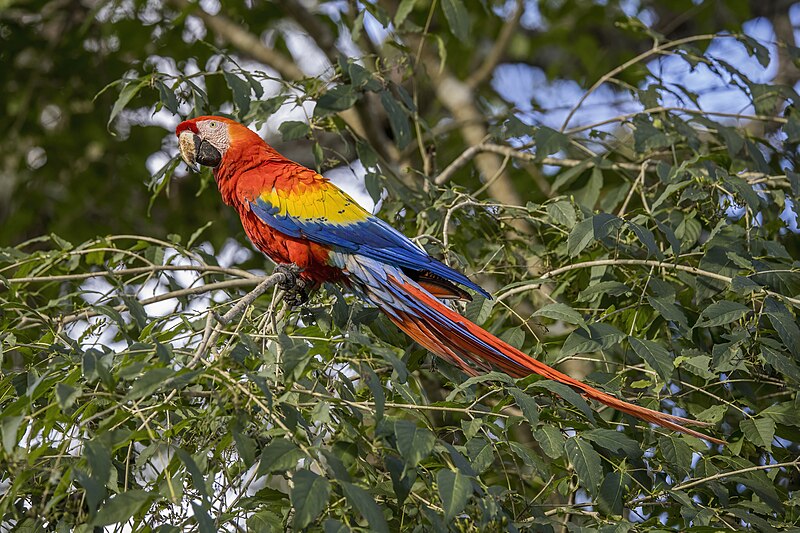
File:Scarlet_macaw_(Ara_macao_cyanopterus)_Copan.jpg · Wikimedia Commons · See Wikimedia Commons
OverviewAI-generated
The Scarlet Macaw, scientifically known as *Ara macao*, is a species of bird within the genus *Ara*. It is also referred to by the common names Guacamayo macao, Scharlachara, and Ara rouge. This diurnal organism is classified under the class Aves. Its primary food sources include fruit, nuts, seeds, and flowers. The species has a litter size of two, with an egg incubation period of 26 days.
The taxon range for the Scarlet Macaw includes Brazil, South America, and Belém. It is listed in Appendix I of CITES and holds a Least Concern conservation status according to the IUCN Red List assessment from 2022. The species was described in the Brockhaus and Efron Encyclopedic Dictionary.
Synthesized by Vinony from 26 facts across 4 sources: Wikidata, IUCN Red List, iNaturalist, Vinony graph. Generated from structured data (not the Wikipedia text) and checked against those facts — may still contain errors.
Species
Least ConcernScarlet Macaw
species
via IUCN
Wikidata facts
Show 14 more facts
- litter size
- 2
- CITES Appendix
- Appendix I of CITES
- taxon range
- Belém
- taxon rank
- species
- IUCN conservation status
- Least Concern
- taxon name
- Ara macao
- Commons category
- Ara macao
- Commons gallery
- Ara macao
- described by source
- Brockhaus and Efron Encyclopedic Dictionary
- egg incubation period
- 26
- diel cycle
- diurnality
- short name
- A. macao
- taxon common name
- svetlo rdeči ara
- main food source
- seed
via Wikidata · CC0
~11 min read
Encyclopedic overview
Copan, Honduras A partnered pair of wild scarlet macaws rub against each other in Costa Rica The scarlet macaw (Ara macao) also called the red-and-yellow macaw, red-and-blue macaw or red-breasted macaw, is a large yellow, green, red and blue Neotropical parrot native to humid evergreen forests of the Americas. Its range extends from southeastern Mexico to Peru, Ecuador, Colombia, Bolivia, Venezuela, Honduras, and Brazil in lowlands of 500 m (1,600 ft) (at least formerly) up to 1,000 m (3,300 ft), the Caribbean island of Trinidad, as well as the Pacific island of Coiba. Formerly, the northern extent of its range included southern Tamaulipas. In some areas, it has suffered local extinction because of habitat destruction, or capture for the parrot trade, but in other areas, it remains fairly common. It is the national bird of Honduras. Like its relative the blue-and-yellow macaw, the scarlet macaw is a popular bird in aviculture as a result of its striking plumage. It is the third most common macaw species in captivity after the blue-and-yellow and red-and-green macaw respectively. In recent years it has become much rarer in captivity and much more expensive due to stricter laws, its price being higher than even red-and-green macaws.
Taxonomy
Excerpted from Wikipedia’s “Scarlet Macaw” article, available under the CC BY-SA 4.0 licence.
Gallery (12)
Available in 58 languages
- Español
- Français
- Deutsch
- 中文
- 日本語
- Русский
- Português
- Italiano
- العربية
- Armenian
- Bahasa Indonesia
- Balinese
- Basque
- Belarusian
- Breton
- Bulgarian
- Catalan
- Cebuano
Show 39 more
- Croatian
- Czech
- Danish
- Egyptian Arabic
- Esperanto
- Estonian
- Filipino
- Finnish
- Greek
- Hebrew
- Hungarian
- hyw
- Latvian
- Lithuanian
- Malayalam
- Navajo
- Nederlands
- Norwegian
- Norwegian Nynorsk
- Polski
- Quechua
- Romanian
- Serbian
- Serbian (Latin)
- simple
- Slovak
- Svenska
- Tamil
- Tiếng Việt
- Türkçe
- Ukrainian
- Urdu
- Waray
- Welsh
- Western Frisian
- Western Mari
- Western Panjabi
- فارسی
- 한국어
via Wikidata sitelinks · CC0