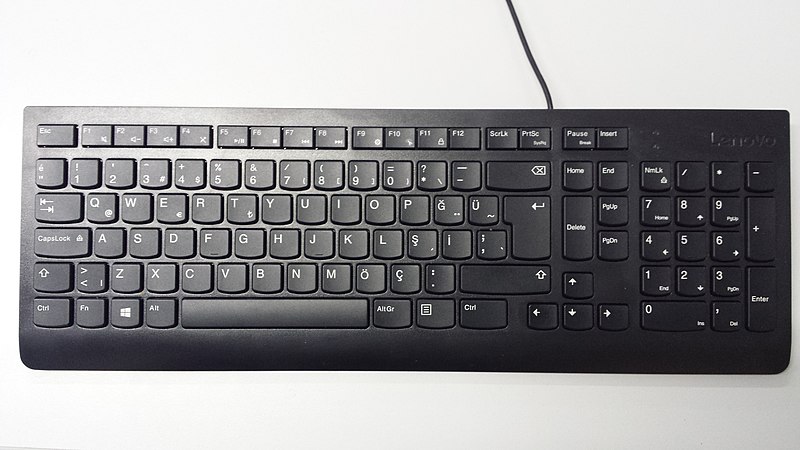
File:Turkish_Q_computer_keyboard.jpg · Wikimedia Commons · See Wikimedia Commons
التركية
Sign in to saveAlso known as Turkish of Turkey, Istanbul Turkish, Türkçe, Anatolian Turkish, Turkish language
لُغة الجُمهوريَّة التُركيَّة الرسميَّة، وأكثر اللُغات الأتراكيَّة تحدُثًا
OverviewAI-generated
Turkish is a natural and modern language belonging to the Turkic family. It is primarily spoken in Turkey, Bulgaria, Cyprus, and Greece. The language is native to Turks and is associated with the regions of Burgas, Kardzhali, and Smolyan. Its native label is Türkçe.
The language uses the Turkish alphabet, Arabic alphabet, and Turkish Braille. It follows a subject–object–verb word order and is classified as an agglutinative, syllabic, and synthetic language. Turkish has present, past, and future tenses, along with admirative, imperative, and indicative moods. It uses capitalization for proper nouns and days of the week. The Turkish Language Association serves as its regulatory body.
Turkish is based on Old Anatolian Turkish. It is studied through Turkology. The language has approximately 82,231,620 speakers, writers, or signers. It is referenced by 15,555 other encyclopedia articles. Films in this language are categorized under Turkish-language films.
Synthesized by Vinony from 24 facts across 3 sources: Wikidata, Vinony graph, Geo. Generated from structured data (not the Wikipedia text) and checked against those facts — may still contain errors.
Wikidata facts
- Subclass of
- Turkic
- Country
- Northern Cyprus
- Based on
- Old Anatolian Turkish
- Image
- Turkish alphabet.svg
Show 29 more facts
- Wikimedia language code
- tr
- Commons category
- Turkish language
- topic's main category
- Category:Turkish language
- writing system
- Turkish Braille
- language regulatory body
- Turkish Language Association
- native label
- Türkçe
- short name
- türgi keel
- linguistic typology
- postposition
- on focus list of Wikimedia project
- Wikipedia:List of articles all languages should have
- category for films in this language
- Category:Turkish-language films
- indigenous to
- Rhodope Prefecture
- studied by
- Turkology
- uses capitalization for
- day of the week
- different from
- Turki
- P10369
- Diego Velázquez
- number of speakers, writers, or signers
- 380300
- P11012
- September 21
- entry in abbreviations table
- ਤੁ.
- has tense
- past tense
- described at URL
- turkic.elegantlexicon.com/lx.php?lx=tur
- P13311
- Rodger Bumpass
- exact match
- afbo.info/languages/81
- has grammatical case
- instrumental case
- maintained by WikiProject
- WikiProject Languages
- main regulatory text
- Constitution of Turkey
- Stack Exchange tag
- linguistics.stackexchange.com/tags/turkish
- ethnic group
- Turks
- female form of label
- la langue turque
- NCI Thesaurus ID
- C154180
Sources (12)
via Wikidata · CC0
Article · العربية
اللغة التركية (: Türkçe، [ˈtyɾct͡ʃɛ])، والتي يُشار إليها أحيانًا باسم التركية الأناضولية أو التركية الإسطنبولية، هي أكثر لغات الترك انتشارًا وأكثرها تحدثًا، إذ أنها تعدّ اللغة الأم لقرابة 83 مليون نسمة. تنتشر هذه اللغة في تركيا وقبرص الشمالية بشكل رئيسي، وتُعد لغة أقلية في كل من العراق، واليونان، وجمهورية مقدونيا، وكوسوفو، وألبانيا، وفي بضعة دول وأقاليم أخرى في أوروبا الشرقية. تُشكل التركية أيضًا اللغة الأم، أو اللغة الثانية لملايين من سكان أوروبا الغربية، وبالأخص ألمانيا. ترجع جذور اللغة التركية إلى آسيا الوسطى، حيث عُثر على نقوش ومخطوطات كُتبت بهذه اللغة وقُدّر عمرها بحوالي 1,300 سنة. انتشرت اللغة التركية وتوسع نطاقها غربًا وارتفع عدد متحدثيها مع اتساع رقعة الدولة العثمانية، خاصة مع استيطان عدد من التُرك بلاد الروملي حديثة الفتح، واعتماد الحكومة العثمانية لغتها الأم اللغة الرسمية في جميع الإدارات بمختلف الولايات. عام 1928 أقدم مصطفى كمال أتاتورك، أوّل رئيس للجمهورية التركية، على إجراء عدّة تغييرات على المستوى الإداري والثقافي للبلاد، كان منها استبدال الأبجدية التركية العثمانية عربية الحرف، بالأبجدية اللاتينية. وفي وقت لاحق أُنشئت جمعية اللغة التركية (: Türk Dil Kurumu؛ اختصارًا: TDK) بهدف توحيد اللغة وإعادة تنظيمها بحيث تتناسب مع الأبجدية الجديدة.
Abstract from DBpedia / Wikipedia · CC BY-SA
Gallery (12)
On the map
Available in 205 languages
- Español
- Français
- Deutsch
- 中文
- 日本語
- Русский
- Português
- Italiano
- العربية
- हिन्दी
- Abkhazian
- Achinese
- Adyghe
- Afrikaans
- Albanian
- Albanian
- Amharic
- Angika
Show 186 more
- Aragonese
- Aramaic
- Armenian
- Assamese
- Asturian
- Avaric
- azb
- Azerbaijani
- Bahasa Indonesia
- Balinese
- Bangla
- Bashkir
- Basque
- bat_smg
- Bavarian
- be_x_old
- Belarusian
- Bosnian
- Breton
- btm
- Bulgarian
- Buriat
- Burmese
- Catalan
- cbk_zam
- cdo
- Cebuano
- Central Dusun
- Central Kurdish
- Chechen
- Cherokee
- Chuvash
- Cornish
- Crimean Tatar
- Croatian
- Czech
- Danish
- Egyptian Arabic
- eml
- Erzya
- Esperanto
- Estonian
- Faroese
- Fiji Hindi
- Filipino
- Finnish
- Gagauz
- Galician
- Georgian
- Gilaki
- Goan Konkani
- Greek
- Guarani
- Gujarati
- Hakka Chinese
- Hausa
- Hebrew
- Hungarian
- hyw
- Iban
- Icelandic
- Ido
- Iloko
- Ingush
- Irish
- Javanese
- Kabardian
- Kabyle
- Kara-Kalpak
- Kashmiri
- Kashubian
- Kazakh
- kge
- Kinyarwanda
- Komi
- Komi-Permyak
- Kongo
- Kotava
- Kurdish
- Kyrgyz
- Ladino
- Lao
- Latin
- Latvian
- lbe
- Lezghian
- Limburgish
- Lingua Franca Nova
- Lithuanian
- lld
- Lombard
- Low German
- Lower Sorbian
- Luxembourgish
- Macedonian
- Madurese
- Malagasy
- Malay
- Malayalam
- Manipuri
- Manx
- Māori
- Marathi
- Mari
- Mazanderani
- Minangkabau
- Mingrelian
- Moksha
- Mongolian
- Moroccan Arabic
- nds_nl
- Nederlands
- Nepali
- Newari
- Northern Frisian
- Northern Sami
- Northern Sotho
- Norwegian
- Norwegian Nynorsk
- Occitan
- Ossetic
- Papiamento
- Pashto
- Picard
- Piedmontese
- Polski
- Punjabi
- Quechua
- Romanian
- Romansh
- Romany
- Rusyn
- Santali
- Sardinian
- Scots
- Scottish Gaelic
- Serbian
- Serbian (Latin)
- Shona
- Sicilian
- Silesian
- simple
- Sindhi
- Sinhala
- Slovak
- Slovenian
- Somali
- Sundanese
- Svenska
- Swahili
- Tajik
- Talysh
- Tamil
- Tatar
- Tiếng Việt
- Toki Pona
- Türkçe
- Turkmen
- Tuvinian
- Tyap
- Udmurt
- Ukrainian
- Upper Sorbian
- Urdu
- Uyghur
- Uzbek
- Venetian
- Veps
- Volapük
- Walloon
- Waray
- Welsh
- Western Frisian
- Western Mari
- Western Panjabi
- wikifunctions
- Wu Chinese
- Yakut
- Yiddish
- Yoruba
- Zaza
- zh_min_nan
- zh_yue
- فارسی
- ไทย
- 한국어
via Wikidata sitelinks · CC0