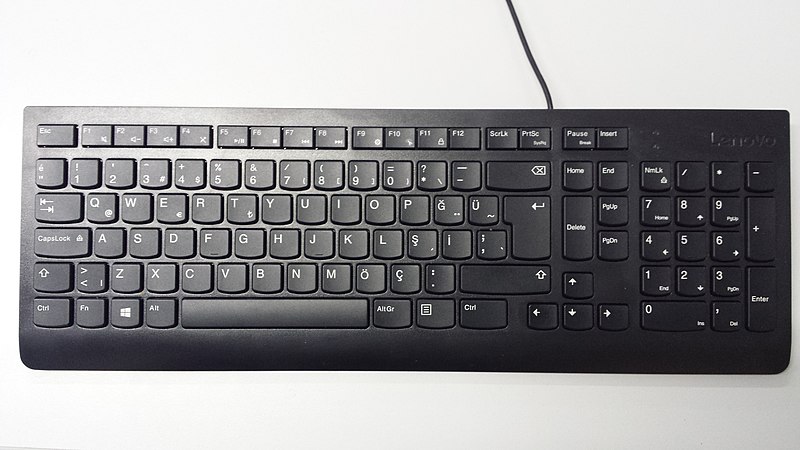
File:Turkish_Q_computer_keyboard.jpg · Wikimedia Commons · See Wikimedia Commons
Türkisch
Sign in to saveAlso known as Turkish of Turkey, Istanbul Turkish, Türkçe, Anatolian Turkish, Turkish language
in der Türkei überwiegend gesprochene Sprache
OverviewAI-generated
Turkish is a natural and modern language belonging to the Turkic family. It is primarily spoken in Turkey, Bulgaria, Cyprus, and Greece. The language is native to Turks and is associated with the regions of Burgas, Kardzhali, and Smolyan. Its native label is Türkçe.
The language uses the Turkish alphabet, Arabic alphabet, and Turkish Braille. It follows a subject–object–verb word order and is classified as an agglutinative, syllabic, and synthetic language. Turkish has present, past, and future tenses, along with admirative, imperative, and indicative moods. It uses capitalization for proper nouns and days of the week. The Turkish Language Association serves as its regulatory body.
Turkish is based on Old Anatolian Turkish. It is studied through Turkology. The language has approximately 82,231,620 speakers, writers, or signers. It is referenced by 15,555 other encyclopedia articles. Films in this language are categorized under Turkish-language films.
Synthesized by Vinony from 24 facts across 3 sources: Wikidata, Vinony graph, Geo. Generated from structured data (not the Wikipedia text) and checked against those facts — may still contain errors.
Wikidata facts
- Subclass of
- Turkic
- Country
- Northern Cyprus
- Based on
- Old Anatolian Turkish
- Image
- Turkish alphabet.svg
Show 29 more facts
- Wikimedia language code
- tr
- Commons category
- Turkish language
- topic's main category
- Category:Turkish language
- writing system
- Turkish Braille
- language regulatory body
- Turkish Language Association
- native label
- Türkçe
- short name
- türgi keel
- linguistic typology
- postposition
- on focus list of Wikimedia project
- Wikipedia:List of articles all languages should have
- category for films in this language
- Category:Turkish-language films
- indigenous to
- Rhodope Prefecture
- studied by
- Turkology
- uses capitalization for
- day of the week
- different from
- Turki
- P10369
- Diego Velázquez
- number of speakers, writers, or signers
- 380300
- P11012
- September 21
- entry in abbreviations table
- ਤੁ.
- has tense
- past tense
- described at URL
- turkic.elegantlexicon.com/lx.php?lx=tur
- P13311
- Rodger Bumpass
- exact match
- afbo.info/languages/81
- has grammatical case
- instrumental case
- maintained by WikiProject
- WikiProject Languages
- main regulatory text
- Constitution of Turkey
- Stack Exchange tag
- linguistics.stackexchange.com/tags/turkish
- ethnic group
- Turks
- female form of label
- la langue turque
- NCI Thesaurus ID
- C154180
Sources (12)
via Wikidata · CC0
Article · Deutsch
Türkische Sprache, kurz Türkisch, auch als Türkeitürkisch oder Osmanisch-Türkisch bezeichnet, ist die Bezeichnung einer agglutinierenden Sprache, die zum oghusischen Zweig der Turksprachen gehört und die als meistgesprochene Turksprache gilt. Türkisch ist die Amtssprache der Türkei und neben dem Griechischen auch auf Zypern (faktisch ausschließlich in der international nicht anerkannten Türkischen Republik Nordzypern). Außerdem wird Türkisch als lokale Amtssprache in Nordmazedonien, Rumänien und im Kosovo verwendet. Eigenbezeichnungen sind Türk dili, Türkçe [tyɾkt͡ʃɛ] und Türkiye Türkçesi. Die türkische Sprache selbst weist eine Reihe von Dialekten auf, von denen der Istanbuler Dialekt von besonderer Bedeutung ist. Seine Phonetik ist die Basis der heutigen türkischen Hochsprache. Bei der Einführung des lateinischen Alphabets für die türkische Sprache im Jahr 1928 wurde nicht auf die historische Orthographie des Osmanisch-Türkischen zurückgegriffen, sondern die Aussprache von Istanbul als Grundlage der Verschriftung herangezogen. Die Dialekte innerhalb der Türkei werden in Gruppen der Schwarzmeerregion (Karadeniz Şivesi), Ostanatolien (Doğu Anadolu Şivesi), Südostanatolien (Güneydoğu Anadolu Şivesi), Zentralanatolien (İç Anadolu Şivesi), Ägäis (Ege Şivesi) und Mittelmeerregion (Akdeniz Şivesi) eingeteilt. Die Alternativbenennung „Türkeitürkisch“ umfasst aber nicht nur die Türkei, sondern auch alle Gebiete des ehemaligen Osmanischen Reichs. Das bedeutet, dass auch die Balkan- oder Zyperntürken ein „Türkeitürkisch“ sprechen.
Abstract from DBpedia / Wikipedia · CC BY-SA
Gallery (12)
On the map
Available in 205 languages
- Español
- Français
- Deutsch
- 中文
- 日本語
- Русский
- Português
- Italiano
- العربية
- हिन्दी
- Abkhazian
- Achinese
- Adyghe
- Afrikaans
- Albanian
- Albanian
- Amharic
- Angika
Show 186 more
- Aragonese
- Aramaic
- Armenian
- Assamese
- Asturian
- Avaric
- azb
- Azerbaijani
- Bahasa Indonesia
- Balinese
- Bangla
- Bashkir
- Basque
- bat_smg
- Bavarian
- be_x_old
- Belarusian
- Bosnian
- Breton
- btm
- Bulgarian
- Buriat
- Burmese
- Catalan
- cbk_zam
- cdo
- Cebuano
- Central Dusun
- Central Kurdish
- Chechen
- Cherokee
- Chuvash
- Cornish
- Crimean Tatar
- Croatian
- Czech
- Danish
- Egyptian Arabic
- eml
- Erzya
- Esperanto
- Estonian
- Faroese
- Fiji Hindi
- Filipino
- Finnish
- Gagauz
- Galician
- Georgian
- Gilaki
- Goan Konkani
- Greek
- Guarani
- Gujarati
- Hakka Chinese
- Hausa
- Hebrew
- Hungarian
- hyw
- Iban
- Icelandic
- Ido
- Iloko
- Ingush
- Irish
- Javanese
- Kabardian
- Kabyle
- Kara-Kalpak
- Kashmiri
- Kashubian
- Kazakh
- kge
- Kinyarwanda
- Komi
- Komi-Permyak
- Kongo
- Kotava
- Kurdish
- Kyrgyz
- Ladino
- Lao
- Latin
- Latvian
- lbe
- Lezghian
- Limburgish
- Lingua Franca Nova
- Lithuanian
- lld
- Lombard
- Low German
- Lower Sorbian
- Luxembourgish
- Macedonian
- Madurese
- Malagasy
- Malay
- Malayalam
- Manipuri
- Manx
- Māori
- Marathi
- Mari
- Mazanderani
- Minangkabau
- Mingrelian
- Moksha
- Mongolian
- Moroccan Arabic
- nds_nl
- Nederlands
- Nepali
- Newari
- Northern Frisian
- Northern Sami
- Northern Sotho
- Norwegian
- Norwegian Nynorsk
- Occitan
- Ossetic
- Papiamento
- Pashto
- Picard
- Piedmontese
- Polski
- Punjabi
- Quechua
- Romanian
- Romansh
- Romany
- Rusyn
- Santali
- Sardinian
- Scots
- Scottish Gaelic
- Serbian
- Serbian (Latin)
- Shona
- Sicilian
- Silesian
- simple
- Sindhi
- Sinhala
- Slovak
- Slovenian
- Somali
- Sundanese
- Svenska
- Swahili
- Tajik
- Talysh
- Tamil
- Tatar
- Tiếng Việt
- Toki Pona
- Türkçe
- Turkmen
- Tuvinian
- Tyap
- Udmurt
- Ukrainian
- Upper Sorbian
- Urdu
- Uyghur
- Uzbek
- Venetian
- Veps
- Volapük
- Walloon
- Waray
- Welsh
- Western Frisian
- Western Mari
- Western Panjabi
- wikifunctions
- Wu Chinese
- Yakut
- Yiddish
- Yoruba
- Zaza
- zh_min_nan
- zh_yue
- فارسی
- ไทย
- 한국어
via Wikidata sitelinks · CC0