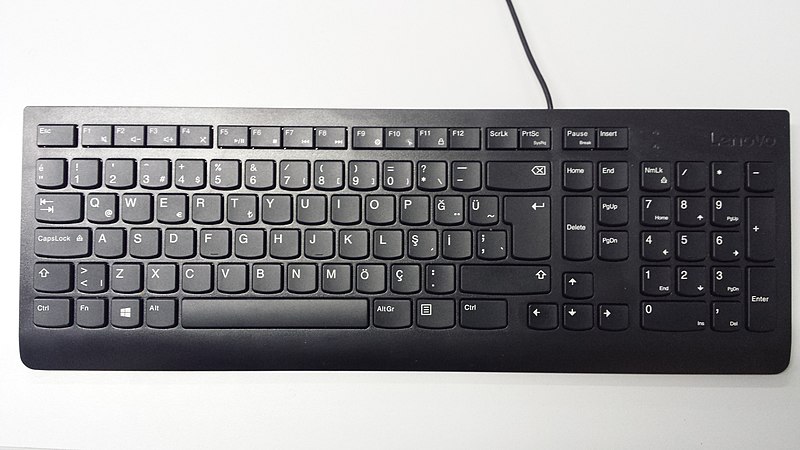
File:Turkish_Q_computer_keyboard.jpg · Wikimedia Commons · See Wikimedia Commons
турецкий язык
Sign in to saveAlso known as Turkish of Turkey, Istanbul Turkish, Türkçe, Anatolian Turkish, Turkish language
тюркский язык, государственный язык Турции
OverviewAI-generated
Turkish is a natural and modern language belonging to the Turkic family. It is primarily spoken in Turkey, Bulgaria, Cyprus, and Greece. The language is native to Turks and is associated with the regions of Burgas, Kardzhali, and Smolyan. Its native label is Türkçe.
The language uses the Turkish alphabet, Arabic alphabet, and Turkish Braille. It follows a subject–object–verb word order and is classified as an agglutinative, syllabic, and synthetic language. Turkish has present, past, and future tenses, along with admirative, imperative, and indicative moods. It uses capitalization for proper nouns and days of the week. The Turkish Language Association serves as its regulatory body.
Turkish is based on Old Anatolian Turkish. It is studied through Turkology. The language has approximately 82,231,620 speakers, writers, or signers. It is referenced by 15,555 other encyclopedia articles. Films in this language are categorized under Turkish-language films.
Synthesized by Vinony from 24 facts across 3 sources: Wikidata, Vinony graph, Geo. Generated from structured data (not the Wikipedia text) and checked against those facts — may still contain errors.
Wikidata facts
- Subclass of
- Turkic
- Country
- Northern Cyprus
- Based on
- Old Anatolian Turkish
- Image
- Turkish alphabet.svg
Show 29 more facts
- Wikimedia language code
- tr
- Commons category
- Turkish language
- topic's main category
- Category:Turkish language
- writing system
- Turkish Braille
- language regulatory body
- Turkish Language Association
- native label
- Türkçe
- short name
- türgi keel
- linguistic typology
- postposition
- on focus list of Wikimedia project
- Wikipedia:List of articles all languages should have
- category for films in this language
- Category:Turkish-language films
- indigenous to
- Rhodope Prefecture
- studied by
- Turkology
- uses capitalization for
- day of the week
- different from
- Turki
- P10369
- Diego Velázquez
- number of speakers, writers, or signers
- 380300
- P11012
- September 21
- entry in abbreviations table
- ਤੁ.
- has tense
- past tense
- described at URL
- turkic.elegantlexicon.com/lx.php?lx=tur
- P13311
- Rodger Bumpass
- exact match
- afbo.info/languages/81
- has grammatical case
- instrumental case
- maintained by WikiProject
- WikiProject Languages
- main regulatory text
- Constitution of Turkey
- Stack Exchange tag
- linguistics.stackexchange.com/tags/turkish
- ethnic group
- Turks
- female form of label
- la langue turque
- NCI Thesaurus ID
- C154180
Sources (12)
via Wikidata · CC0
Article · Русский
Туре́цкий язы́к (самоназвание: Türk dili (кратко: Türkçe [ˈt̪yɾktʃe] ), рус. историч. турской языкъ) — официальный язык Турции, входящий в тюркскую языковую семью. В качестве альтернативного названия в тюркологии используется также Türkiye Türkçesi («турецкий тюркский»). Современный турецкий язык относится к юго-западной (или западно-огузской) подгруппе тюркских языков. Языками, наиболее близкими к турецкому в лексическом, фонетическом и синтаксическом отношении, являются прежде всего балкано-тюркский язык гагаузов, распространённый на территории современных Молдавии, Румынии и Болгарии (собственно гагаузский и балкано-гагаузский), и южный диалект крымскотатарского языка. Чуть далее отстоит от литературного турецкого азербайджанский[страница не указана 1248 дней] (сохранивший немало архаизмов и персидских заимствований и образующий с восточно-анатолийскими диалектами турецкого языка диалектный континуум) и, ввиду ряда фонетических и некоторых грамматических отличий, туркменский язык. Турецкий язык и в особенности его северо-западные диалекты, и гагаузский — оба сближаются с печенежским языком: ср. переходы в печенежском языке g/k > y в конце слов (beg > bey), k/g > в v интервокальной позиции (между гласными, напр., kökerçi > küverçi), t > d в начале слов (tağ > dağ), с полной аналогией в турецком и гагаузском языках: bey, güvercin, dağ/daa.
Abstract from DBpedia / Wikipedia · CC BY-SA
Gallery (12)
On the map
Available in 205 languages
- Español
- Français
- Deutsch
- 中文
- 日本語
- Русский
- Português
- Italiano
- العربية
- हिन्दी
- Abkhazian
- Achinese
- Adyghe
- Afrikaans
- Albanian
- Albanian
- Amharic
- Angika
Show 186 more
- Aragonese
- Aramaic
- Armenian
- Assamese
- Asturian
- Avaric
- azb
- Azerbaijani
- Bahasa Indonesia
- Balinese
- Bangla
- Bashkir
- Basque
- bat_smg
- Bavarian
- be_x_old
- Belarusian
- Bosnian
- Breton
- btm
- Bulgarian
- Buriat
- Burmese
- Catalan
- cbk_zam
- cdo
- Cebuano
- Central Dusun
- Central Kurdish
- Chechen
- Cherokee
- Chuvash
- Cornish
- Crimean Tatar
- Croatian
- Czech
- Danish
- Egyptian Arabic
- eml
- Erzya
- Esperanto
- Estonian
- Faroese
- Fiji Hindi
- Filipino
- Finnish
- Gagauz
- Galician
- Georgian
- Gilaki
- Goan Konkani
- Greek
- Guarani
- Gujarati
- Hakka Chinese
- Hausa
- Hebrew
- Hungarian
- hyw
- Iban
- Icelandic
- Ido
- Iloko
- Ingush
- Irish
- Javanese
- Kabardian
- Kabyle
- Kara-Kalpak
- Kashmiri
- Kashubian
- Kazakh
- kge
- Kinyarwanda
- Komi
- Komi-Permyak
- Kongo
- Kotava
- Kurdish
- Kyrgyz
- Ladino
- Lao
- Latin
- Latvian
- lbe
- Lezghian
- Limburgish
- Lingua Franca Nova
- Lithuanian
- lld
- Lombard
- Low German
- Lower Sorbian
- Luxembourgish
- Macedonian
- Madurese
- Malagasy
- Malay
- Malayalam
- Manipuri
- Manx
- Māori
- Marathi
- Mari
- Mazanderani
- Minangkabau
- Mingrelian
- Moksha
- Mongolian
- Moroccan Arabic
- nds_nl
- Nederlands
- Nepali
- Newari
- Northern Frisian
- Northern Sami
- Northern Sotho
- Norwegian
- Norwegian Nynorsk
- Occitan
- Ossetic
- Papiamento
- Pashto
- Picard
- Piedmontese
- Polski
- Punjabi
- Quechua
- Romanian
- Romansh
- Romany
- Rusyn
- Santali
- Sardinian
- Scots
- Scottish Gaelic
- Serbian
- Serbian (Latin)
- Shona
- Sicilian
- Silesian
- simple
- Sindhi
- Sinhala
- Slovak
- Slovenian
- Somali
- Sundanese
- Svenska
- Swahili
- Tajik
- Talysh
- Tamil
- Tatar
- Tiếng Việt
- Toki Pona
- Türkçe
- Turkmen
- Tuvinian
- Tyap
- Udmurt
- Ukrainian
- Upper Sorbian
- Urdu
- Uyghur
- Uzbek
- Venetian
- Veps
- Volapük
- Walloon
- Waray
- Welsh
- Western Frisian
- Western Mari
- Western Panjabi
- wikifunctions
- Wu Chinese
- Yakut
- Yiddish
- Yoruba
- Zaza
- zh_min_nan
- zh_yue
- فارسی
- ไทย
- 한국어
via Wikidata sitelinks · CC0