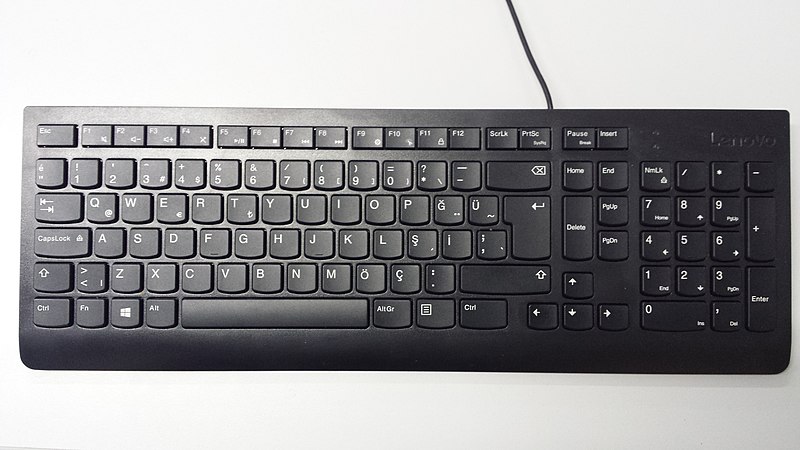
File:Turkish_Q_computer_keyboard.jpg · Wikimedia Commons · See Wikimedia Commons
turco
Sign in to saveAlso known as Turkish of Turkey, Istanbul Turkish, Türkçe, Anatolian Turkish, Turkish language
lengua túrquica de Eurasia
OverviewAI-generated
Turkish is a natural and modern language belonging to the Turkic family. It is primarily spoken in Turkey, Bulgaria, Cyprus, and Greece. The language is native to Turks and is associated with the regions of Burgas, Kardzhali, and Smolyan. Its native label is Türkçe.
The language uses the Turkish alphabet, Arabic alphabet, and Turkish Braille. It follows a subject–object–verb word order and is classified as an agglutinative, syllabic, and synthetic language. Turkish has present, past, and future tenses, along with admirative, imperative, and indicative moods. It uses capitalization for proper nouns and days of the week. The Turkish Language Association serves as its regulatory body.
Turkish is based on Old Anatolian Turkish. It is studied through Turkology. The language has approximately 82,231,620 speakers, writers, or signers. It is referenced by 15,555 other encyclopedia articles. Films in this language are categorized under Turkish-language films.
Synthesized by Vinony from 24 facts across 3 sources: Wikidata, Vinony graph, Geo. Generated from structured data (not the Wikipedia text) and checked against those facts — may still contain errors.
Wikidata facts
- Subclass of
- Turkic
- Country
- Northern Cyprus
- Based on
- Old Anatolian Turkish
- Image
- Turkish alphabet.svg
Show 29 more facts
- Wikimedia language code
- tr
- Commons category
- Turkish language
- topic's main category
- Category:Turkish language
- writing system
- Turkish Braille
- language regulatory body
- Turkish Language Association
- native label
- Türkçe
- short name
- türgi keel
- linguistic typology
- postposition
- on focus list of Wikimedia project
- Wikipedia:List of articles all languages should have
- category for films in this language
- Category:Turkish-language films
- indigenous to
- Rhodope Prefecture
- studied by
- Turkology
- uses capitalization for
- day of the week
- different from
- Turki
- P10369
- Diego Velázquez
- number of speakers, writers, or signers
- 380300
- P11012
- September 21
- entry in abbreviations table
- ਤੁ.
- has tense
- past tense
- described at URL
- turkic.elegantlexicon.com/lx.php?lx=tur
- P13311
- Rodger Bumpass
- exact match
- afbo.info/languages/81
- has grammatical case
- instrumental case
- maintained by WikiProject
- WikiProject Languages
- main regulatory text
- Constitution of Turkey
- Stack Exchange tag
- linguistics.stackexchange.com/tags/turkish
- ethnic group
- Turks
- female form of label
- la langue turque
- NCI Thesaurus ID
- C154180
Sources (12)
via Wikidata · CC0
Article · Español
El idioma turco ( (?·i) o Türk dili) pertenece a la familia lingüística de las lenguas túrquicas, cuya área geográfica se extiende desde el occidente de China hasta los Balcanes. Las lenguas más próximas al turco son el azerí, el tártaro de Crimea, el gagauzo y el turcomano. Es oficial en Turquía, donde se habla desde la época medieval, cuando los turcos procedentes de Asia Central se instalaron en Anatolia, que entonces era parte del Imperio bizantino. Es oficial también en Chipre, donde comparte cooficialidad con el griego, así como en la autoproclamada República Turca del Norte de Chipre. En algunas zonas balcánicas se habla una variedad conocida como turco otomano (Osmanlı Türkçesi), que tiene diferencias con el turco de Turquía. En varios países de la Europa occidental existen importantes comunidades de hablantes de turco, emigradas de Turquía en fechas recientes. Es una lengua aglutinante, como lo son el quechua, el finés, el japonés o el vasco, y por tanto se basa en un sistema de afijos añadidos a la raíz de las palabras que permiten expresar gran cantidad de significados con pocas palabras. El turco usa casi exclusivamente sufijos. Su morfología no suele tener excepciones y es altamente regular. Otras importantes características son la ausencia del género gramatical, el orden sintáctico es SOV, que es una lengua de núcleo final y que usa postposiciones. Ha tenido varios sistemas de escritura. Se escribió con caracteres árabes (alfabeto turco otomano) adaptados desde el siglo XIII hasta la reforma ortográfica emprendida en los años 1920 por el gobierno de Mustafa Kemal Atatürk, que emprendió varias iniciativas de occidentalización del país para contribuir a su modernización. La reforma ortográfica vino acompañada de un intento de "depuración" nacionalista, es decir, de sustituir la ingente cantidad de préstamos lingüísticos (sobre todo aquellos provenientes del árabe y, en menor medida, del persa) por vocablos de raíz turca, objetivo vigente hoy en día que no ha cosechado los éxitos esperados.[cita requerida] Está regulada por la Türk Dil Kurumu (TDK), la Sociedad de la Lengua Turca. Ejemplo de texto: Artículo 1 de la Declaración Universal de los Derechos Humanos Bütün insanlar hür, haysiyet ve haklar bakımından eşit doğarlar. Akıl ve vicdana sahiptirler ve birbirlerine karşı kardeşlik zihniyeti ile hareket etmelidirler. Todos los seres humanos nacen libres e iguales en dignidad y derechos y, dotados como están de razón y conciencia, deben comportarse fraternalmente los unos con los otros.
Abstract from DBpedia / Wikipedia · CC BY-SA
Gallery (12)
On the map
Available in 205 languages
- Español
- Français
- Deutsch
- 中文
- 日本語
- Русский
- Português
- Italiano
- العربية
- हिन्दी
- Abkhazian
- Achinese
- Adyghe
- Afrikaans
- Albanian
- Albanian
- Amharic
- Angika
Show 186 more
- Aragonese
- Aramaic
- Armenian
- Assamese
- Asturian
- Avaric
- azb
- Azerbaijani
- Bahasa Indonesia
- Balinese
- Bangla
- Bashkir
- Basque
- bat_smg
- Bavarian
- be_x_old
- Belarusian
- Bosnian
- Breton
- btm
- Bulgarian
- Buriat
- Burmese
- Catalan
- cbk_zam
- cdo
- Cebuano
- Central Dusun
- Central Kurdish
- Chechen
- Cherokee
- Chuvash
- Cornish
- Crimean Tatar
- Croatian
- Czech
- Danish
- Egyptian Arabic
- eml
- Erzya
- Esperanto
- Estonian
- Faroese
- Fiji Hindi
- Filipino
- Finnish
- Gagauz
- Galician
- Georgian
- Gilaki
- Goan Konkani
- Greek
- Guarani
- Gujarati
- Hakka Chinese
- Hausa
- Hebrew
- Hungarian
- hyw
- Iban
- Icelandic
- Ido
- Iloko
- Ingush
- Irish
- Javanese
- Kabardian
- Kabyle
- Kara-Kalpak
- Kashmiri
- Kashubian
- Kazakh
- kge
- Kinyarwanda
- Komi
- Komi-Permyak
- Kongo
- Kotava
- Kurdish
- Kyrgyz
- Ladino
- Lao
- Latin
- Latvian
- lbe
- Lezghian
- Limburgish
- Lingua Franca Nova
- Lithuanian
- lld
- Lombard
- Low German
- Lower Sorbian
- Luxembourgish
- Macedonian
- Madurese
- Malagasy
- Malay
- Malayalam
- Manipuri
- Manx
- Māori
- Marathi
- Mari
- Mazanderani
- Minangkabau
- Mingrelian
- Moksha
- Mongolian
- Moroccan Arabic
- nds_nl
- Nederlands
- Nepali
- Newari
- Northern Frisian
- Northern Sami
- Northern Sotho
- Norwegian
- Norwegian Nynorsk
- Occitan
- Ossetic
- Papiamento
- Pashto
- Picard
- Piedmontese
- Polski
- Punjabi
- Quechua
- Romanian
- Romansh
- Romany
- Rusyn
- Santali
- Sardinian
- Scots
- Scottish Gaelic
- Serbian
- Serbian (Latin)
- Shona
- Sicilian
- Silesian
- simple
- Sindhi
- Sinhala
- Slovak
- Slovenian
- Somali
- Sundanese
- Svenska
- Swahili
- Tajik
- Talysh
- Tamil
- Tatar
- Tiếng Việt
- Toki Pona
- Türkçe
- Turkmen
- Tuvinian
- Tyap
- Udmurt
- Ukrainian
- Upper Sorbian
- Urdu
- Uyghur
- Uzbek
- Venetian
- Veps
- Volapük
- Walloon
- Waray
- Welsh
- Western Frisian
- Western Mari
- Western Panjabi
- wikifunctions
- Wu Chinese
- Yakut
- Yiddish
- Yoruba
- Zaza
- zh_min_nan
- zh_yue
- فارسی
- ไทย
- 한국어
via Wikidata sitelinks · CC0