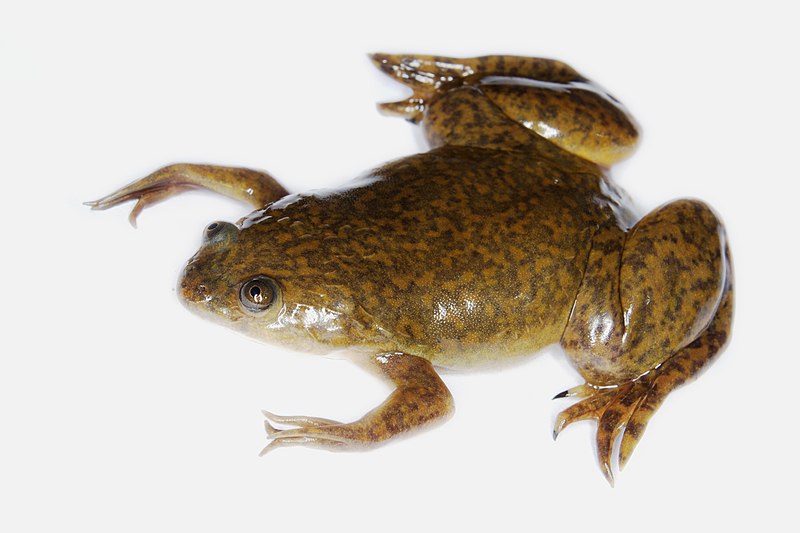
File:Xenopus_laevis_02.jpg · Wikimedia Commons · See Wikimedia Commons
Xenopus laevis
Sign in to saveAlso known as xenopus, African clawed toad, African claw-toed frog, platanna, plattie, African clawed frog, South African clawed frog
species of amphibian
OverviewAI-generated
Xenopus laevis, commonly known as the African Clawed Frog or Clawed Toad, is a species of amphibian in the family Pipidae. It belongs to the genus Xenopus within the order Anura, class Amphibia, and phylum Chordata. The species was described by Daudin in 1802 and is classified as a model organism. Its diel cycle is cathemeral, and it inhabits freshwater environments.
The IUCN Red List assessed the species as Least Concern in 2009. Records indicate its presence in South Africa, Congo, and The Democratic Republic Of The Dr Congo. Various databases have documented the species, with occurrence counts ranging from 4,338 to 12,920. It has been referenced in 341 other encyclopedia articles.
Synthesized by Vinony from 40 facts across 9 sources: Wikidata, GBIF, PubMed, IUCN Red List, iNaturalist, Gbif Occ, WoRMS, iDigBio, Vinony graph. Generated from structured data (not the Wikipedia text) and checked against those facts — may still contain errors.
Species
Least ConcernAfrican Clawed Frog
SPECIES
- KingdomAnimalia
- PhylumChordata
- ClassAmphibia
- OrderAnura
- FamilyPipidae
非洲爪蟾(学名:Xenopus laevis),又名光滑爪蟾、非洲爪蛙,是南非的一種水生青蛙,是一種重要的模式生物。牠們可以長達12厘米,頭部及身體扁平,沒有外耳或舌頭。其後腳上有3趾短爪,可能是用來挖泥來躲避掠食者。 非洲爪蟾廣泛分佈在非洲大部份地區,另有一些被引入到北美洲、南美洲及歐洲。
via GBIF · IUCN
Museum specimens
- Specimen records
- 4,338
- With media
- 60
- Family
- Pipidae
- Collections
- MVZ, UTEP, RBINS-SCIENTIFIC HERITAGE
- Recorded in
- South Africa, Congo, The Democratic Republic Of The, Dr Congo
Research
33,385 papers- Convergent extension in the amphibian, Xenopus laevis.Current topics in developmental biology · 2020
- Xenopus laevis as a model system to study cytoskeletal dynamics during axon pathfinding.Genesis (New York, N.Y. : 2000) · 2017
- Animal Maintenance Systems: Xenopus laevis.Cold Spring Harbor protocols · 2020
- Xenopus laevis Oocytes.Methods in molecular biology (Clifton, N.J.) · 2010
- Xenopus laevis in developmental and molecular biology.Science (New York, N.Y.) · 1988
via PubMed
Wikidata facts
- Instance of
- model organism
- Parent taxon
- Xenopus
- Image
- ACFtadpole (32849150450).jpg
Show 7 more facts
- taxon rank
- species
- IUCN conservation status
- Least Concern
- Commons category
- Xenopus laevis
- taxon name
- Xenopus laevis
- Commons gallery
- Xenopus laevis
- taxon common name
- Glatter Krallenfrosch
- diel cycle
- cathemeral
via Wikidata · CC0
~18 min read
Encyclopedic overview
The African clawed frog (Xenopus laevis), also known as simply xenopus, African clawed toad, African claw-toed frog or the platanna) is a species of African aquatic frog of the family Pipidae. Its name is derived from the short black claws on its feet. The word Xenopus means 'strange foot' and laevis means 'smooth'.
The species is found throughout much of Sub-Saharan Africa (Nigeria and Sudan to South Africa), and in isolated, introduced populations in North America, South America, Europe, and Asia. All species of the family Pipidae are tongueless, toothless and completely aquatic. They use their hands to shove food in their mouths and down their throats and a hyobranchial pump to draw or suck things in their mouth. Pipidae have powerful legs for swimming and lunging after food. They also use the claws on their feet to tear pieces of large food. They have no external eardrums, but instead subcutaneous cartilaginous disks that serve the same function. They use their sensitive fingers and sense of smell to find food. Pipidae are scavengers and will eat almost anything living, dying, or dead and any type of organic waste.
Excerpted from Wikipedia’s “Xenopus laevis” article, available under the CC BY-SA 4.0 licence.