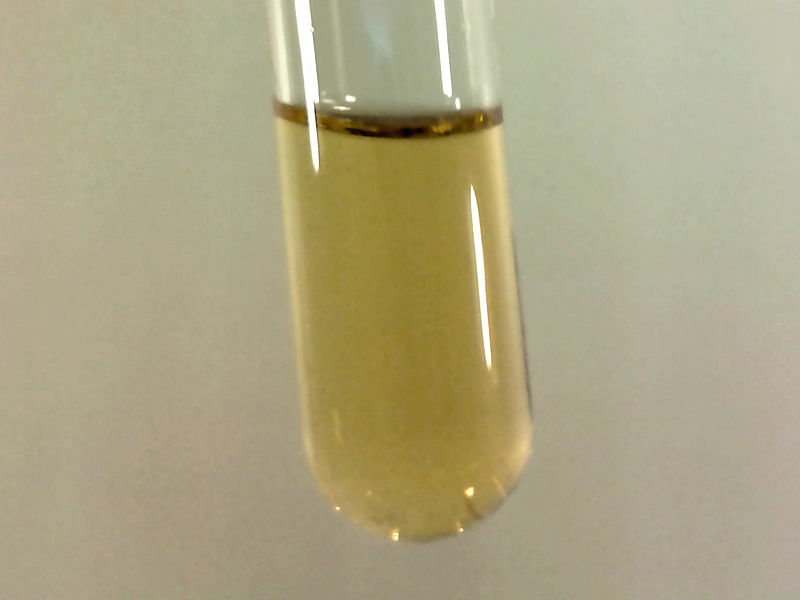
File:Fluoro_liquido_a_-196°C_1.jpg · Wikimedia Commons · See Wikimedia Commons
Fluor
Sign in to saveAlso known as element 9, ₉F
chemisches Element mit dem Symbol F und der Ordnungszahl 9
OverviewAI-generated
Fluorine is a chemical element with the symbol F and atomic number 9. Its mass is 18.998403162, and it has an electron configuration of 1s² 2s² 2p⁵, or [He] 2s² 2p⁵. The element exhibits an oxidation state of -1 and an electronegativity of 3.98. Its ionization energy is 15.7, and its ionic radius is 1.33.
Fluorine was discovered in 1810. It has a melting point of -363 and a boiling point of -307. The vapor pressure is 1. The substance is immediately dangerous to life or health at a level of 38.75. The time-weighted average exposure limit is 0.2. The NIOSH Pocket Guide ID is 0289.
Synthesized by Vinony from 32 facts across 4 sources: Wikidata, PubChem, PubMed, Vinony graph. Generated from structured data (not the Wikipedia text) and checked against those facts — may still contain errors.
Chemical data
- Formula
- F
- Molecular weight
- 18.99840316 g/mol
- IUPAC name
- fluorane
- SMILES
- [F]
- InChIKey
- YCKRFDGAMUMZLT-UHFFFAOYSA-N
- XLogP
- 0.6
- Polar surface area
- 0 Ų
- H-bond donors
- 0
- H-bond acceptors
- 0
- Formal charge
- 0
via PubChem
Research
64,795 papers- Fluorine biocatalysis.ReviewCurrent opinion in chemical biology · 2020Wu L, Maglangit F, Deng HDOI: 10.1016/j.cbpa.2020.01.004
- Drug Discovery Based on Fluorine-Containing Glycomimetics.ReviewMolecules (Basel, Switzerland) · 2023Wei X, Wang P, Liu F et al.DOI: 10.3390/molecules28186641
- Fluorine in psychedelic phenethylamines.ReviewDrug testing and analysis · 2012Trachsel DDOI: 10.1002/dta.413
- Fluorine-Directed Automated Mannoside Assembly.Angewandte Chemie (International ed. in English) · 2023Teschers CS, Gilmour RDOI: 10.1002/anie.202213304
- Fluorine and Fluorinated Motifs in the Design and Application of Bioisosteres for Drug Design.ReviewJournal of medicinal chemistry · 2018Meanwell NADOI: 10.1021/acs.jmedchem.7b01788
- The Role of Fluorine in Glycomimetic Drug Design.ReviewChemistry (Weinheim an der Bergstrasse, Germany) · 2021Hevey RDOI: 10.1002/chem.202003135
- Applications of Fluorine in Medicinal Chemistry.ReviewJournal of medicinal chemistry · 2015Gillis EP, Eastman KJ, Hill MD et al.DOI: 10.1021/acs.jmedchem.5b00258
- Modulating the Efficacy of Carbonic Anhydrase Inhibitors through Fluorine Substitution.ReviewAngewandte Chemie (International ed. in English) · 2021Berrino E, Michelet B, Martin-Mingot A et al.DOI: 10.1002/anie.202103211
via PubMed
Wikidata facts
- Instance of
- lithophile
- Subclass of
- halogens
- Part of
- halogens
- Named after
- hydrofluoric acid
- Followed by
- neon
- Mass
- 18.998403162
- Image
- Liquid fluorine tighter crop.jpg
Show 25 more facts
- immediately dangerous to life or health
- 38.75
- Commons gallery
- Fluorine
- melting point
- -363
- oxidation state
- -1
- element symbol
- F
- Commons category
- Fluorine
- topic's main category
- Category:Fluorine
- electronegativity
- 3.98
- atomic number
- 9
- NIOSH Pocket Guide ID
- 0289
- discoverer or inventor
- André-Marie Ampère
- boiling point
- -307
- vapor pressure
- 1
- ionization energy
- 15.7
- described by source
- Encyclopædia Britannica 11th edition
- time-weighted average exposure limit
- 0.2
- time of discovery or invention
- 1810-00-00
- location of discovery
- France
- Unicode character
- 氟
- different from
- fluorene
- electron configuration
- [He] 2s² 2p⁵
- chemical formula
- F
- ionic radius
- 0.08
- on focus list of Wikimedia project
- Wikipedia:Vital articles/Level/4
- maintained by WikiProject
- WikiProject Elements
via Wikidata · CC0
Article · Deutsch
Fluor [ˈfluːoːɐ̯] ist ein chemisches Element mit dem Symbol F und der Ordnungszahl 9. Im Periodensystem steht es in der 7. Hauptgruppe und gehört damit zur 17. IUPAC-Gruppe, den Halogenen, von denen es das leichteste ist. Es liegt unter Normalbedingungen in Form des zweiatomigen Moleküls F2 gasförmig vor und ist das reaktivste aller Elemente. Es reagiert mit allen Elementen mit Ausnahme der Edelgase Helium und Neon. Fluor ist farblos und erscheint stark verdichtet blassgelb. Es ist das elektronegativste aller Elemente und hat in Verbindungen mit anderen Elementen stets die Oxidationsstufe −1. Der Name des Elementes ist von lateinisch fluores für Flussspat abgeleitet, dem natürlich vorkommenden Mineral Fluorit, das in der Metallurgie als Flussmittel zur Herabsetzung des Schmelzpunktes von Erzen verwendet wird. Elementares Fluor ist stark ätzend und sehr giftig; sein durchdringender Geruch kann schon in geringeren Konzentrationen bemerkt werden. Dessen Salze – Fluoride und diverse Fluorokomplexsalze wie Natriummonofluorophosphat – sind in höherer Konzentration ebenfalls giftig. Schon in Spuren beeinflussen Fluor und Fluoride die Bildung von Knochen und Zähnen, insbesondere des Zahnschmelzes. Sie werden daher zur Prophylaxe von Zahnkaries in Zahnpasten eingesetzt sowie als Fluoridierung dem Trinkwasser oder dem Speisesalz zugesetzt.
Abstract from DBpedia / Wikipedia · CC BY-SA
Gallery (33)
Available in 172 languages
- Español
- Français
- Deutsch
- 中文
- 日本語
- Русский
- Português
- Italiano
- العربية
- हिन्दी
- abstract
- Afrikaans
- Albanian
- Amharic
- Angika
- Aragonese
- Armenian
- Asturian
Show 153 more
- Awadhi
- Azerbaijani
- Bahasa Indonesia
- Balinese
- Bangla
- Bashkir
- Basque
- be_x_old
- Belarusian
- Bhojpuri
- Bikol
- blk
- Bosnian
- Breton
- Bulgarian
- Burmese
- Catalan
- cdo
- Cebuano
- Central Kurdish
- Cherokee
- Chuvash
- Cornish
- Corsican
- Croatian
- Czech
- Danish
- Egyptian Arabic
- Erzya
- Esperanto
- Estonian
- Extremaduran
- Faroese
- Fiji Hindi
- Filipino
- Finnish
- Friulian
- Galician
- Gan Chinese
- Ganda
- Georgian
- Greek
- Gujarati
- Haitian Creole
- Hakka Chinese
- Hawaiian
- Hebrew
- Hungarian
- hyw
- Icelandic
- Ido
- Inari Sami
- Interlingua
- Irish
- Javanese
- Kalmyk
- Kannada
- Kazakh
- kbp
- Komi
- Kurdish
- Kyrgyz
- Lao
- Latin
- Latvian
- Ligurian
- Limburgish
- Lingala
- Lithuanian
- Lojban
- Lombard
- Low German
- Luxembourgish
- Macedonian
- Malay
- Malayalam
- Manipuri
- Manx
- Māori
- Marathi
- Mongolian
- Moroccan Arabic
- Nederlands
- Nepali
- Newari
- Northern Frisian
- Norwegian
- Norwegian Nynorsk
- Novial
- Occitan
- Odia
- olo
- Oromo
- Ossetic
- Papiamento
- Pashto
- Piedmontese
- Polski
- Punjabi
- Quechua
- roa_rup
- Romanian
- Sanskrit
- Santali
- Saterland Frisian
- Scots
- Scottish Gaelic
- Serbian
- Serbian (Latin)
- Shona
- Sicilian
- Silesian
- simple
- Sindhi
- Sinhala
- Slovak
- Slovenian
- Somali
- Standard Moroccan Tamazight
- Sundanese
- Svenska
- Swahili
- Tajik
- Tamil
- Tatar
- Telugu
- Tibetan
- Tiếng Việt
- Toki Pona
- Tumbuka
- Türkçe
- Ukrainian
- Urdu
- Uyghur
- Uzbek
- Veps
- Volapük
- Walloon
- Waray
- Welsh
- Western Frisian
- Western Mari
- Western Panjabi
- Wu Chinese
- Yiddish
- Yoruba
- zh_classical
- zh_min_nan
- zh_yue
- Zulu
- فارسی
- ไทย
- 한국어
via Wikidata sitelinks · CC0